
This Fucking Guy: Mark Zuckerberg
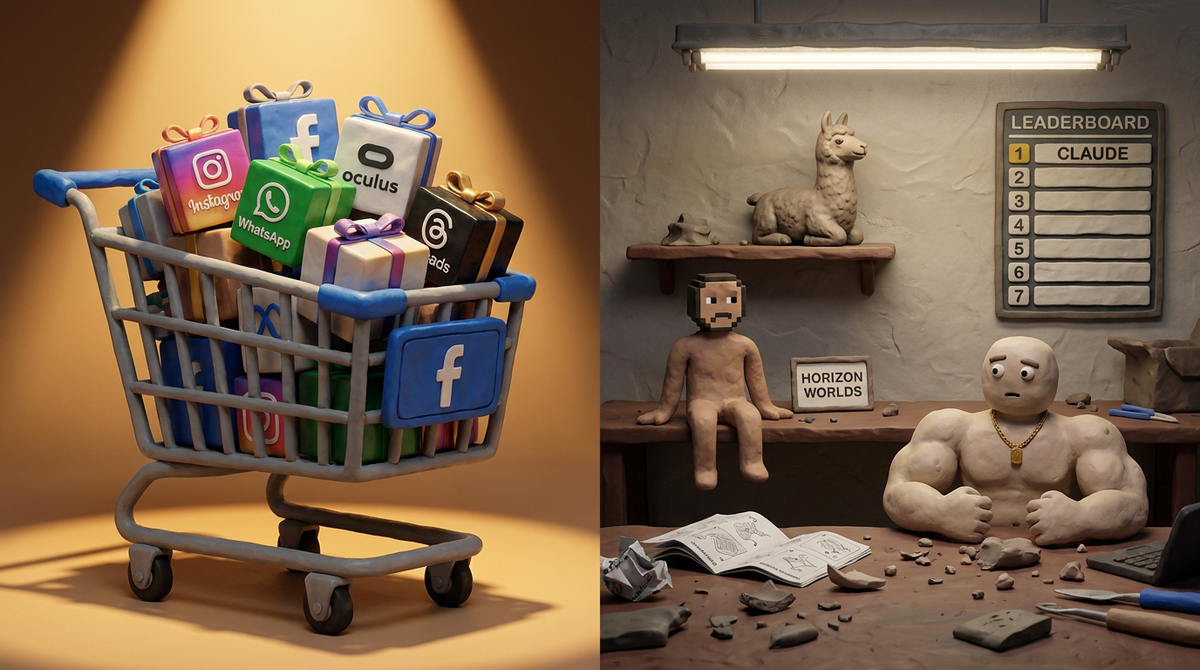
Meta's employees named their internal AI status leaderboard 'Claudeonomics.' Not Llamanomics. Claudeonomics. Zuckerberg spent billions building a frontier AI model his own people won't use, while paying a competitor to power his flagship AI product. The acquirer can't sell to his own staff.

Billionaire Victims Club, Vol. 5
On August 16th, 2022, Mark Zuckerberg posted a screenshot to Facebook to celebrate the launch of Horizon Worlds — Meta's flagship metaverse product, the one he had staked his company's future on, the one he had renamed an entire corporation after — in France and Spain. The screenshot showed his avatar standing in virtual Paris. The avatar had no legs. The CEO of a company that had spent $50 billion building a virtual world celebrated its European launch with a screenshot so embarrassing that he had to post a new one four hours later with improved graphics, explaining that the visuals had "significantly improved." He was not wrong about that. The bar he needed to clear was: give your avatar legs.
This is the image that tells you everything you need to know about Mark Zuckerberg as a builder. Not the $50 billion — though we'll get to that. Not the legless avatar specifically. It's the fact that he posted it in the first place, apparently without anyone on the team thinking it might be a problem. A company that had spent more money than the GDP of a medium-sized country building a product, and the CEO shared a screenshot of it without legs, apparently because nobody in the room was willing to say anything. This is what happens when an acquirer performs as a builder. The acquirer has no instinct for what the product actually looks like from the outside, because he's never had to build something from nothing and watch it die. He buys things. And when he builds things himself, uncompelled by competition or necessity, we get legless avatars and $50 billion receipts.
I. The Acquirer Record
Let's be precise about what Zuckerberg actually is, because it's genuinely impressive and the Metaverse disaster obscures it. He is one of the greatest competitive strategists and threat-neutralizers of his generation. The moves, in sequence: Instagram, 2012, bought for $1 billion when it had thirteen employees, no revenue, and was clearly the social graph that would eat Facebook's lunch with younger users. It is now worth somewhere between $100 billion and $200 billion and is the reason Meta's ad business survived TikTok. WhatsApp, 2014, $19 billion, buying the global messaging layer before anyone else could and sealing off a competitive flank that would have been catastrophic. Oculus, 2014, $2 billion, buying the only VR hardware team with any credibility and any head start, before anyone understood what the space would become.
And when he can't buy the threat, he copies it with a ruthlessness that deserves its own credit. Snapchat turned down his $3 billion acquisition offer in 2013. Within three years, Instagram Stories had cloned the core Snapchat feature, Instagram's user base surpassed Snapchat's, and Snap has been a distressed asset ever since. TikTok emerged and ate the short-video market. Reels appeared. Clubhouse briefly threatened to make audio social interesting. Live Audio Rooms appeared. Twitter became unstable under Musk's ownership and suddenly Threads launched inside a week, built on Instagram's existing social graph, positioned to absorb Twitter's fleeing user base before any other competitor could organize. Every single one of these moves was competitively rational, well-executed, and precisely timed. The man can read a threat and move fast. That is a real skill and it has made him one of the most successful businesspeople alive.
Now hold that record in your mind and return to the legless avatar. Because there is a clean line between what Zuckerberg does when competition forces the issue and what he does when he gets to build something from pure personal vision. The metaverse was the latter — no competitor threatening the space, no acquisition target to neutralize, no Snapchat to clone. Just Zuckerberg with unlimited money, unlimited time, and a genuine enthusiasm for virtual reality that nobody at the company was apparently empowered to push back on. Reality Labs has lost over $50 billion since 2020. A leaked internal document in 2022 described Horizon Worlds as "lifeless" and noted that most Meta employees weren't using the product. "Why would they?" one internal memo asked, in a sentence that no consultant at a $13.7 billion loss should be able to write without causing a board meeting. The metaverse pivot was announced in October 2021, three weeks after Frances Haugen testified before Congress about the documented harms of Facebook's algorithmic amplification to teenagers' mental health. The timing of the rebrand from Facebook to Meta — a name with no prior association with anything — was not, one suspects, entirely unconnected to the desire to change the subject.
II. The Luck Audit
The founding myth runs: Harvard dorm room, Zuckerberg alone at a keyboard, social network built from scratch, genius recognizes an opportunity nobody else saw. The true version is both less romantic and more interesting.
The dorm room did the work that no garage could replicate. Harvard in 2003 meant a captive, high-density social network of future engineers, venture capitalists, and journalists, all in the same physical space, all already looking for ways to connect with each other online. It meant Eduardo Saverin as a classmate, who funded the early servers with $19,000 of his own money before the company had outside investment. It meant the Winklevoss twins, who had already conceived a Harvard social network called ConnectU and hired Zuckerberg to help build it — giving him direct access to their concept, their feedback, and their understanding of what the social graph of a selective university could become. Zuckerberg did not steal their idea in any clean legal sense; the lawsuit eventually settled for $65 million in Facebook stock. What's accurate is that he was handed a working hypothesis by well-resourced classmates, built a version of it faster than they could, and had the native network of Harvard to seed it before any outsider could have accessed the same starting conditions.
The outside capital came from Peter Thiel, who wrote a $500,000 check in June 2004 for a 10.2% stake in a product that had proven exactly one thing: that horny Ivy League undergrads would rate each other's photos. Thiel's check didn't just provide money. It provided credibility, network access, and a direct line to Silicon Valley's venture capital ecosystem that no cold-calling from a Cambridge dorm room would have opened. By the time Facebook graduated from Harvard to the broader internet, it had a social graph, a founding capital structure, and a VC imprimatur that every subsequent competitor had to build from zero.
Congressional testimony is where the myth structure gets its most public airing, and it's worth a moment. In April 2018, Zuckerberg sat before two days of Senate and House hearings about Facebook's data practices, Cambridge Analytica, and the platform's role in election interference. His performance was a masterclass in strategic ignorance: a man who had built one of the most sophisticated behavioral targeting and data extraction systems in human history repeatedly explaining to elderly senators that he wasn't quite sure how his own product worked. "Senator, we run ads," he said, in a line that has since passed into legend. It was delivered with the affect of someone genuinely uncertain whether Congress understood what the internet was. Meanwhile, his platform was at that moment running targeting systems of a precision that would have made any Cold War intelligence agency weep with envy. The performance of ignorance was the performance of a man who understood exactly what his product did and had concluded that confusion was safer than explanation.
III. The Rebrand
The Facebook to Meta pivot deserves its own section because it has layers. There is the obvious layer: three weeks after Haugen's testimony, the company named after Facebook's most embarrassing moment stopped being called Facebook. Meta sounds like a future. Facebook sounds like a thing that got teenagers depressed and helped organize a genocide in Myanmar. The brand consultants earned their fee.
But there's a second layer that the metaverse losses have obscured. The rebrand was also a strategic bet — Zuckerberg's genuine conviction that virtual reality was the next computing platform, the way mobile was the previous one, and that whoever controlled the VR social layer would control the next era the way Facebook had controlled the social layer of the mobile era. This is not an unreasonable thesis. It is simply one that $50 billion has so far failed to validate, primarily because Zuckerberg's instinct for what people actually want from a virtual world turned out to be wrong in ways that legs-on-an-avatar could not fix. The pivot back to AI came in 2023, precisely when ChatGPT created a competitive threat that required neutralizing. Not because Zuckerberg believed in AI in 2023 the way he believed in VR in 2021. Because there was a new threat on the board.
The personal rebrand has run parallel to the corporate one and is, if anything, more revealing. The gold chain appeared around 2023. The MMA training became public, with Zuckerberg posting cage fight clips and challenging Musk to a literal fight — a challenge Musk eventually accepted and then backed out of citing a back injury, which is its own Billionaire Victims Club chapter. In January 2025, Zuckerberg told Joe Rogan on his podcast that corporate America had become too feminine and needed "more masculine energy." He sat on the Trump inauguration dais. Meta donated $1 million to Trump's inaugural fund. He announced changes to Meta's content moderation policies, ending third-party fact-checking, in the week before the inauguration. The Kauai compound, which includes an emergency bunker, is real and has been reported. The full-body transformation from awkward-robot-doing-human to sunburned cage fighter is visually complete.
None of this is the behavior of a persecuted man. It is the behavior of a man managing his regulatory exposure to an administration that could decide his companies' future in any number of ways, while performing a masculine rebrand calculated to distance himself from the progressive tech identity that made him a political target in the first place. It is, in other words, an acquisition. The product being acquired is political safety. The currency is a persona.
IV. The AI Section
Meta's artificial intelligence strategy, as revealed by actual internal behavior rather than earnings call rhetoric, consists of three components, and they tell a cleaner story than anything Zuckerberg has said publicly about Llama.
Component one: flood Facebook with AI-generated engagement-farming slop targeted at older users. Instagram's own chief Adam Mosseri has acknowledged that AI slop "has won" on the platform. Rolling Stone documented Facebook's domination by AI-generated images of Jesus, soldiers, babies, and the American flag — designed to extract "amens" and heart reactions from older, conservative-leaning users while the creators monetize the engagement through Meta's own creator payment programs. Meta actively incentivizes this content because it drives engagement, engagement drives ad inventory, and ad inventory drives revenue. The math doesn't care whether the Jesus images are real. Neither does Meta's content policy, which has concluded that AI slop doesn't technically violate community standards unless it's spam, and engagement-farming is not spam if it's working. The company that invented the modern social graph is now a machine for farming elderly engagement with AI-generated religious imagery. Revolutionary.
Component two: build Meta's most ambitious consumer AI product on a competitor's model because Llama can't do it yet. Meta is training its new consumer agent, codenamed Hatch, on Claude — paying Anthropic to power the product that will eventually compete with Anthropic, because Llama does not perform at the required level for the task. Zuckerberg has spent years telling investors and developers that Meta's open-source Llama strategy is competitive with closed frontier models. His own product team, facing a June internal testing deadline, looked at Llama and called Anthropic instead.
Component three, and this is the one that ties the room together: Meta's 85,000 employees, given free choice of AI tools and a status incentive to use them, created an internal leaderboard called "Claudeonomics." Not "Llamanomics." Claudeonomics. The leaderboard ranked the top 250 power users by Claude token consumption, awarding titles like "Session Immortal" and "Token Legend." In a single month, Meta employees burned 60.2 trillion Claude tokens — equivalent to roughly $900 million at API rates. The company had to kill the leaderboard after the press reported on it. The fact that it existed at all tells you everything: Llama is open-source and free. You don't build a status leaderboard around burning tokens on a model you own. Claudeonomics exists because Meta's employees were already using Claude, already competing on Claude usage, already treating Claude proficiency as a proxy for competence. Zuckerberg spent billions developing a frontier model that his own people named a status competition after a competitor's product to avoid using.
He is, in this specific sense, the most efficient possible demonstration of the acquirer-as-builder problem. The one time competitive pressure forced him toward something genuinely new — the metaverse, his own vision, uncloned from anywhere — he produced legless avatars and a $50 billion receipt. The one time he needed his own AI model to carry his most important new product, it couldn't. And his 85,000 employees, left to their own devices, named their AI enthusiasm after someone else's work.
V. The Close
In March 2026, Zuckerberg was appointed to the President's Council of Advisors on Science and Technology, taking his seat alongside the rest of the cast of this series: Brin, Andreessen, Ellison, Musk's conspicuous absence from the list, and David Sacks as co-chair. The council has thirteen members. Twelve are tech executives. One is a university scientist. Their combined net worth exceeds $900 billion, and the scientific body it most closely resembles is a cap table.
Zuckerberg doesn't quite fit the standard billionaire victim club profile — he doesn't perform persecution the way Andreessen does, doesn't have Musk's grievance-as-brand, doesn't carry Thiel's philosophical architecture of democratic decline. What he has instead is the smoothest and most efficient conversion of political liability into political access of anyone in this series. Congressional testimony, regulatory threat, Cambridge Analytica, Myanmar, teenage mental health, election interference — none of it stuck in any durable way. He rebranded the company, grew a chain, trained MMA, sat on the dais, cut a check, and walked into a federal advisory appointment. The acquirer acquired his way out of accountability. The product being built now is whatever PCAST advises the president to do about AI, with Mark Zuckerberg in the room.
His Llama models didn't make the leaderboard. He did.
Thanks for reading Sweaty Spice. Subscribe for free to receive new posts and support my work.