
This Fucking Guy: Elon Musk
Billionaire Victims Club, Vol. 1. As I drafted this, I was watching SPCX lose $400B in market value. Only about $1.5T more to go to be "right priced" Glorious!

On May 18th, a federal jury in Oakland took less than two hours to throw out Elon Musk's lawsuit against Sam Altman, Greg Brockman, OpenAI, and Microsoft. Less than two hours, after three weeks of testimony, a parade of witnesses including Satya Nadella, and a claim that — had Musk won — could have forced OpenAI and Microsoft to disgorge up to $150 billion back into a nonprofit foundation. The jury didn't even reach the merits. They ruled, unanimously, that Musk waited too long to sue, sitting on claims he himself had known about since at least 2021 while he quietly built a competing AI company, then filing suit only after that competitor needed a leg up.
Musk's response was not "well, that's a fair reading of the statute of limitations." His response was to call the verdict a "terrible precedent" and vow to appeal a decision a jury reached faster than it takes to get through security at LAX. On the stand, when asked why he hadn't sued sooner if he genuinely believed Altman had stolen a charity out from under him, Musk offered the legal theory that suspecting someone might steal your car someday isn't the same as them actually stealing it — which is, charitably, an argument that a man worth several hundred billion dollars needed eleven days of a federal trial and a parade of witnesses to test out loud, in front of a jury, before having it rejected unanimously in under two hours.
This is the whole genre in miniature: lose, on the merits, after a fair process, and respond not by examining your own behavior but by recasting the loss itself as the injustice. Welcome to the actual subject of today's post, a man who has built an entire public identity out of being the aggrieved party in conflicts he started, funded, or both.
The Pattern, Zoomed Out
The OpenAI suit isn't an aberration, it's a method. Run the last eighteen months: Musk spent the first half of 2025 as Trump's handpicked head of DOGE, the "Department of Government Efficiency," touring federal agencies in search of waste, fraud, and abuse with the energy of a man who'd never personally benefited from a single dollar of federal money in his life. Then, this summer, he broke publicly with Trump over the "Big Beautiful Bill," called for impeachment, floated launching his own political party, and started dropping references to the Epstein files in Trump's direction. Trump, in turn, threatened on Truth Social to cancel Musk's government contracts entirely. Musk responded by threatening to immediately decommission Dragon — currently the only American spacecraft capable of carrying astronauts to the International Space Station — as if national space policy were a chip he could throw on the table in a personal feud.
And then, because none of this was ever about principle, it quietly resolved itself. By August, Trump was telling reporters Musk had "had a bad moment" but was "a good person." By September, they were shaking hands at Charlie Kirk's memorial. By January, they were having a "lovely dinner" at Mar-a-Lago, Musk posting that 2026 was going to be amazing. By May, he was on the guest list for Trump's state visit to China. The impeachment talk, the Epstein insinuations, the threats to gut a sitting president's signature legislation, all of it evaporated the moment the relationship became inconvenient to maintain as a feud. That's not a man standing on principle. That's a man managing a vendor relationship, and the vendor relationship is with the United States government.
The Self-Made Myth, By the Numbers
Which brings us to the part of the post where I do to Musk what I already did to Andreessen and the rest of the chat: show the math behind the genius.
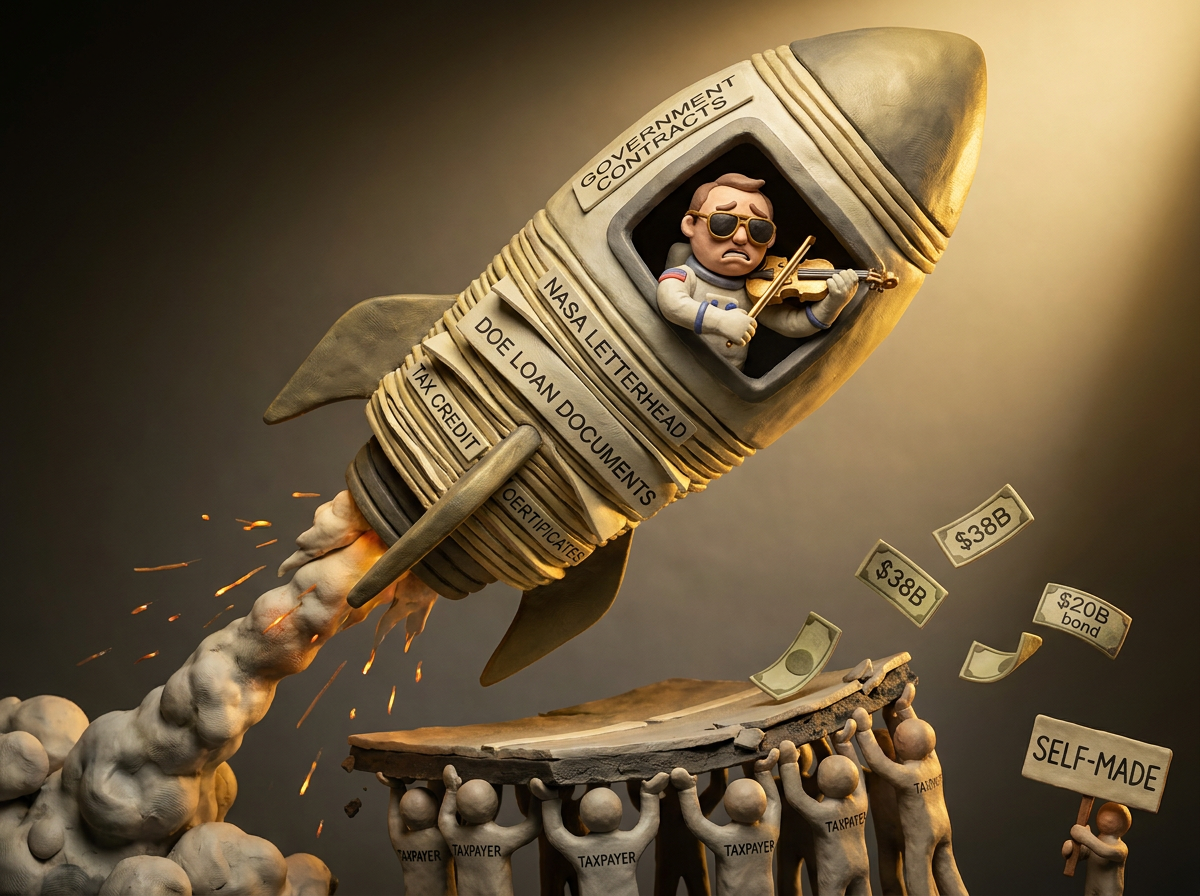
A Washington Post analysis — published, with no small irony, in the middle of Musk's tenure running the federal efficiency crusade — found that Musk's companies have received at least $38 billion in government contracts, loans, subsidies, and tax credits since 2003. More than 400 federal contracts. Nearly 90 federal and local grants. Two dozen tax credits or property tax abatements. Six loans. Nearly two-thirds of that total arrived in just the last five years, with 2024 alone setting a record at $6.3 billion committed.
Some specifics, because the specifics are the whole point. In 2010, with Tesla bleeding cash and years from profitability, the Department of Energy approved a $465 million loan that Musk personally lobbied for — money that kept the company alive long enough to become the company it is today. SpaceX has pulled in somewhere north of $22 billion in NASA and Defense Department contracts, with NASA alone accounting for nearly $15 billion of it, and that's before counting the classified defense and intelligence work the Post's analysis explicitly couldn't include. Tesla, separately, has banked roughly $11.4 billion in regulatory credits — the same zero-emission-vehicle credit scheme Musk now argues should be abolished, conveniently after Tesla stopped needing it and its competitors started relying on it instead. Without those credits in 2020 alone, Tesla doesn't post an $862 million profit. It posts a $700 million loss.
So: the rocket company, the car company, and the solar company that together constitute the empire Musk built through sheer force of will and disruptive genius are, by the numbers, one of the largest sustained transfers of public money into a single individual's hands in modern American history. He spent the first half of 2025 hunting for government waste with a chainsaw he literally brought on stage at CPAC, while sitting on top of the largest private claim on the federal budget of anyone in the country. That's not hypocrisy as a side effect. That's the load-bearing structure of the whole operation: extract maximum public subsidy, then build a personal brand on the idea that government doesn't work and only he can fix it.
The Persecution Engine
None of this is incidental to the brand — it is the brand. Musk has spent years cultivating the idea that he is uniquely targeted: by regulators, by "woke" advertisers, by judges, by the media, by anyone who declines to treat his pronouncements as load-bearing fact. When a Delaware judge voided his $56 billion Tesla pay package on the grounds that the board process was conflicted beyond repair, Musk didn't treat it as a corporate governance problem. He treated it as proof Delaware itself was broken, and reincorporated in Texas. When advertisers fled X over content moderation and hate speech concerns, he didn't treat it as a market response to his own decisions. He sued them, framing a boycott — the most basic mechanism of a free market he claims to revere — as an illegal antitrust conspiracy. When a jury spent under two hours rejecting his own lawsuit, he called the outcome a technicality and announced an appeal before he'd left the courthouse parking lot.
Every one of these has the same shape: an institution applies a rule evenly, Musk loses by that rule, and the loss gets reclassified as evidence the institution itself is corrupt, captured, or out to get him personally. It's a genuinely efficient psychological trick, because it never requires him to update on anything. The pay package wasn't excessive, Delaware was unfair. The lawsuit wasn't time-barred, the statute of limitations is a technicality. The advertisers didn't have legitimate brand-safety concerns, they were colluding. At no point in any of this does the possibility surface that he might simply have been wrong, or overreached, or — in the case of OpenAI — opportunistically suing a former colleague who'd built something more valuable than the thing Musk walked away from in 2018.
Close
What makes Musk the right person to lead off this series isn't that he's the richest — though he is — or the loudest, though he's that too. It's that he's the cleanest demonstration of the whole club's actual operating logic: take in more public money than almost any private citizen in American history, build a political identity around hostility to the very government you depend on, and the instant any institution — a court, a board, an advertiser, a jury — applies a rule you don't like, recast yourself as the victim of the system rather than a participant who lost a round. He didn't get rich by beating the system. He got rich by being exceptionally good at using it, then convincing tens of millions of people he'd done it alone.
Next up: Peter Thiel, who didn't just benefit from this logic — he wrote it down.
Thanks for reading Sweaty Spice. Subscribe for free to receive new posts and support my work. If you enjoyed this, help spread the word and share!