Übermensch in a Cubicle Farm Pt 4: The Ticket Queue Is Not a Career
In the 4th installment, we look at the CS/STEM to tech pipeline, but also the fact that not all roles were equal. Puncturing the mythos.

Post 3 of this series laid out the material architecture underneath the Valley mythology – the RSU vesting cage that made financial dependence feel like ownership, and the stack ranking tournament that made your peers your competition. The ideology from Posts 1 and 2 wouldn't have lasted without those structural reinforcements, and it didn't have to, because the reinforcements were excellent.
Here's the part nobody planned for: the system was designed for a specific era, and that era ended. What replaced it was something the mythology had no language for.
The Bubble That Wasn't a Bubble
Between roughly 2012 and 2021, the tech industry did something that looked, from a hiring standpoint, like a gold rush. CS enrollment at American universities roughly doubled over that decade, producing a large and relatively well-trained cohort of graduates who entered a job market that appeared, at the time, to have unlimited appetite for software engineers.
The appetite was real. The nature of the work that satisfied it was not what the mythology described.
The 2010s were the decade of SaaS – software-as-a-service – which is a genuinely useful business model and also, for a significant portion of its practitioners, a genuinely unremarkable form of labor[1]. Building a multi-tenant HR platform for mid-market logistics companies is software engineering. It involves real skill, real complexity, real problem-solving. What it is not is building the future. What it is not is the garage-to-IPO mythology that the Whole Earth Catalog set and Wired magazine codified.
The 10x engineer mythology, the founder aspiration, the sense of operating at the frontier of human possibility – none of that was calibrated for the experience of maintaining a microservices architecture for a company whose primary product helps regional insurance adjusters file claims faster. And yet that is where a substantial portion of the CS boom cohort landed, inside a culture that kept insisting, with a straight face, that all software engineering was fundamentally the same transformative enterprise.
Nobody said this out loud. The mythology mandated that it be hidden.
The Bifurcation Nobody Named
What actually happened in 2010s tech was a structural split that the industry's self-description actively obscured.
At one end: a genuine frontier. The actual FAANG core, the AI research labs, the infrastructure companies building the things that other things run on. Technically demanding, well-compensated, and – this is the important part – honestly closer to the mythology than most of the industry. The people doing this work were, in some real sense, operating at the edge of what was known. The equity outcomes for this cohort during the growth era were sometimes genuinely extraordinary.
At the other end: a vast and expanding feature factory tier. SaaS companies, enterprise software shops, internal tooling teams at companies whose primary business was emphatically not software. The work was real, the compensation was good, the RSUs vested on schedule. But the work was commodity work, in the sense that economists use the word: reasonably interchangeable, executed by a reasonably interchangeable workforce, in service of business objectives that had nothing to do with the frontier.
The mythology made no distinction between these two things. The conference talks, the LinkedIn content, the engineering blog posts – all of it treated software engineering as a unified profession with a unified identity. The 10x mythology applied equally in Palo Alto and in the enterprise software wing of a company headquartered in suburban Ohio. The founder aspiration was available to everyone who wanted it. The implicit promise was identical regardless of the actual work.
This mattered because the implicit promise carried with it the implicit contract: stay loyal, perform well, trust the system, and the system will take care of you. That contract was always on shakier ground for the feature factory tier than the mythology admitted. The 2022-2023 layoff cycle didn't break the contract. It just finally said so.
The Walkout That Should Have Changed Everything
Before the layoffs, there was a moment that should be examined more carefully than it usually is.
On November 1, 2018, roughly 20,000 Google employees across the globe walked off the job (gift link). The proximate cause was a New York Times report revealing that Google had paid Android creator Andy Rubin a $90 million exit package after finding credible evidence of sexual misconduct. The walkout was organized in days, involved workers across dozens of countries, and constituted the largest collective action in the history of the tech industry.
It worked, in a limited sense. Google made some procedural concessions. It felt, briefly, like evidence that tech workers could act collectively when sufficiently motivated.
What happened next was more instructive. The organizers – the actual individuals who had built the coordination infrastructure for that walkout – were systematically sidelined. Demotions. Reassignments. The slow bureaucratic application of pressure that doesn't require a single explicitly retaliatory act. By 2019, several of the core organizers had left the company.
Here is the structural lesson: the walkout demonstrated that collective action was possible. The aftermath demonstrated why, without a formal bargaining structure, collective action is also quite fragile. There was no union. There was no legal protection for the organizers beyond general labor law, which is designed for formal organizing and doesn't map cleanly onto a spontaneous walkout at a non-union employer. There was no mechanism to hold Google to its concessions. The energy dissipated because there was no institutional channel to run it through.
The Alphabet Workers Union, formed in January 2021, is the direct descendant of those organizers and that lesson. It is affiliated with the Communications Workers of America and has several thousand members. It is also a minority union – open to all Alphabet workers including contractors, but without a formal bargaining unit, which means it cannot compel Google to negotiate with it. It can advocate. It can publicize. It cannot bargain. That is not an accident of structure. It is a consequence of where organizing happened to land given the legal terrain.
The Year the Implicit Contract Died
In 2022 and 2023, the tech industry laid off somewhere north of 200,000 people, depending on how you count and which companies you include. The specific numbers matter less than the shape of the thing. These were not layoffs at struggling companies. These were layoffs at profitable companies managing investor expectations about margins in a rising rate environment. The people being let go had, in many cases, been told explicitly and recently that they were valued, that their contributions were essential, that the company was a family.
The implicit contract – perform well, demonstrate loyalty, trust the system – was not renegotiated. It was simply withdrawn, in a series of Thursday morning Zoom calls followed by immediate badge deactivation.
For the frontier tier, this was painful but survivable. Skills that are genuinely scarce remain scarce during a hiring correction. For the feature factory tier, which had spent the better part of a decade being told its work was indistinguishable in kind from frontier work, the layoffs arrived with a secondary injury: the discovery that the mythology had been doing them a disservice for years. The work wasn't the same. The protections weren't the same. The outcomes, in a downturn, weren't the same.
And then, before most of them had finished processing that, generative AI arrived and started asking, with genuine seriousness, how much of the feature factory tier it could simply absorb.
What the Ticket Queue Always Was
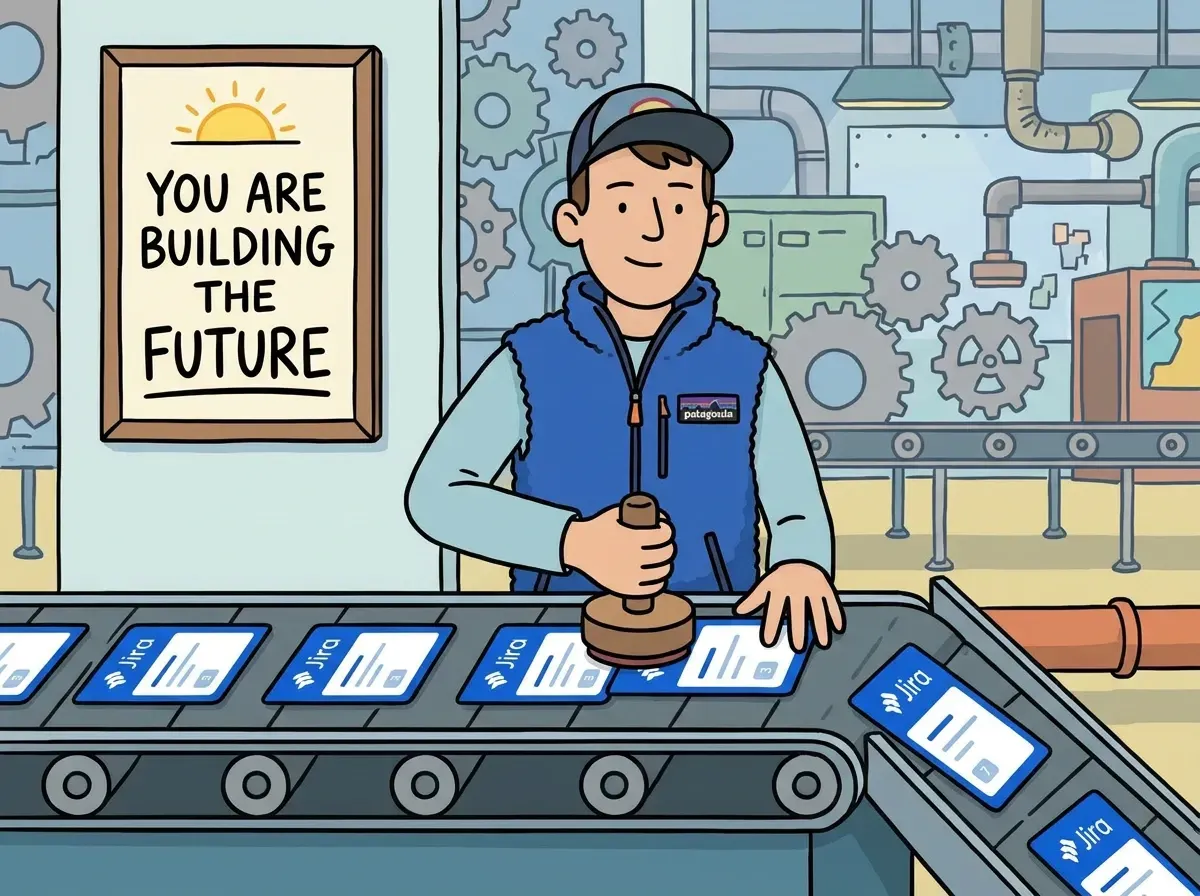
The ticket queue – the Jira board, the sprint planning session, the carefully scoped story with acceptance criteria and a point estimate – is not a bad thing. It is a useful coordination mechanism. It is also, if you look at it without the mythology in the way, a pretty good description of what a significant portion of tech labor actually is: discrete, bounded, specified units of work that flow through a system.
The mythology insisted this was something other than labor. It was craft. It was art. It was the leading edge of the future. And that insistence, which served employer interests throughout the growth era by keeping workers from thinking too clearly about their own structural position, is now in direct collision with a technology that is specifically designed to process discrete, bounded, specified units of work.
The feature factory didn't become vulnerable to AI displacement suddenly. It became visible.
That's where we're going in the final post. Because the question of what happens next – whether the structural conditions that made organizing impossible for fifty years have finally shifted enough to make it possible – is actually now open in a way it hasn't been since the Homebrew Computer Club decided it was a bunch of free individuals rather than a trade guild.
Next: "The Reckoning" – AI displacement, the cracked implicit contract, and whether the conditions that prevented organizing for fifty years have finally changed enough to matter.
1 - The irony is that in the late 2010's and early 2020's saw the snapping up of SaaS companies by private equity companies, as they assumed that SaaS was the golden future to return on investment. The rise of Generative AI has sent shockwaves through this industry, and that makes me a little happy. Sticking it to the PE companies is a good thing.