Übermensch in a Cubicle Farm Pt 5: The Reckoning
Bringing it to a close, what are the chances of the tech industry unionizing? It's possible, but it will be more difficult than if it happened in the 80's and 90's

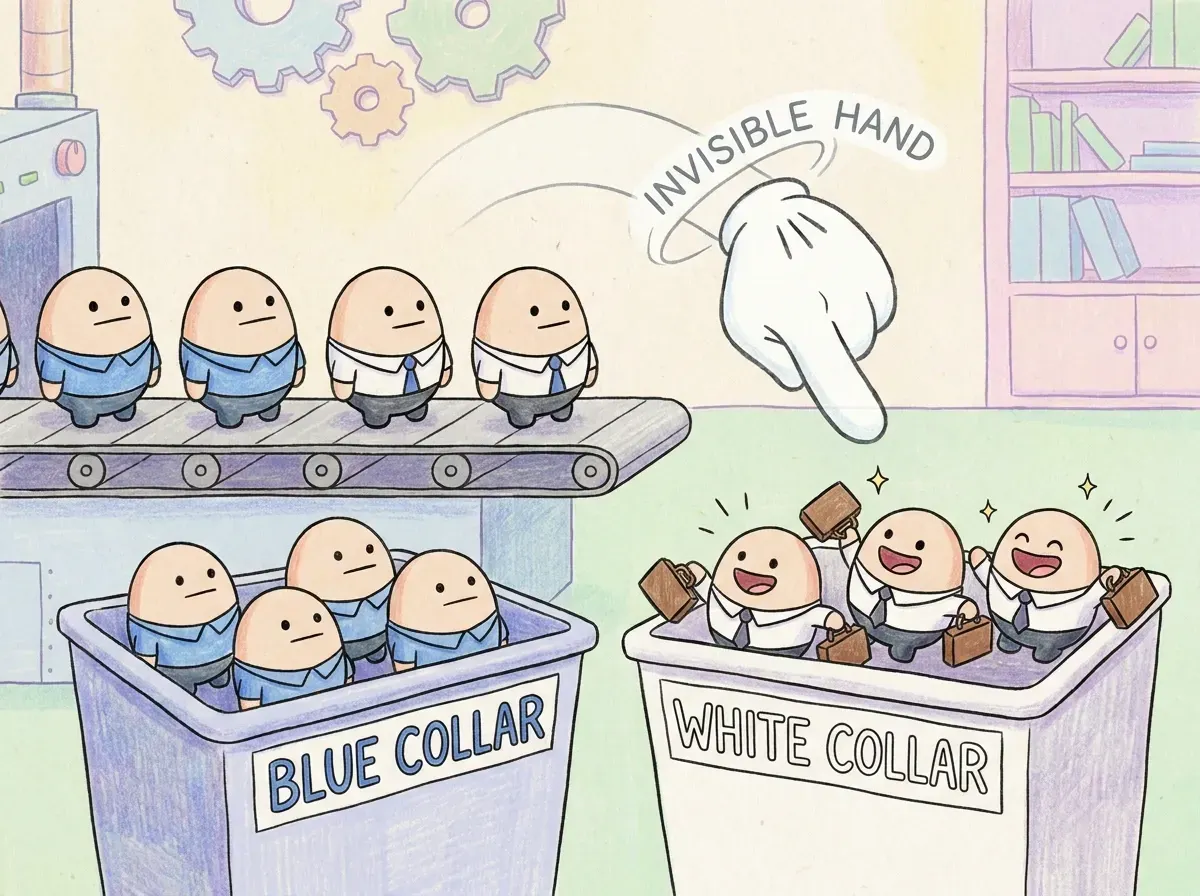
We started this series in 1919, with a steel strike and a clerk crossing a picket line. A person who probably should have been on the other side of that line, who walked past it anyway, not out of cowardice but out of genuine conviction that he was on a different team. We traced that conviction through the Valley mythology machine, through the material architecture that reinforced it with golden handcuffs and a tournament structure, and through the decade when the mythology quietly stopped matching the work but kept insisting loudly that it did.
Here's where we land. I hope it sticks.
It is 2026. The clerks' successors are still out there, and their situation has gotten considerably more complicated. Some of them were laid off in 2022 or 2023 and have since found other roles, or haven't. Some of them are watching AI handle a growing share of the tickets. Some of them are still in the open-plan office, telling themselves they're different from the people who got cut, that their work is more strategic, that the mythology still applies to them specifically.
Some of them are right. Most of them are not. And the difficulty of telling those two groups apart, from the inside, is part of what makes this moment both dangerous and, for the first time in a long time, genuinely interesting.
What AI Is Actually Doing
Let's be precise about this, because the discourse has been sloppy.
Generative AI is not replacing "software engineers" as a category. It is not replacing "tech workers" as a category. What it is doing is compressing the time and headcount required to execute discrete, well-specified, bounded units of software work. Which is to say, it is doing exactly what you would expect it to do if you had been paying attention to what a significant portion of tech work actually was, rather than what the mythology said it was.
The frontier tier – genuine research, novel architecture, ambiguous problem spaces where the solution isn't known in advance – is not primarily threatened by AI. It is, in many cases, augmented by it. The researchers and engineers working at that level are using AI the way previous generations used better calculators: more output, faster iteration, same fundamental human judgment at the center. This is a tiny fraction of the market.
The feature factory tier is a different story. The work that involves translating a reasonably specified requirement into working code, within a known architecture, against established patterns, is precisely the work that large language models are increasingly capable of doing adequately. Not perfectly. Not always. But adequately, and getting better, and at a cost structure that is going to make a lot of headcount conversations very short.
Here is the thing the industry spent a decade refusing to say clearly: those two categories of work are not the same thing. The mythology insisted they were. The layoff cycle started to crack that insistence open. AI is finishing the job.
The feature factory didn't become vulnerable because of AI. It became visible because of AI. The vulnerability was always there, underneath the mythology, waiting for something to make it legible.
The Three Pillars, Degraded
For fifty years, three interlocking structures made organizing in tech not just culturally unappealing but individually irrational. Post 3 laid out how they worked. What's worth examining now is how thoroughly all three have been compromised.
The RSU golden cage required equity that appreciated. The four-year vest cycle was tolerable, even exciting, when the underlying stock was going somewhere meaningful[1]. The cage loses most of its behavioral force when the stock is flat, when the company has just demonstrated that it will lay you off mid-vest with two weeks of severance and a nice LinkedIn post about restructuring, or when you've watched enough colleagues lose unvested equity in a Thursday morning Zoom call to update your priors about how the implicit contract actually works. The financial tether is still real. The psychological capture it was supposed to produce is considerably less so.
Stack ranking as a retention and motivation tool depends on there being something to compete for. It produces increasingly bizarre results in a workforce that has been through multiple rounds of reduction, where the bottom percentile being managed out is operating in a shrinking pool, and where the people who survived the layoffs know they survived partly through luck of project assignment and partly through manager politics and only partly through anything resembling merit. The tournament is hard to take seriously when you've watched the brackets get reshuffled by a macro decision that had nothing to do with anyone's performance.
The founder aspiration is, in 2026, a hard sell. The venture funding environment has been contracting. The AI infrastructure costs required to build anything competitive in the current landscape are substantial. The window between "interesting idea" and "absorbed by a larger player or killed by a foundation model" has compressed to the infinitessimal. None of this makes founding impossible, and some people will do it and some of them will succeed. But as a mass psychology – as the story that a whole industry tells its workforce about why this job is really just a stepping stone to something else – the founder aspiration has lost the ambient plausibility it had in 2015. It requires more active suspension of disbelief than most people are currently in the mood for.
The three pillars are not gone. But they are damaged, and damaged in ways that specifically affect the feature factory tier that AI is simultaneously targeting. The workers who are most exposed to displacement are, for the first time in a long time, also the workers for whom the structural impediments to collective action are weakest.
What Organizing Would Actually Require
This is the part where a certain kind of piece would pivot to optimism. Unions are coming! The workers are rising! History is on our side!
That's not what this is.
What organizing in tech would actually require is a set of things that are possible but not inevitable, and the gap between those two words is where most of the story lives.
It would require a legal structure. The National Labor Relations Act was written in 1935 for a manufacturing economy, and its application to knowledge workers, contractors, and the genuinely novel employment arrangements that dominate tech is awkward at best. The Alphabet Workers Union made a pragmatic choice in forming as a minority union without a formal bargaining unit – it gets to organize broadly, including contractors, but it cannot compel Google to negotiate. That trade-off reflects the terrain. Changing the terrain requires either legislative action (not currently on the menu) or a series of NLRB decisions that build new precedent (slow, contested, reversible).
It would require a model. The best existing template is not in tech – it's in entertainment. The SAG-AFTRA agreement reached in 2023 after a 118-day strike included specific provisions around AI: consent requirements for digital likenesses, compensation frameworks for AI training use, jurisdiction over synthetic performances. It is imperfect and will require ongoing renegotiation as the technology moves. It is also the first time a major labor agreement successfully established that workers have a claim on how AI uses their labor. The principle, not the specific terms, is what matters as a precedent.
Game workers, organized through the CWA, have been building a track record of successful votes at individual studios. These are small bargaining units, often hard-won, and the industry has not exactly welcomed them. But the wins are real, and the workers doing this work – creative, technical, project-based, in an industry that sold them a passion-work mythology almost as potent as the Valley's – are doing it anyway, and some of them are winning.
It would require, finally, enough people to decide that the mythology isn't serving them anymore. That's not a legal or structural question. It's a psychological and cultural one, and it's the hardest one, because the mythology was very good at its job and it got into some deep places.
The Honest Answer
The conditions that made organizing structurally irrational for fifty years have shifted. They have not disappeared. The shift is meaningful and the gap is real, and what happens in that gap over the next few years is genuinely uncertain in a way it hasn't been since the Homebrew Computer Club decided it was a collection of free individuals rather than a trade guild.
The clerks who crossed the picket line in 1919 were not bad people. They were people operating inside a constructed identity that told them which team they were on, and the construction was good enough that most of them never questioned it. The question now is not whether the construction was false – this series has spent five posts making the case that it was – but whether it is finally false in ways that enough people can feel.
The collar color was always a con. The Patagonia vest was always a collar.
The RSU was always a wage with strings. The stack ranking tournament was always a mechanism for making sure you were too busy competing with your peers to notice you had any.
None of that changes automatically. None of it changes because the AI disruption is real, or because the layoffs happened, or because the founder mythology requires more effort to believe than it used to. It changes because people decide it changes, which is both the most obvious thing in the world and, historically, the hardest.
Something is cracking. What grows in the crack is still an open question.
"Ubermensch in a Cubicle Farm" is a five-part series. Start from the beginning with Part 1: "The Collar Color Was Always a Con."
1 - one of my colleagues departed to work for Amazon in this era, they told me that every employee has a tracker on their homepage that listed Jeff Bezo's net worth, because that number going up meant their RSU's were doing the heavy lift