Elon Musk Didn't Spend Enough
The world's richest man regrets spending nearly half a billion dollars on Republicans. An economist thinks he may have been too cheap. That's the part that should worry us.

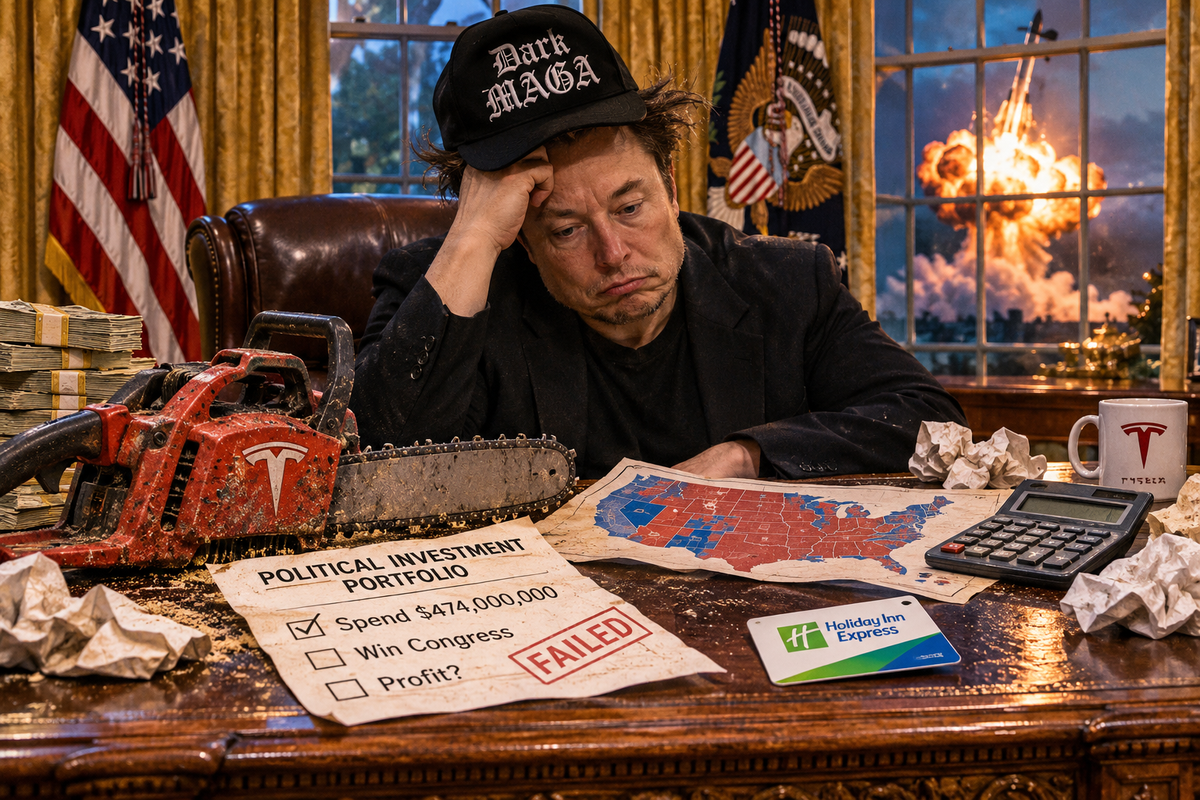
Yesterday, Elon Musk appeared at the New York Times DealBook Summit and announced that he felt foolish.
Well, there's something we can agree on.
But the source of his embarrassment wasn't his enthusiastic embrace of Donald Trump, his stint running DOGE, or his ridiculous appearance at CPAC waving a chainsaw around like a deranged lumberjack.
Nope. It was the money.
According to the Financial Times, Musk spent more than $470 million trying to elect Republicans in the 2026 midterms, and the Republicans got their asses handed to them. Democrats took both chambers of Congress, and even Texas elected a Democratic governor and senator.
Musk told Andrew Ross Sorkin that he felt foolish about the spending and, given another chance, would have spent less.
He also announced that he wasn't really MAGA.
This from the fellow who proudly declared himself Dark MAGA in 2024, wore the stupid hats, became Trump's First Buddy, and spent months helping dismantle parts of the federal government.
Apparently, MAGA was just a phase. Like a teenager discovering death metal.
But there's something more interesting than watching Musk attempt to slink away from his political commitments.
What if he didn't spend enough?
A half-billion-dollar rounding error
On November 6, economist Justin Wolfers published a fascinating piece at Platypus Economics titled Why Didn't Elon Musk Spend More?.
At first glance, that sounds insane.
Nearly half a billion dollars is an obscene amount to spend influencing an election. Musk spent more than any individual donor in a single election cycle. And Wolfers thinks he should have spent MORE?
Well, yes. And his reasoning is both compelling and rather disturbing.
Wolfers looked at what happened to the market valuations of Tesla and SpaceX as the election results came in. Both declined, even as the broader market rose.
Using Musk's ownership stakes and adjusting for the broader market's performance, Wolfers estimates that the election-night surprise represented roughly $50–70 billion in lost market-implied wealth.
Not an actual $70 billion check written to someone, mind you. These are estimates based on market movements, with real uncertainty, particularly around SpaceX.
But even allowing considerable room for error, we're talking about tens of billions of dollars.
And here's the kicker. Because investors had already anticipated a Democratic victory, some of that unfavorable outcome was priced into the companies before Election Day.
Wolfers' analysis suggests the full financial difference between Republican and Democratic control could be worth hundreds of billions to Musk.
Suddenly, spending $474 million doesn't look quite so extravagant.
It looks like chump change.
Sweaty's Corner doesn't have a marketing budget or an algorithm pushing it into anyone's feed. It has readers who share it. If this one landed, sending it to someone who'd get something out of it — or subscribing so the next one finds you directly — genuinely moves the needle.
The world's richest amateur political strategist
Wolfers also examined where Musk spent his money.
More than $200 million in Musk-backed spending went toward electing Ken Paxton to the Senate in Texas.
Is Elon Musk a competent political strategist?
Hell no. But he did stay at a Holiday Inn Express last night.
Paxton lost to James Talarico by twelve percentage points.
That's an enormous amount of money to throw at a candidate who lost by a comfortable margin.
Wolfers then runs an interesting hypothetical. What if Musk had directed a fraction of that money toward six closer Senate contests instead?
Using an illustrative assumption of $1,000 to change one voter's mind, he calculates that $124 million might have been sufficient to change the outcome in those races.
Now, Wolfers is clear that this is an oversimplification. Voters don't come with price tags. Campaign spending has diminishing returns, and nobody can know in advance precisely where every dollar will be most effective.
But the broader point survives.
Musk had enormous resources and powerful financial incentives to influence the outcome. His preferred candidates lost, but that doesn't mean the money couldn't have mattered if it had been deployed differently.
Perhaps we're fortunate that Musk's political instincts weren't as effective as his checkbook was large.
Yet that brings up a deeply uncomfortable question:
What happens when the next billionaire approaches this problem with more discipline, better information, and fewer personal grudges to settle?
FDR had something to say about this
On October 31, 1936, Franklin Delano Roosevelt delivered a remarkable campaign speech at Madison Square Garden.
The nation was still struggling through the Great Depression, and Roosevelt was confronting powerful financial interests that bitterly opposed his New Deal.
In his speech, Roosevelt accused those interests of treating the federal government as an appendage of their private businesses.
And then came this:
Government by organized money is just as dangerous as Government by organized mob.
Ninety years ago.
Roosevelt wasn't talking about super PACs, cryptocurrency billionaires, AI data centers, or the richest man on the planet attempting to buy a congressional majority.
He was talking about the danger of concentrated economic power translating into political power, with the machinery of government serving the interests of the wealthy rather than the people.
Wolfers, approaching the problem as an economist1, provides an explanation of why this remains such a persistent danger.
When government decisions can affect personal fortunes by tens or hundreds of billions of dollars, spending enormous sums to influence those decisions can become an entirely rational financial calculation.
This is related to an old economic question called Tullock's Puzzle: Why do wealthy businesses and individuals spend so little trying to influence government when the potential financial rewards are so enormous?
Perhaps we should be grateful they haven't figured out how to spend more effectively.
The wrong lesson
Back at DealBook, Musk suggested that the election demonstrated American elections weren't simply about money.
And in a narrow sense, he's right.
He spent nearly half a billion dollars and didn't get what he wanted.
But that doesn't prove our democratic institutions are sufficiently protected from the influence of concentrated wealth. It merely proves that this particular expenditure didn't produce the desired outcome.
The next billionaire may study Musk's mistakes. The next one may concentrate spending in competitive races, work through more sophisticated political organizations, and avoid becoming quite so personally identified with unpopular candidates.
Or maybe not. Money still can't guarantee an electoral outcome.
But here's what troubles me.
We have reached a point where an individual's private fortune is so enormous, and so dependent on government decisions, that spending billions of dollars influencing elections could be economically rational.
Think about that for a moment.
The country that Roosevelt warned about in 1936 has produced individuals wealthy enough to treat control of Congress as an investment opportunity.
Musk says he spent too much.
Wolfers suggests he might have spent too little.
And I'm left thinking that perhaps we got lucky this time.
But a functioning democracy cannot depend on its oligarchs being lousy political investors.
1: Economists are almost as weird as physicists...