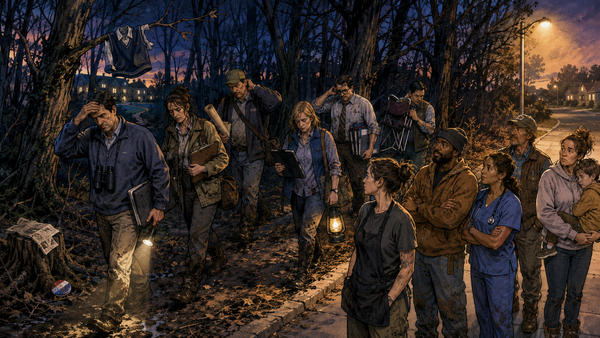
Off the Record Is Not Opposition
Republican officials have spent a decade privately recognizing the danger of Trump while publicly enabling him. Their anonymous anguish is not resistance. It is an alibi.

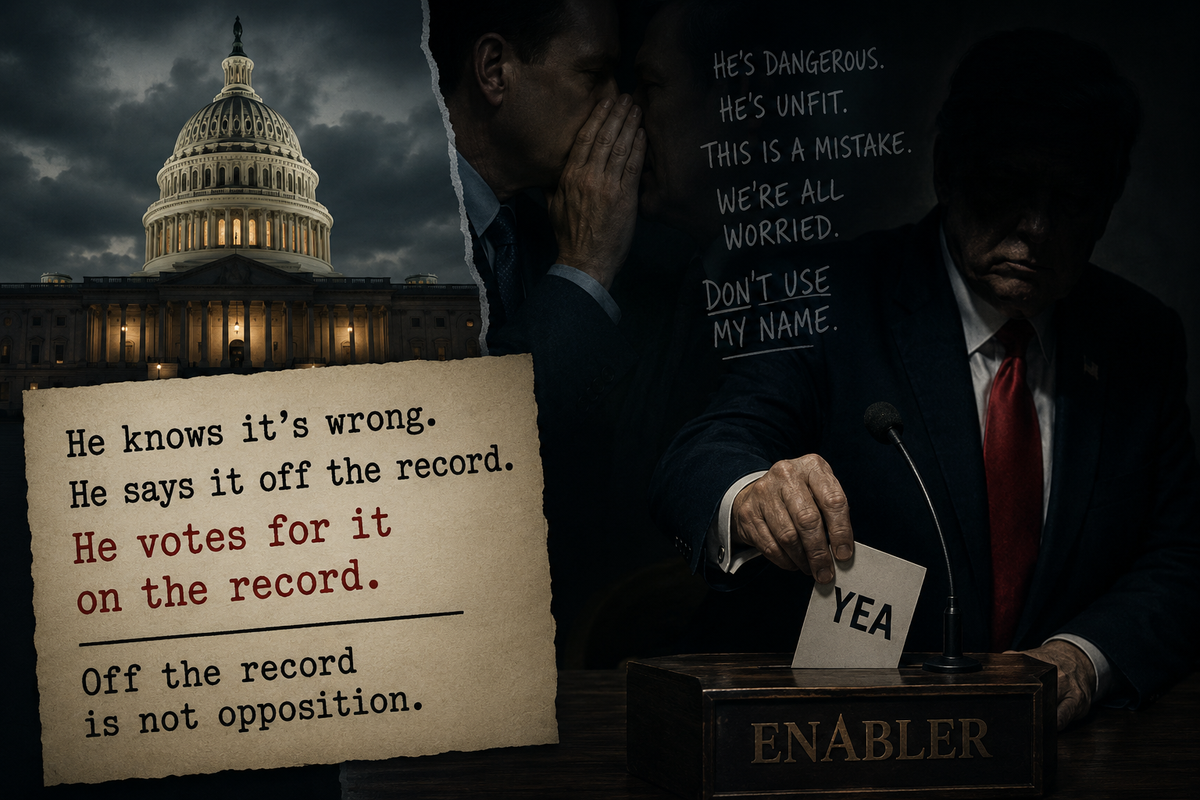
Somewhere in Washington, at this very moment, a Republican senator is expressing grave concern to a reporter who has agreed not to use his name. He is troubled by Donald Trump's conduct. Deeply troubled, in fact. He believes the president has crossed a line. He fears for the Constitution, the rule of law, the credibility of the party, and perhaps the future of the republic itself. Tomorrow, he will vote for it. You have read this story hundreds of times since 2016. The details rotate — a scandal, an impeachment, an assault on an institution, a corrupt nominee, an act of open self-dealing — but the structure never changes:
Republican senators are privately alarmed. White House aides are deeply concerned. Senior officials describe the president as increasingly erratic. Members of his own party worry he has gone too far. None of them will say so publicly. The vote passes 52–48.
He is disturbed. She is appalled. They are furious behind closed doors. And then they emerge from the closed room, straighten their jackets, and vote exactly as Trump demands.
"Off the record" is where Republican courage goes to die with its reputation intact.
First, the carve-out
Before I get going, the obligatory disclaimer, because this is not a brief against anonymous sourcing.
Anonymous sources can be essential. They expose crimes, abuses of power, hidden government actions, retaliation, corruption — information the public would not otherwise possess. A whistleblower who risks employment, prosecution, or personal safety to drag hidden misconduct into the light is performing a public service, full stop. That is not what the Republican-anxiety genre describes. In these stories, the conduct is already visible. The public heard what Trump said. The vote is scheduled. The nominee is known. The abuse is happening in plain sight, on camera, usually with a Truth Social post confessing to it. The anonymous Republican is not revealing the misconduct. He is revealing that he recognizes the misconduct.
Which while it may be psychologically fascinating. It is rarely politically useful. Anonymity can protect someone who is telling the public something it does not know. It should not be confused with courage when it merely confirms that the speaker possesses eyes and a functioning conscience. The only secret being exposed is that he knows better.
What the confession actually buys
Let's ask the practical question: what changes because a Republican senator privately admits that Trump is dangerous? It reassures the journalist, for one. The reporter walks away with evidence that responsible Republicans still exist somewhere inside the institution, and the story can preserve the comforting two-faction narrative — the MAGA extremists over here, the sober conservatives privately struggling to restrain them over there. Comforting, because it implies the system still has internal safeguards. Safeguards that exist only as anonymous quotations are not safeguards. They are a bedtime story with a dateline.
It reassures the politician. He gets to preserve a moral distinction between himself and the people he enables:
I am not one of the true believers. I understand what is happening. I objected privately. The public doesn't know how hard I fought behind the scenes.
The anonymous quote becomes a receipt for private virtue, redeemable nowhere. Value? Bupkis.
It reassures the respectable Republican reader, who gets to believe the old party is still alive beneath the surface — quietly resisting, waiting for the right moment, working levers nobody else can see. This sustains hope long after the observable evidence has collapsed. It is a coping mechanism wearing a press pass.
And here is what it does not do:
It builds no constituency, because no voter can rally behind an unnamed senator. It gives no colleague cover, forces no donor to choose, creates no public record. It imposes no cost on Trump, who does not have to answer an unnamed critic. It risks no primary for the senator, who keeps his committee assignments, his donor relationships, his media access, and his seat at every good table in town.
And it changes no vote. This is the brutal final test. After the private alarm comes the public act: the nominee advances, the acquittal is delivered, the funding is approved, the investigation is blocked.
Anonymous dissent gives everyone involved the emotional experience of resistance without the inconvenience of resistance itself. It is complicity with an alibi attached.
"He knows better" is not a defense
The Never Trump crew — who I read, and mostly like, even while I'm in the middle of dunking on them — have a favorite observation: they know what Trump is.
Republican senators know he lies. His aides know he is impulsive. His former officials know he is dangerous. Party leaders know the election claims were fraudulent. This is invariably presented as a reason for hope. Instead, it should be presented as an aggravating factor.
If these people didn't understand what was happening, they could plead ignorance, deception, misjudgment. The anonymous quotations take that defense off the table and set it on fire. They tell us the officials recognize the danger and choose accommodation anyway. "He knows better" has become one of the strangest exonerations in American politics. If he knows better and still votes for it, that does not make him one of the good Republicans. It makes the vote more revealing.
A senator who recognizes corruption but enables it is not morally superior to the senator who swallows the propaganda. He may be intellectually superior. Congratulations. Knowledge has moral significance only when it informs conduct — and knowing the truth privately does not count when your public power is exercised on behalf of the lie.
The autobiography protection program
So why do they keep talking?
Because the unnamed source is not only protecting his career. He is protecting the story he tells himself about his career. In that story, he was never an accomplice. He was an adult in the room. He worked quietly. He prevented worse things. He stayed because responsible people had to remain inside.The fact that the worse things kept happening is treated as an unfortunate production detail.
Remember the 2018 New York Times op-ed, "I Am Part of the Resistance Inside the Trump Administration"? Peak genre. An unnamed "senior official" assuring America that the grown-ups were quietly thwarting the president's worst impulses from inside the house he was burning down. Two years later we learned it was Miles Taylor, a DHS chief of staff, who parlayed the bit into a book and a CNN gig.[1] The resistance, it turned out, had a fucking book deal.
And this is where the single most load-bearing fiction in Republican Washington comes in: the bad-advisers excuse. When Trump does something indefensible, these people never say Trump wanted this because it serves his interests and reflects his character. They say someone is giving the president bad advice.
This is not a paraphrase. Thom Tillis — the most "liberated" Republican in the Senate, a man with literally nothing left to lose electorally — told CNN this spring, on the record: "I don't criticize him, because I expect these people to protect him." Read that sentence again. The senator's theory of his own job is to yell at the staff so the staff will better protect the man he believes needs protecting from his own staff.
Blaming the advisers protects Trump's innocence and the senator's autobiography at the same time. It's a BOGO laundering special.
The YOLO caucus, or: liberation, my ass
Which brings us to the current cast, because the press has helpfully assembled one for us.
The "YOLO Republicans"[2] — Tillis, who's retiring; Bill Cassidy, who lost his Louisiana primary in May; John Cornyn, who lost to Ken Paxton and became the first incumbent Texas senator to lose a primary since 1970. I took my shots at this crew in the Buckley piece, and nothing since has changed my mind.
The theory was simple and appealing. These men were afraid of primaries. Once defeated or retiring, untethered from reelection, they would finally speak honestly and resist. Nothing left to lose. Or so they say.
But the theory misunderstood what they value. A politician can lose his seat and still care plenty: about remaining welcome in Republican society, about donor relationships and future board seats, about colleagues and conservative media, about personal and family safety, about a legacy that doesn't mark him as a traitor to the tribe. Most of all, he may still be unwilling to admit what his prior behavior means.
So Tillis can be "unleashed" — the press loves that framing — can demand Kristi Noem's resignation, can sneer at "30 and 40 somethings like Stephen Miller," can say he's "sick of stupid," and can turn around and text the president "Great job" for sending Tom Homan into Minnesota in the same stretch where federal agents' conduct in Minneapolis is the thing he's supposedly furious about. He can say, out loud, on the record: "You will see over the next 339 days that I support the vast majority of what the president wants."He can criticize the plan. He can criticize the advisers. He can demand better paperwork.
He still cannot say: the president is corrupt, and he is doing this deliberately. The YOLO caucus turned out to have no elections left to lose and an astonishing number of fucks left to give.
Now, to be fair — and I try, it hurts, but I try — Tillis has also done one genuinely real thing, and we'll get to it in a minute, because it's the exception that proves the entire rule.
Courage is infrastructure
Here's the mechanical point, and it's the one the anonymous-confession crowd never engages.
Political courage is not merely a personal virtue. It is infrastructure.
One person's visible refusal lowers the cost of the next person's refusal. When a senator speaks plainly and puts his name on it, another senator has cover, donors can support the break, voters discover they aren't alone, journalists can describe an actual faction instead of an imaginary one, and the price of dissent gets split among more people.
Anonymous dissent does none of this. It traps every potential dissenter in the belief that he's alone. The senator tells the reporter, on deep background, that many colleagues feel the same way. The public sees no disagreement. Trump sees no disagreement. The base sees no disagreement. The next wavering senator sees no disagreement.Ten private consciences can produce the same public result as no conscience at all.
A word about the reporters
This is not an attack on journalists. These conversations produce real insight into internal dynamics, and I've linked to several of them in this very post.
But the framing needs to be called out. Too often the anonymous anxiety is presented as evidence of meaningful Republican resistance rather than evidence of its absence. The story says Republicans privately recoil from Trump's latest move.
The observable political reality says Republicans are supporting Trump's latest move. The private reaction is context. The public behavior is the story.
The anonymous quotation should not be allowed to outweigh the recorded vote. A senator's private disgust tells us something about his emotional condition. His public act tells us what he is doing with power. If the piece must run the unnamed hand-wringing — and it will, every time — then write it with the load-bearing word included: Republicans who say privately that the measure is dangerous are nevertheless expected to support it publicly.
That "nevertheless" is the whole story. Everything else is set decoration.
What the real thing looks like
Real opposition does not require martyrdom or a dramatic floor speech with a soundtrack. It can simply be voting "no". Withholding consent. Using committee authority. Refusing to confirm an unfit nominee. Signing the letter with your actual name. Joining the lawsuit. Appearing with members of the other party. Supporting a primary challenger. Resigning rather than carrying out an unlawful order.
The standard is not theatrical heroism. It is public conduct with consequences.And here is the exception that proves the rule, because it shows exactly how mundane and effective the real thing can be. Tillis — the same guy who won't criticize Trump directly — used his seat on the Banking Committee to single-handedly hold up Kevin Warsh, Trump's pick to run the Fed, until the Justice Department dropped its clown-show criminal probe of Jerome Powell.[3] One senator, one hold, applied at one pressure point, and DOJ folded. That was not a vibe. That was not an emotion shared with a reporter over drinks. That was power exercised in rough accordance with a danger the senator plainly recognized.
Nobody is asking these people to become martyrs because they gave a stern interview on Sunday morning. We are asking them to make their public behavior correspond, occasionally, with the constitutional emergency they describe off the record.
And yes, public language itself counts when it accurately names the thing. "Trump is receiving bad advice" is evasion. "Trump is using the Justice Department for personal protection and revenge" is political information. The first sentence is a lullaby. The second one costs the speaker something, which is how you know it matters.
The moral accounting
For nearly a decade, respectable Republicans have asked to be judged by their private intentions rather than their public effects. They were concerned. They clutched pearls. They worked behind the scenes. They prevented worse outcomes. They disapproved of the tone. They understood the danger.
But these were not powerless citizens watching from the cheap seats. They were senators, representatives, cabinet officials, advisers, prosecutors, lawyers, donors, party leaders. They possessed authority. Their votes, confirmations, endorsements, and silences had consequences, and the consequences are the ledger.
The moral unit in politics is not the private thought. It is the public use of power. History will not footnote every destructive vote with the senator's anonymous assurance that he felt terrible about it. Their private discomfort may prove they were not deceived.It does not prove they resisted.
Put your name on it
Another scandal will come, probably before the weekend. Another reporter will receive a call. Another Republican official will explain that colleagues are alarmed, the president has crossed a line, the situation is worse than the public understands.
The response should be one question, and it should be asked every single time: what are you going to do about it, and may I use your name? There will be another anonymous Republican tomorrow. He will be deeply troubled. He will understand the stakes. He will assure the reporter that many of his colleagues feel the same way.
Then he will vote with Trump.
At this point, the anonymous confession should not reassure anyone. It should be entered into evidence.
He knew. He understood. He helped anyway.
Off the record is not opposition. Private courage is not a political act. And a conscience that never interferes with the exercise of power is only a story the coward tells himself.
Like what you've read, but not able to switch to paid? Why not buy me a coffee instead! All money goes to help defray the expense of running the site.
1 - Taylor's follow-up book was titled A Warning. It sold extremely well, because warnings always sell best when they're anonymous and consequence-free. He is now a CNN contributor, which is where the adults in the room go when the room burns down anyway.
2 - NPR, The Dispatch, and Politico have all used the "YOLO" framing for Tillis, Cassidy, and Cornyn. Cornyn rejects the label, which is honestly the most John Cornyn response imaginable.
3 - Credit where due, and I mean it: this is the same Tillis who, when accused of only speaking freely now that he's free of reelection, answered "It's like no shit, Sherlock." The man is not incapable of candor. He is rationing it.