
One True Church: The Republican Party and the Logic of Rome
If the Democrats are like the messy Protestant universe, the Republicans are pure Catholic hierarchy.

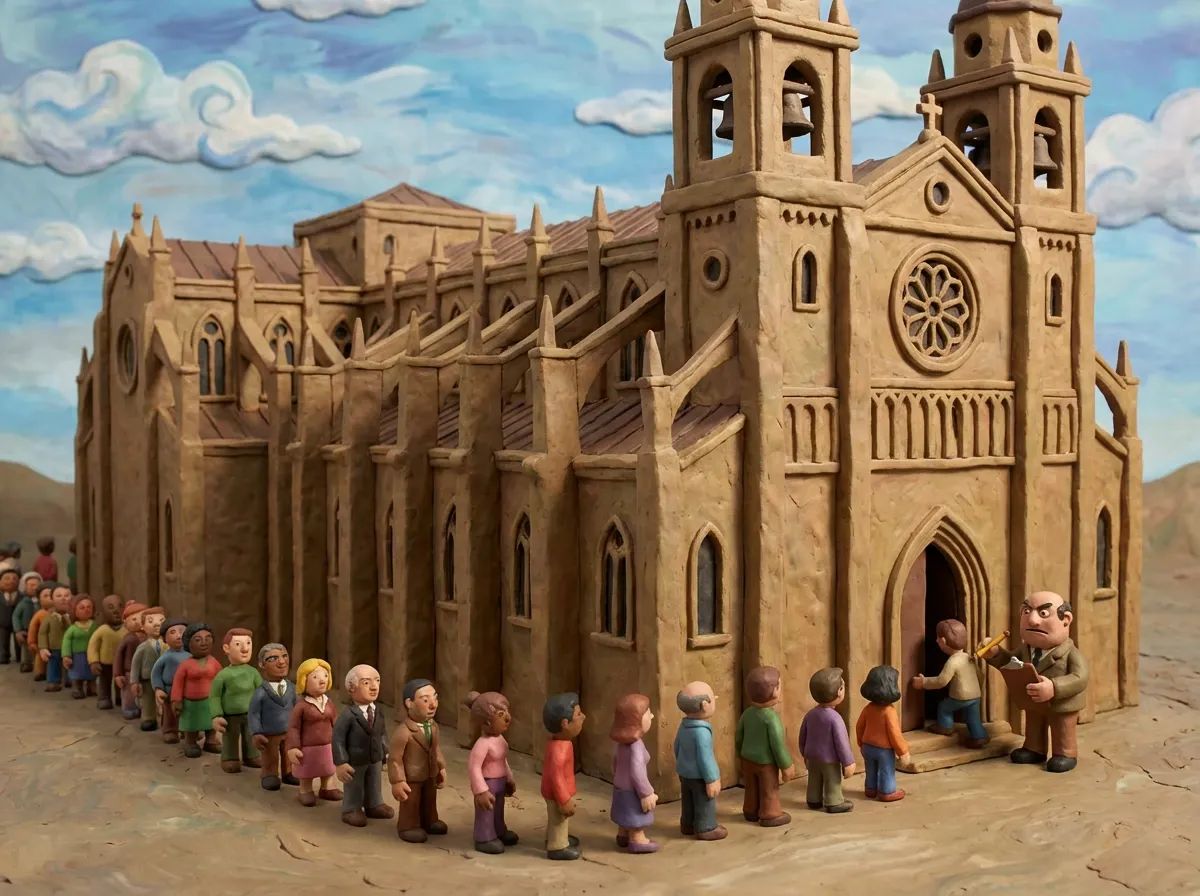
The Roman Catholic Church has roughly 1.4 billion members across 195 countries. It operates in dozens of languages, across wildly divergent cultures, in political environments ranging from liberal democracy to outright authoritarianism. Its members disagree, sometimes ferociously, about economics, about social policy, about what their faith requires of them in the world.
And yet it functions as a recognizable, coherent institution in a way that American Protestantism – with its thousands of denominations and its permanent internal theological civil wars – simply does not. The reason for this is not that Catholics are more naturally docile, or that their faith is simpler, or that they just happen to agree more. The reason is structural: the Catholic Church has a central authority capable of defining what the tradition means, disciplining deviations from that definition, and enforcing a version of unity that does not depend on everyone actually agreeing.
That's the Republican Party, full stop. And once you see it, a lot of things that look like political pathology start to look like institutional logic.
The Architecture of Authority
The Catholic Church's organizational genius – and it is a genuine genius, whatever you think of the institution – is that it solved a problem that has destroyed every decentralized religious tradition that tried to scale: the problem of doctrinal drift. When you have no central authority, local communities interpret the tradition according to their own needs and contexts, and over generations those interpretations diverge until the tradition itself fragments. Protestantism is a five-hundred-year demonstration of this dynamic in real time.
The Catholic solution was hierarchy. A clear chain of authority running from the parish up through the diocese, through the national church, to Rome. Councils that could define doctrine formally. And crucially, a mechanism for declaring what falls outside the tradition entirely -- heresy is a technical term before it's a rhetorical one, and the Church used it with precision.
This does not make the Catholic Church monolithic. There are Catholic liberation theologians and Catholic traditionalists who would happily strangle each other over a glass of sacramental wine. There are Jesuits and Opus Dei operating from what amount to competing ecclesiologies under the same institutional roof. The diversity is real. What the hierarchy does is contain that diversity -- channel it, manage it, and periodically clarify the boundaries when the internal tension threatens to produce actual schism.
The pre-Trump Republican Party ran on something close to this model. There were genuine internal factions: neoconservatives and foreign policy realists, business conservatives and social conservatives, libertarians and religious traditionalists. The party platform was a managed compromise among these factions, held together by shared commitments -- low taxes, strong defense, cultural traditionalism -- that were broad enough to accommodate considerable internal variation. The establishment functioned as a kind of curia: not democratically accountable in any meaningful sense, but effective at maintaining coherence and managing succession.
The Counter-Reformation Moment
Here's where the Catholic analogy gets genuinely illuminating rather than merely decorative.
The Catholic Church has faced several moments in its history where an external challenge – the Protestant Reformation, the French Revolution, the cultural upheavals of the twentieth century – provoked not adaptation but consolidation. Theologians have a term for the specific impulse that drives this response: ultramontanism, from the Latin for "beyond the mountains," referring to the tendency to look to Rome – rather than to local authority – as the ultimate source of doctrinal clarity in times of crisis. When the tradition feels threatened, the response is to concentrate authority more intensely at the center, police the boundaries of acceptable belief more aggressively, and define the tradition in sharper, harder terms than it had used before.
The First Vatican Council's 1870 declaration of papal infallibility is the clearest historical example. The Church was in genuine crisis – it had just lost the Papal States to Italian unification, its temporal power was gone, and modernity was eating its cultural authority from every direction. The response was not to loosen and adapt. The response was to declare, formally and for the first time, that the Pope speaking on matters of faith and morals was incapable of error. An institution under existential threat asserting maximum authority as a defensive response.
Barack Obama's presidency was, for a significant portion of the Republican coalition, exactly this kind of existential threat – not in any policy sense, but in a civilizational one. As I noted in the previous post, for a certain kind of culturally traditional, non-college, white conservative, Obama's election was not experienced as a political loss. It was experienced as evidence that the country they understood themselves to inhabit had changed in ways they hadn't consented to and didn't recognize. The Tea Party emerged within months of his inauguration, ostensibly about the deficit, animated by something considerably deeper.
What followed was a Republican ultramontanism. The party's internal diversity – which had been genuine and sometimes productive – collapsed into a single overriding imperative that crowded everything else out. The complexity of the pre-Obama coalition got replaced by a harder, simpler orthodoxy organized around cultural restoration. And the boundaries of acceptable belief got policed with an aggression the pre-Obama GOP establishment would have found alarming – because the establishment was one of the things being defined out of the tradition.
This is the process that made Trump not just possible but, in retrospect, structurally inevitable. He didn't create the calcified orthodoxy. He recognized it before anyone else in the professional Republican class did, stepped into it, and became its most authentic expression. He was, to use the theological language that the analogy keeps forcing on us, the figure who correctly read what the faithful actually believed – and was willing to say it plainly, without the management-speak the establishment had layered over it for decades.
The Magisterium Problem
The papal infallibility declaration solved one problem and created another. If the Pope is infallible on matters of faith and morals, what happens when two popes disagree? What happens when a pope says something the faithful find difficult or inconvenient? What happens when the tradition requires acknowledging that a previous authoritative position was wrong?
These are not hypothetical problems. The Catholic Church has been wrestling with them for a century and a half, and the answers are not tidy. The current papacy under Leo XIV represents a genuinely different theological and institutional vision from the papacy under Benedict XVI, his predecessor-but-one, in ways that the doctrine of infallibility makes difficult to acknowledge openly. The institution manages this by making fine distinctions about when the infallibility doctrine applies, which is coherent in theological terms and somewhat absurd in practical ones.
The Republican Party has an identical problem, and it is managing it in an identical way.
Trump's hold on the party's doctrinal authority has been, since 2016, essentially papal in character. His endorsements make careers. His condemnations end them. The list of Republicans who tried to position themselves as post-Trump – DeSantis most visibly, but Haley, Scott, Pence in his hapless way – is a roster of people who misunderstood the nature of what they were challenging. They thought they were running against a politician. They were trying to challenge a magisterium, and they lost the way heretics tend to lose: decisively, and with their reputations diminished in the process.
The complication, and it's the same one the Church faces, is that authoritative leaders die. Popes and presidents both have a finite tenure, and the institution has to survive the transition. The Catholic Church has developed sophisticated mechanisms for managing succession – the conclave, the College of Cardinals, the careful management of who gets elevated to positions that influence future selections. These mechanisms don't always work perfectly – the history of papal succession includes some spectacular disasters – but they exist and they function.
The Republican Party has not yet developed equivalent mechanisms for the post-Trump transition, and this is its most significant institutional vulnerability. The Catholic Church can survive a bad pope because the institution is larger than any individual and the succession mechanism, however imperfect, produces another pope. What the Republican Party produces after Trump – whether it consolidates around a designated successor who inherits the magisterial authority, fragments back into its pre-ultramontane factions, or does something structurally novel – is genuinely unclear. History offers some guidance, but not a clean answer. What I can be certain of, it's not going to be a reversion to a "normie" Republican.
What the Counter-Reformation Suggests
The Catholic Counter-Reformation is worth examining as a historical parallel, because it's the closest analog to what the Republican Party has been doing since 2016 and it has a long enough track record to be instructive.
The Counter-Reformation was not just a defensive response to Protestantism. It was a comprehensive institutional project: doctrinal clarification through the Council of Trent, the founding of the Jesuits as an elite missionary and intellectual order, the Roman Inquisition as an enforcement mechanism, and a sustained effort to define the Catholic tradition in sharper, more explicit terms than it had previously used. It worked, in the sense that it stopped the hemorrhage of territory and souls to Protestantism and produced a period of genuine Catholic renewal and cultural achievement. The Baroque is, among other things, a Counter-Reformation phenomenon.
It also produced rigidities that took centuries to undo. The Index of Forbidden Books. The suppression of internal theological creativity. The Galileo affair, which is not the simple story of religion vs. science that the shorthand version suggests, but is partly a story about what happens when an institution in defensive consolidation mode encounters ideas it hasn't approved. The Council of Trent defined Catholic doctrine with a clarity and precision that made the tradition coherent and also made it brittle – harder to adapt when circumstances changed, because the adaptation required acknowledging that the previous authoritative position needed revision.
The Republican Party's MAGA consolidation has the same double-edged quality. It works -- the 2024 election results are not ambiguous on that point. A coherent, hierarchically organized political movement with a clear doctrinal center beats a fractured, quarreling coalition in most circumstances, and it did. But the consolidation has also produced rigidities: an immigration position so maximalist that it's creating genuine economic complications even among people broadly sympathetic to restriction, a relationship with empirical reality that makes governing some policy domains genuinely difficult, and a loyalty-enforcement culture that has driven out much of the institutional expertise the party needs to actually run a government.
The Counter-Reformation Catholic Church was more coherent than the pre-Trent Church. It was also, for the better part of two centuries, less capable of genuine intellectual and theological renewal. The question for the Republican Party is whether the MAGA consolidation has the same trade-off baked into it: more coherent in the near term, less adaptable when circumstances change in ways the doctrine didn't anticipate.
The historical answer, from the Catholic case, is yes. But "less adaptable" played out over roughly two hundred years before Vatican II started unwinding the rigidities of Trent. In political terms, two hundred years is not a useful planning horizon.
This is part 3 of a three part series, read part one and part two if you missed them.
 Share on Bluesky
 Share on Threads
 Share on Facebook
 Share on Mastodon
 Share on Reddit
 Share on Email