Performed Piety, Practiced Bullshit - Douthat v. Vance
JD Vance converted to Catholicism five years into his marriage to a woman who hasn't. Ross Douthat interviewed him about his faith and forgot to notice. Here's what legitimacy laundering looks like.

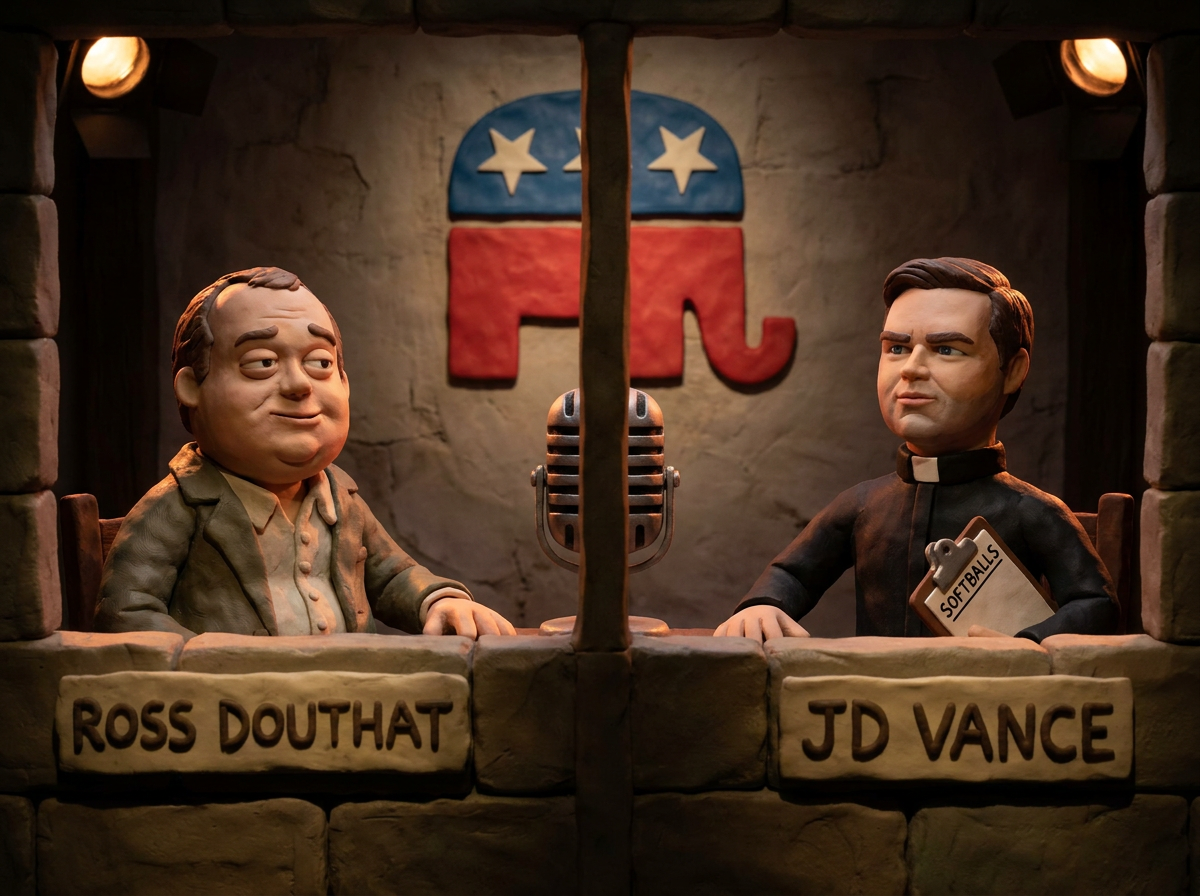
Two men walk into a podcast studio. One is a priest who forgot his vows. The other is a very expensive piece of luggage.
Let's start with Ross Douthat, because understanding who he is explains everything about what this interview was and wasn't.
Douthat has been the New York Times' resident Catholic conservative intellectual for going on two decades, which is either a testament to his longevity or evidence that the Times keeps him around the way a zoo keeps a cassowary — exotic, vaguely threatening, and useful for pointing at when people accuse you of monoculture. He is genuinely learned, genuinely serious about his faith, and the author of a body of work arguing that American conservatism needs to be grounded in religious tradition rather than mere market orthodoxy. It is a project that has produced shelf-loads of smart essays and exactly one tangible political result: JD Vance. That's not entirely fair to Douthat, but fairness is not really the currency of the moment, and Douthat has enough invested in Vance's success that he should have recused himself from interviewing him. He did not.
The Priest Who Likes the Defendant
Douthat's interview is what rigorous examination looks like when the examiner doesn't actually want to find anything.
The tell comes about a third of the way through, when Douthat is pressing Vance on what's actually Christian about the Trump administration. He identifies three specific areas where the administration looks, in his word, "functionally post-Christian": the gutting of humanitarian aid, the arm's-length treatment of pro-life organizations, and the administration's general tone of aggressive uncharity toward anyone not on board with the program. These are real criticisms, substantive ones, and Douthat has spent years writing exactly this kind of critique.
Then Vance gives three evasive non-answers. And Douthat moves on.
The most egregious moment comes when Douthat says, and I am quoting directly from the transcript: "Let's stipulate that the Trump administration has, in some way, a kind of vision of rebuilding the working class that's connected to Christianity." He hands Vance the theological credibility claim that the entire interview has been building toward, without the slightest resistance, and pivots to Iran. Ross Douthat has a PhD from Harvard and has spent his career making exactly the kind of argument that should make that stipulation impossible. The stipulation is not journalism. It is not intellectual engagement. It is a friend covering for a friend.
The pope exchange is even sharper. Douthat essentially backs Vance into a corner that should be inescapable: Vance privately opposed the Iran war, the pope publicly opposed the Iran war, yet Vance ended up in public tension with the pope while defending a war he apparently didn't want. That is a genuinely devastating paradox. Douthat's framing of it? "Ironic." "Strange." He calls it a "strangeness of position." Not hypocritical. Not a failure of integrity. Strange. Like finding your keys in the refrigerator. You observe it, maybe shake your head a little, and move on.
That's not an accident. That's a choice. Douthat has too much riding on Vance's success, too deep an investment in the idea that serious Catholic intellectual tradition can produce serious Catholic political leaders, to let the obvious conclusion land. He asked the sharp questions and then declined to press the answers. The result is an interview that performs rigor while producing none.
The Automaton and His Pivot Package
JD Vance is what you get when someone very smart decides to be very useful.
Strip away the memoir framing and what you have is a man who converted to Catholicism in 2019, roughly five years after marrying a woman who remains outside the Catholic church, roughly a decade after entering the circles of elite conservative thought where Catholicism functions as a prestige marker, and directly within the orbit of Peter Thiel, who bankrolled his Senate campaign and whose own engagement with Catholic intellectual tradition is less about moral constraint than about having a sophisticated vocabulary for power. The sequencing matters. Yale came first. The career came first. Usha came first. The faith came conveniently later.
None of that is disqualifying on its own. People convert for complicated reasons and the journey isn't always linear. But it becomes relevant when Vance presents his conversion as the organizing narrative of his moral life, because the transcript shows you what that moral life actually looks like under mild pressure, and it looks like a series of very smooth pivots.
Ask him what's Christian about an administration that shredded PEPFAR and defunded international humanitarian programs: he pivots to NGO inefficiency and left-wing bureaucratic capture. Ask him about Christian tone in an administration that has made cruelty into a brand: he pivots to the argument that tone-policing is how elites dismiss working-class communication. Ask him about the pope: he pivots to the distinction between the pope's job and the vice president's job. Ask him about the Iran deal's risks: he pivots to Gulf state enthusiasm. Every hard question meets a pre-loaded framework, delivered with a smoothness that suggests extensive rehearsal.
This is not a man wrestling with the genuine demands of his faith in public office. This is a man who has thought very carefully about how to sound like that man.
The Catholic intellectual tradition that Vance claims is notably not doing any of the work here. Catholic social teaching is a comprehensive package. It includes the preferential option for the poor. It includes a robust just war tradition with a presumption against military force. It includes explicit obligations to the global community that do not stop at national borders. Vance's version of Catholic political thought consists almost entirely of domestic economic nationalism, which is one strand of Catholic social teaching, cherry-picked clean of everything that would create friction with the political project he serves.
The Usha Problem
If your wife is the instrument of your understanding of sacramental love, and she hasn't converted, what exactly did she understand that you did?
Vance's account of coming to faith runs through Usha. She is the person who made him understand that love has a sacramental dimension, that the union of man and woman is something more than a social arrangement. He says this repeatedly and with apparent sincerity. It is the most emotionally genuine passage in the transcript.
And Usha remains outside the Catholic church.
This would be unremarkable in a man who held his faith quietly and privately. It is a sharp irony in a man whose entire political brand is performative Catholic identity, who brings it to every interview, every speech, every encounter with a pope he's privately aligned with but publicly positioned against. Usha, who supposedly showed him the way, has not followed him through the door. Draw your own conclusions about what that tells you about the nature of the journey.
What the Performance Is Actually For
When two members of the same club perform intellectual rigor for each other, what gets produced is not rigor. It is legitimacy.
The Douthat-Vance podcast (gift link) is not a conversation between a journalist and a public official. It is a ceremony. Douthat plays the serious Catholic intellectual who asks the hard questions. Vance plays the serious Catholic convert who has genuinely wrestled with them. The format requires the appearance of friction. The friendship, the shared project, and the mutual investment in the outcome ensure that the friction never gets past the skin.
What comes out the other end is a vice president who sounds like someone whose faith has genuinely shaped his politics, in an interview that sounds like genuine intellectual accountability. Neither of those things is true, and the men involved are smart enough to know it. That is not buffoonery. Buffoons don't know what they're doing. These two know exactly what they're doing.
The ancient, intellectually serious tradition of the Catholic church is being operated here as a legitimizing apparatus. It provides the vocabulary, the weight of centuries, the suggestion of something that transcends mere political calculation. It does not provide any actual constraint on that calculation. Vance takes what he needs from the tradition and quietly sets aside everything that would cost him anything. Douthat helps him do it by providing a stage that makes the whole performance look like something more than performance.
It is, in the end, a very expensive confessional where no one actually confesses anything, and absolution is granted before anyone kneels.