
The College-For-All Catastrophe
Series: The Boys Are Not Alright — And Nobody's Fixing It, Part 2 - College isn't really for everybody, but somehow that became the mantra.

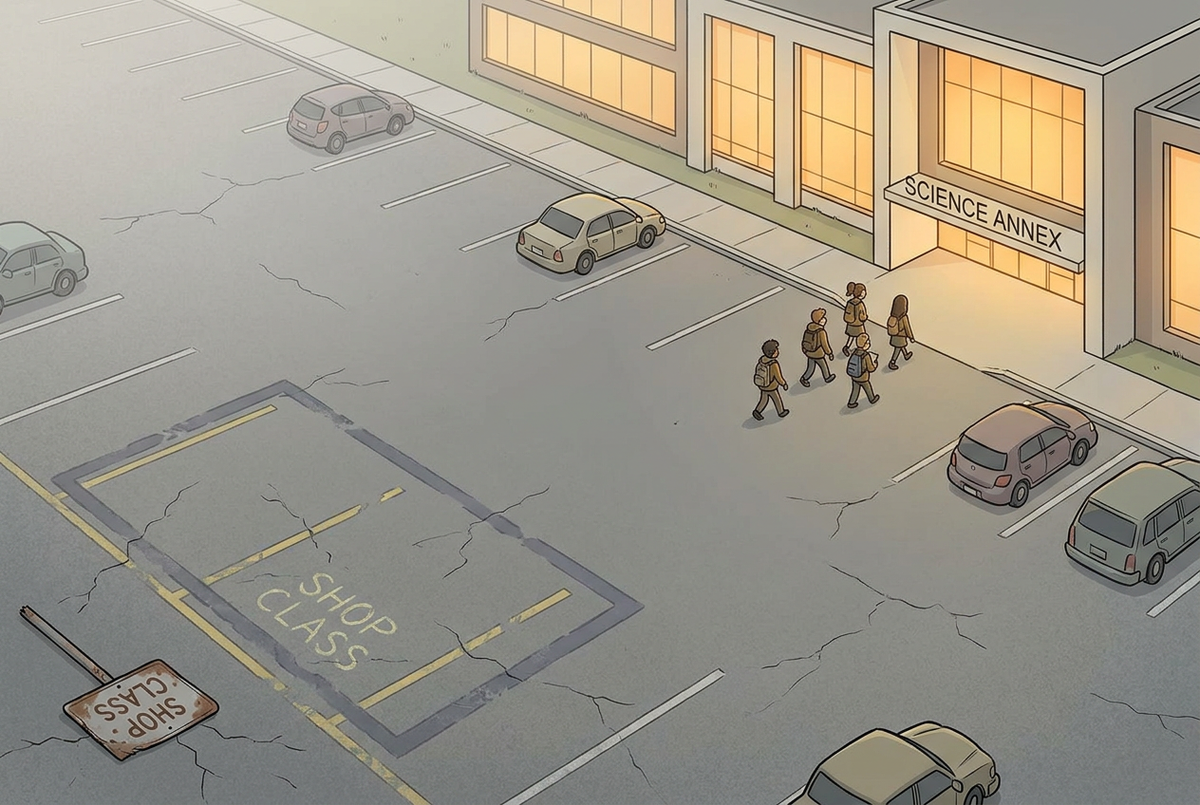
This is part 2 of a series on how the Boys are Not Alright.
In 2013, I went back to my high school in Silicon Valley for my 30th reunion. I graduated in 1983, and the place had changed in the ways you'd expect — updated facilities, different signage, the general patina of institutional renovation that accumulates over three decades. But two things stopped me cold.
The first: a new science annex had consumed roughly half of what used to be the student parking lot. Which was explained to me, casually, as no longer necessary — so few students drive to school now that the space was available. In 1983, the parking lot was a social ecosystem. In 2013, it was a building site. Make of that what you will about how adolescence has changed.
The second thing: the three shop classes were gone. Auto shop, wood shop, metal shop — the whole complex, replaced. Not neglected or defunded into irrelevance. Gone. The physical space repurposed, the equipment cleared out, the instructors long since moved on.
I want to be precise about what those shop classes were in 1983, because the way they get discussed now — when they get discussed at all — tends toward nostalgia that misses the actual point. They weren't a consolation prize for kids who couldn't hack the academic track. They weren't a dumping ground. Being a shop kid wasn't a mark of failure. It was a viable identity with a visible path: you learned to work with your hands, you got good at something concrete and useful, and there were jobs — real jobs, union jobs, dignity-and-a-mortgage jobs — waiting on the other side of that skill set.
By 2013, that entire philosophy had been erased from my high school's physical footprint. Not gradually. Completely.
The science annex was lovely, by the way. Genuinely impressive facility. I'm not making an argument against science education. I'm making an argument about what disappeared to make room for it, and who paid the price.
How The Mantra Got Built
The college-for-all consensus didn't arrive fully formed. It was constructed, over roughly three decades, through a confluence of policy decisions, institutional incentives, and cultural pressures that nobody designed as a unified project but that produced one anyway.
The postwar GI Bill generation established the template: college as the pathway to middle-class stability, available to people who wouldn't previously have accessed it. That was a genuine democratization and it worked. The problem is that the lesson extracted from it — college good, more college better, college for everyone — was a category error. The GI Bill worked in an economy that needed the credential output it was producing, for a generation whose alternative was farm labor or factory work, in an era when a state university education cost something a working family could actually absorb.
None of those conditions persisted, but the mantra did.
The Clinton-era "School-to-Work" reorientation, No Child Left Behind and its singular obsession with academic assessment metrics, the systematic defunding of Perkins Act vocational programs — these were bipartisan policy decisions that together accomplished something neither party explicitly intended: they made the college track the only track that received institutional investment, cultural validation, and adequate funding. The vocational pathway didn't lose a policy fight. It lost the budget, the physical infrastructure, and the cultural standing simultaneously, over twenty years, and by the time anyone looked up, my high school's parking lot had a science annex on it.
The parental psychology followed the institutional logic and then amplified it. Once enough employers required degrees for jobs that previously didn't need them — partly for skill reasons, mostly as a cheap screening mechanism — the degree became defensive. You needed it not because it taught you what the job required but because not having it got your resume filtered out before a human being looked at it. Parents internalized this. Steering a capable kid toward a trade stopped feeling like a reasonable choice and started feeling like giving up on them. By the late 1990s, in communities like the one I grew up in, it had metastasized into something close to shame.
That parental psychology is not irrational, given the incentive structure it was responding to. It is, however, a self-fulfilling disaster at scale.
The Credential Inflation Spiral
Once the degree became defensive, the spiral became self-reinforcing in ways that have no natural correction mechanism.
More people pursuing credentials for defensive reasons means more credentialed people competing for the same pool of jobs. Employers respond to credential surplus by inflating the credential requirement — administrative positions that required a high school diploma in 1975 required an associate's degree in 1995 and a bachelor's degree in 2010. Which pulls more people into college for defensive reasons. Which inflates the requirement further. Which pulls more people in.
The people at the bottom of the credential hierarchy — lower-tier schools, less marketable majors, students who worked during school and took longer to finish, students who enrolled and didn't complete — bear the full cost of this spiral while the institutions that sold them the credential bear essentially none of it. A for-profit university that takes $40,000 in federal loan money from a first-generation student and delivers a credential that the labor market treats as worthless has committed what would, in any other consumer context, be considered fraud. In higher education, it's a business model.
The student debt crisis is the financial scar tissue of this spiral. The outstanding federal student loan balance sits north of $1.7 trillion. A significant chunk of that represents people who were told the credential was the path and took on debt to walk it, and are now discovering that the path didn't go where advertised. The institutions that told them that are largely fine.
The Higher Education Industrial Complex
Here is the thing about the college-for-all consensus that doesn't get said directly enough: it has powerful institutional beneficiaries who have spent considerable money and lobbying effort making sure it persists.
Universities are businesses. They have bond ratings, endowments, construction projects, administrative payrolls, and athletic programs to fund. Enrollment is revenue. The student loan system — in which the federal government essentially backstops unlimited borrowing for attendance at accredited institutions, with minimal accountability for whether the credential delivers the promised return — is an extraordinary gift to those businesses. It socializes the lending risk while privatizing the tuition revenue, and it requires a continuous supply of students willing to take on debt to attend.
The lobby that protects this arrangement is substantial and bipartisan. The Obama administration made genuine moves toward accountability — gainful employment regulations that would have tied federal loan eligibility to whether programs actually produced graduates who could repay their loans — and got fought to a standstill by the higher education lobby before the regulations were gutted by the subsequent administration. The accountability mechanism that would have created market feedback on whether the credential was worth the debt was killed precisely because the industry understood what that feedback would show.
This is not a left-right story. It is an institutional interests story. The higher education complex, like the agricultural complex and the defense complex, has successfully captured enough of the policy apparatus to protect its business model from the market correction that would otherwise have happened fifteen years ago.
What Was Lost — And Who Lost It
The shop classes were not just a curriculum option. They were a philosophy about what paths to dignity looked like and who was entitled to walk them.
The German and Swiss apprenticeship systems — which produce electricians, machinists, and software technicians through structured employer-integrated training, with genuine labor market status and wages attached — work because they are philosophically grounded in the premise that skilled technical work is not a lesser category of human activity. A German master tradesperson has social standing, economic security, and institutional recognition that has no American equivalent. The system has been continuously supported across sixty years of political turnover because it is embedded in employer associations, unions, and educational institutions that all have stakes in its continuation.
America's vocational pathway never had that institutional embedding, which made it vulnerable to exactly the kind of defunding and status erosion that happened. And because the people it served — non-college-bound working class kids, disproportionately male, disproportionately from communities without political leverage — had no organized institutional voice, nobody fought particularly hard when it was dismantled.
The trades didn't disappear. The labor shortage in skilled trades is real and getting worse — plumbers, electricians, HVAC technicians, welders. The wages are solid. The work is meaningful. The career trajectories are genuine. What disappeared was the institutional pathway and the cultural standing that would have made the trades a legible option for young men coming out of high school without a clear sense of where they were going.
A young man in 2025 who might have been a proud union tradesperson in 1975 has no clear equivalent identity available to him. The institutional infrastructure that would have recruited him, trained him, and given him a community was quietly cleared away to make room for a science annex.
The Politics of the Vacuum
Here is where the college-for-all catastrophe connects back to everything we discussed in Post 1. The young men left behind by this system — economically stranded, institutionally unserved, culturally invisible in the policy conversation — are the exact population the manosphere pipeline recruits from. Not because the pipeline is clever, but because it is the only thing talking to them.
The progressive policy agenda on education has centered, with considerable moral seriousness, on student debt relief, on equity in access to higher education, on the particular burdens facing first-generation college students. These are real issues that deserve the attention they've received.
But student debt relief is a policy that primarily benefits people who went to college. It has nothing to say to the young man who didn't go, or who enrolled and dropped out, or who looked at the debt-to-credential calculation and correctly assessed that it didn't work for him, and who is now working a job that pays badly, lives alone, and has no particular institutional reason to believe that the political party claiming to represent working people has any idea he exists.
The Republican answer to this young man is a villain — immigrants, feminists, the globalist elite — and a permission structure for the resentment he already feels. It is a terrible answer that makes his actual situation worse. It is also, currently, the only answer he's being offered by anyone who seems to take his situation seriously, which tells you something important about the failure on the other side.
The college-for-all catastrophe didn't just destroy a vocational pathway. It produced a generation of young men with legitimate grievances, no institutional advocate, and a political culture that is either actively exploiting their anger or studiously ignoring the conditions that produced it.
The parking lot had plenty of room. We just decided to build something else.
Next: Unable, Unwilling, or Playing a Rigged Game? — The disaggregation piece. Elite men are fine. Professional class men are competing on a changed field. Working class men are structurally stranded. And the question of whether MAGA is, functionally, affirmative action for white men that doesn't call itself that.