
The Architects of the Rubble
How the Never Trump Brain Trust Built What They're Now Selling You Protection From

Jonathan V. Last published a piece (PDF since it is paywalled) on June 25th that is worth your time. He digs into a new Johns Hopkins Agora Institute study — researchers embedded with actual Trump voters in Wyoming, Michigan, and South Carolina for months, had real conversations, did real ethnography — and surfaces the finding that 14 out of 21 participants had an immediate negative reaction when asked about democracy.
JVL's takeaway is bleak and correct: these voters have built a coherent alternative theory of political legitimacy organized around faith, community, and the explicit belief that majority rule is a threat to the righteous minority they believe themselves to be. They don't want democracy. They want minority rule. They're not confused about this. They've thought it through.
And then JVL asks the question that his entire apparatus has been asking since 2016: how did these people get this way? Can we reach them? How can I be optimistic about them?
These are reasonable questions. They're just being asked by people who have very specific, very traceable answers to the first one — answers they have organized their entire post-Republican careers to avoid examining.
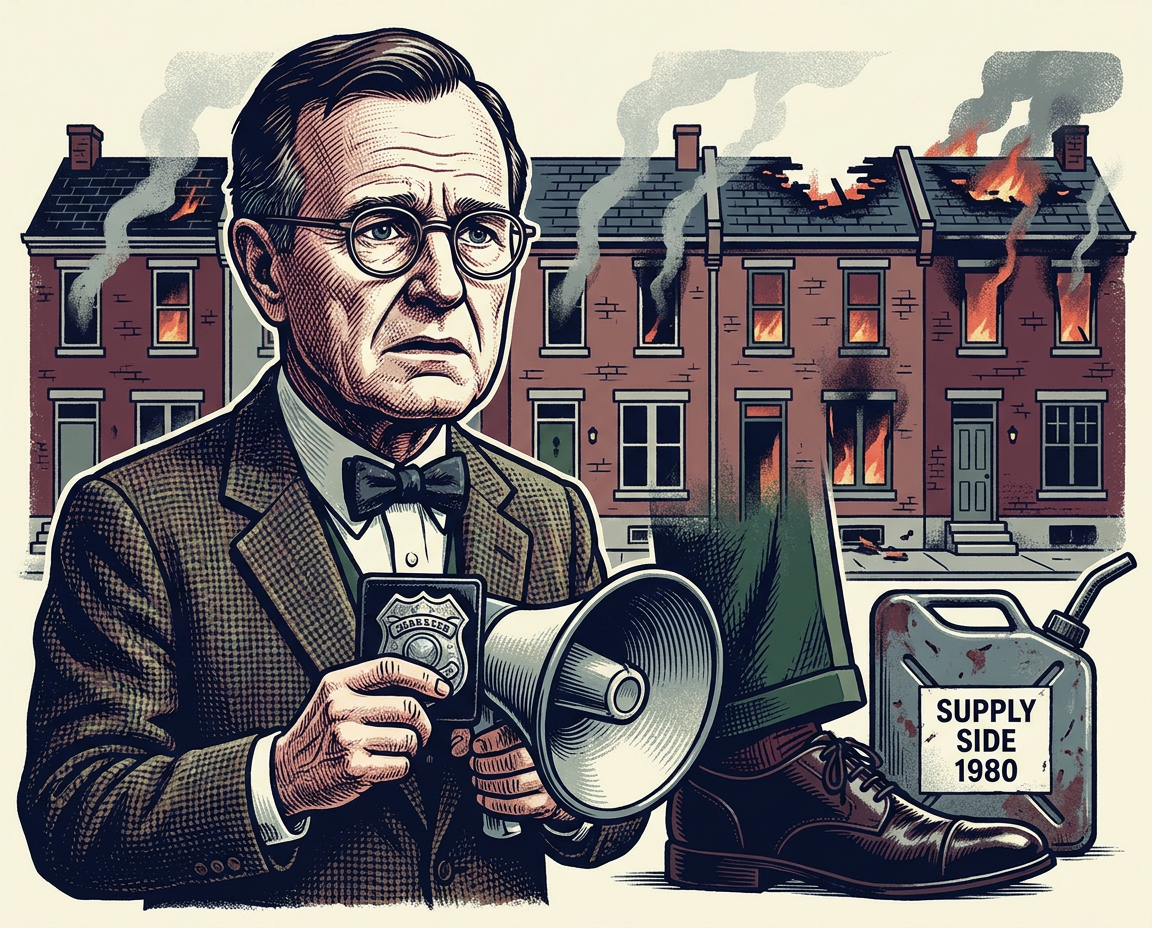
Here's what the fire marshals aren't telling you: they set the fire.
The Diagnosis They're Selling
It's not wrong. It's just missing the most important chapter.
The Never Trump narrative about what happened to the Republican base goes roughly like this: the party was captured by bad actors. Bannon weaponized resentment. Fox News radicalized the elderly. Social media algorithms fed the beast. Trump exploited latent authoritarian tendencies that respectable conservatism had always kept in check. The people who saw it coming — the Kristols, the Schmidts, the Longwells, the Sykes — warned that this was where things were headed and weren't heeded.
All of this is partially true. Carefully curated. And missing the prior act entirely.
The Never Trump apparatus's authority claim rests specifically on their Republican credentials. They know this movement because they built it. They have unique insight into the base because they spent decades cultivating it. They're credible validators of democratic norms because they were once credible validators of conservative governance.
Which is precisely the thing that cuts the other way.
You don't get to be the expert witness on the crime scene if you're also the one who committed the crime. Or rather — you can be, but the jury deserves to know the full context before you start testifying.
What They Actually Built: The Economic Leg
These aren't mysterious outcomes. They're receipts.
Let's run the specific bill of particulars, because the piece these people are never going to write requires specificity.
Trade liberalization and the destruction of manufacturing communities. NAFTA and its successor agreements didn't happen to the Republican base. They were championed by the intellectual apparatus of which the Weekly Standard wing was a central pillar. The argument — comparative advantage, creative destruction, the efficient reallocation of labor toward higher-value activities — was made with contemptuous confidence toward anyone who raised concerns about what was being destroyed. Those concerns turned out to be right. The reallocation never happened at the scale or speed the models predicted. The communities that absorbed the losses while the professional class captured the gains didn't radicalize randomly. They radicalized specifically, in direct proportion to the gap between what they were promised and what they got.
Farm consolidation and rural economic decimation. USDA policy, agricultural credit structures, the systematic favoritism toward industrial operations over family farms — this was Republican-dominated policy over decades. Farm bankruptcies hit eight-year highs in 2019. Average farm operator income trended negative for a sustained period. The people in Wyoming and South Carolina sitting in front of Hopkins researchers talking about institutions failing them are living in the measurable aftermath of specific policy choices with specific political patrons.
The opioid epidemic as regulatory failure. The DEA's distribution monitoring program was gutted. The FDA's approval process was corrupted. State medical boards were captured. Purdue Pharma's political protection was bipartisan but skewed in a specific direction. The harm landed on rural communities at disproportionate scale — communities that had no institutional cushion to absorb it, because the institutional cushion had been theorized away as inefficient. Every person in those communities who lost someone to OxyContin while regulators looked the other way has a legitimate grievance. The Never Trump narrative has no place for that grievance because accounting for it requires accounting for who ran the regulatory apparatus when it failed.
Rural hospital closures as a direct consequence of Medicaid expansion refusal. This one is almost too clean. The closures accelerated specifically in states that refused expansion. Republican governors and legislators made that choice in direct response to the base that is now furious about being medically underserved. The institutions failed them because the politicians they voted for refused the institutional resources that would have prevented the failure. The causal loop is tight, documented, and completely absent from the Never Trump self-accounting.
These are not acts of God. They are the predictable consequences of specific policy choices made by specific people who are now on your podcast circuit explaining how the base lost its mind.
What They Actually Built: The Ideological Leg
The economic damage alone doesn't get you to the Hopkins study. The framework that prevented attribution is equally load-bearing.
The Friedmanite economic framework didn't just produce bad outcomes. It produced a specific epistemological architecture designed to make those outcomes unattributable to their actual causes. "Government is the problem" isn't just a slogan. It's a closed interpretive system. When rural hospitals close, the framework says government failed you. When farm prices collapse, the framework says regulation strangled you. When manufacturing leaves, the framework says coastal elites sold you out. Every bad result confirms the original premise. The system was specifically engineered to survive outcomes data.
This framework required a legitimizing intellectual layer to achieve the cultural penetration it achieved. That layer was provided by the Weekly Standard, the Public Interest, the network of credentialed conservative commentators who made anti-government radicalism sound like serious policy analysis rather than just Grover Norquist wanting to drown the administrative state in a bathtub. Without that validation, it's just ideological grievance. With it, it becomes the common sense of an entire political coalition that meets every week in churches across rural America and processes every bad outcome through its lens.
The contempt was part of the product. The Brooks/Kristol/Weekly Standard aesthetic wasn't just intellectually confident — it was specifically contemptuous toward anyone who raised concerns about distributional consequences. Protectionists were rubes. Union advocates were dinosaurs. Anyone attached to the economic ecosystems being destroyed was romantically sentimental about an inefficient past. This condescension wasn't incidental to the project. It was load-bearing in the MAGA origin story. When Trump pointed at the experts and the elites and the people who thought they knew better, he was pointing at something real. The something real had a green room at MSNBC and a subscription to The Atlantic and a very clear memory of calling your grandfather a rube for worrying about what NAFTA would do to his town.
The Founding Document Nobody Wants to Cite
Irving Kristol put it in writing. His son built a career on never mentioning it.
Here is the specific genealogical receipt that makes this more than an opinion column.
Irving Kristol — Bill's father, the founding figure of neoconservatism, the person who platformed Arthur Laffer and kicked off the supply side revolution — was explicit about what he was doing in ways that his successors never acknowledge. He didn't claim the Laffer Curve was sound economics. He claimed it was useful politics. He argued, in print, that supply side economics was valuable not because it was necessarily correct as a description of how economies work, but because it was politically effective as a framework for achieving ideological goals. The deficit explosion was a feature, not a bug — "starving the beast," draining government of the revenue it needed to provide the services that made people dependent on it.
George H.W. Bush correctly called it voodoo economics in 1980. He was right. He got punished for being right, lost the primary, won the presidency, governed with the consequences of the voodoo, and eventually lost to Clinton partly because the deficit he inherited from Reagan's experiment required tax increases that his base — the base the voodoo had cultivated — never forgave.
The Never Trump apparatus celebrates Bush 41 now as a dignified institutionalist representing the conservatism they want to restore. They don't mention that their intellectual forebears called his accurate economic analysis a betrayal and helped primary him. They don't mention that the "voodoo" he identified became the unkillable zombie framework that has governed Republican fiscal policy for forty years, exploded deficits in every Republican administration since, and provided the "starve the beast" justification for cutting the rural services, hospital funding, and agricultural supports that the Hopkins study participants are now furious about losing.
The napkin Laffer sketched his curve on has a straight line to Wyoming. Irving Kristol drew the route. Bill inherited the map and spent twenty years celebrating the scenery.
The Celebration, Not the Mistake
"We made some policy errors" is the wrong frame. Try "we were ecstatic about what we were building."
What has to be said plainly, because it never gets said plainly, is that these people were not reluctant pragmatists making difficult tradeoffs with heavy hearts. They were triumphalists. They had won the argument. Friedman had solved the equation. History had ended. The Weekly Standard wasn't a journal of cautious technocratic analysis hedged with concern for the communities being restructured out of economic viability. It was a victory lap publication, week after week, year after year.
The columns weren't "this trade liberalization involves painful tradeoffs we should monitor carefully." They were "this is morning in America again and the people who don't understand it deserve to lose the argument." The tone was celebratory because the belief was total. They had built a new order. The people living in the rubble of that order were on the wrong side of history and would adapt or be replaced by something better.
"Adapt or be replaced" is the thing that needs to be said out loud, because it was the actual operating premise. The Friedmanite framework didn't merely ignore distributional consequences — it theorized them away. Acceptable losses on the way to a more efficient economy. The communities destroyed were inefficient. The jobs lost were jobs that shouldn't have existed in the efficient equilibrium. The people whose lives were organized around those jobs and those communities were invited to retrain, relocate, and participate in the glorious new knowledge economy that was definitely coming.
It didn't come. Not for them. Not at any scale that mattered. And the people who told them it was coming, with such confident contempt for their doubts, are now on your television explaining how those same people lost their attachment to democratic norms.
The Psychological Architecture of Non-Accountability
The Cassandra self-image is doing a lot of work here.
These were genuinely important people for a meaningful period. Their phone calls mattered. Their publications shaped policy. Their endorsements moved primaries. They were not delusional about their importance — they were important.
What happened is that the movement they built outgrew them and discarded them. And they have spent the years since constructing an elaborate psychological framework that explains this as the movement's failure rather than their own. The framework requires them to remain important as validators and analysts, because if they're not important, the entire story they're telling about themselves collapses. They're not failed architects of a forty-year radicalization project. They're Cassandras who warned and weren't heeded.
The commercial incentive structure cements the revision in place. Their subscriber base and donor base run on Democratic existential anxiety. A Democratic Party winning confidently and not needing their guidance is bad for the product. Every outcome gets processed as confirming their relevance — Democrats lose because they didn't listen, Democrats lose because they listened wrong, Democrats win because the coalition Never Trump helped build was decisive. The framework has no failure condition for them. Only for the Democrats who did or didn't comply.
Here is the thing worth sitting with: this epistemological structure is identical to the one operating in the communities JVL is writing about. Both are self-sealing systems. Both have answers for every outcome that confirm the original premise. Both require the threat to remain ongoing to sustain the framework. The MAGA version is cruder, more dangerous, and more honest about what it is. The Never Trump version is more genteel, more credentialed, and more welcome on cable news. The architecture is the same.
They built one closed loop. They're operating inside the other. They will never see the parallel because seeing it would require the reckoning the entire operation was constructed to avoid.
What Honest Accounting Would Actually Require
Not contrition. Just specificity.
It doesn't require sackcloth and ashes. It doesn't require these people to flagellate themselves on their podcasts. It requires something much simpler and much harder: saying what is true.
We didn't merely advocate for these policies. We celebrated them. We were ideological triumphalists who used the language of economic science to dress up what was, as Irving Kristol helpfully acknowledged, a political project. We provided the intellectual legitimacy layer that made Laffer's napkin economics sound like serious governance. We built the framework that made attribution of the resulting damage to its actual causes nearly impossible — because the framework was specifically designed to make government failure the explanation for every outcome, including the outcomes our own preferred policies produced.
We cultivated a base using tools and rhetoric that were always available to someone more extreme than us. We assumed our gentility was structural rather than contingent. We were wrong about that. The base we built didn't belong to us. It belonged to whoever could most convincingly perform the role it had been trained to need. Trump understood that. We were shocked.
The shock is the tell. You don't get to be shocked by the predictable consequences of what you built with such evident satisfaction. The communities in the Hopkins study are not a mystery. They are the documented, measurable human outcome of forty years of economic and ideological construction that had specific architects with specific names who wrote specific things in specific publications that still exist in searchable archives.
JVL asks how he can be optimistic about the voters in the study.
That's the wrong question. The right question is how we got here, and who specifically built the road.
The answer has a byline. Several of them, in fact. You can look them up.
Like what you've read? Subscribe to Sweaty's Corner for more of this kind of thing. If you can't do paid, buy me a coffee — it keeps the lights on and the bile flowing.
Like what you've read, but not able to switch to paid? Why not buy me a coffee instead! All money goes to help defray the expense of running the site.