The Campaign and the Reckoning
A Republican governor and a Democratic Assembly Speaker teamed up to raise the sales tax, the top bracket, and sin taxes all at once. Big government built this one together.

Series: The Fulcrum — Book Two: The Performance, Act One: Governorship, Episode One
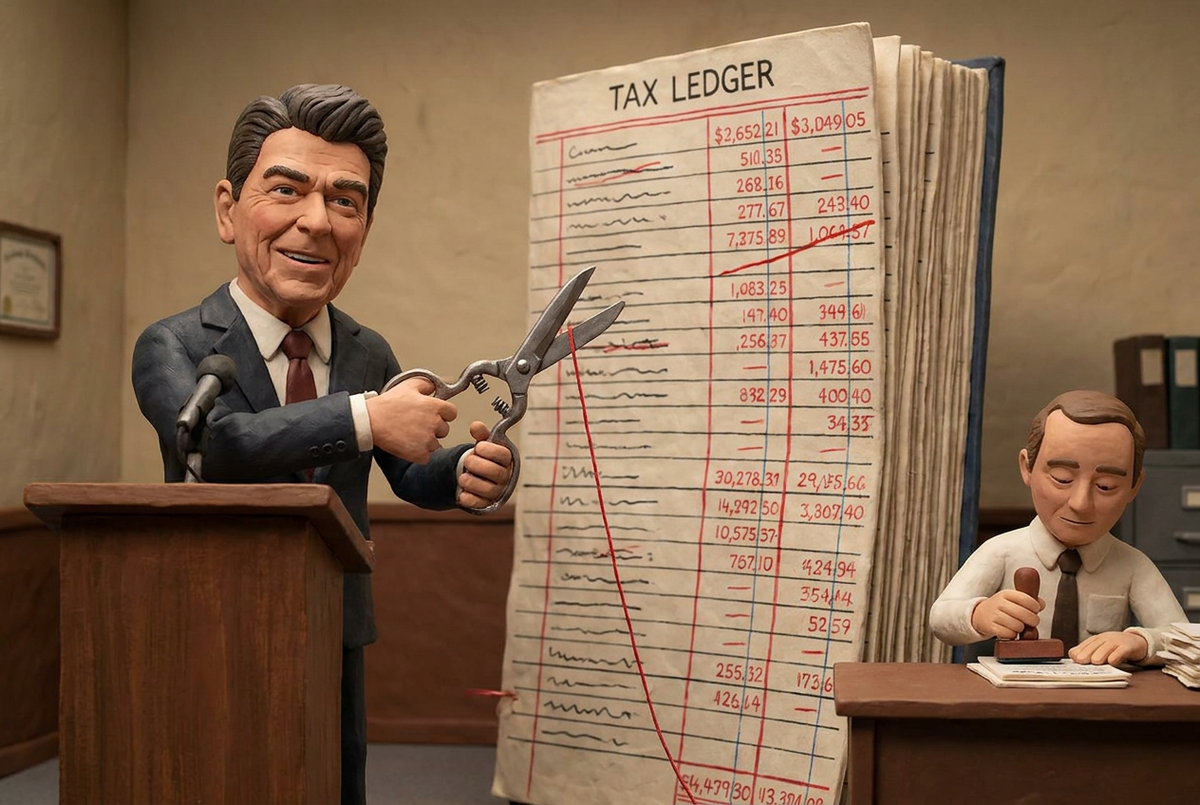
On the trail in 1966, Ronald Reagan told California he had a simple plan for Sacramento: squeeze, cut, and trim. Eleven months into office, he signed what Lou Cannon, the reporter who covered him most closely across four decades, called "the largest tax hike ever proposed by any governor" in American history. The candidate who ran on shrinking the state ended up expanding its revenue base further and faster than the man he'd just beaten.
The Citizen Politician, Briefly Revisited
The 1966 campaign built the frame; this episode just needs the reminder before it breaks it.
The "citizen politician" image from the 1966 race is already on the record here: the outsider positioning, the backlash against the Berkeley protests that Reagan turned into a law-and-order applause line, Pat Brown treating him as an actor who'd wandered out of his depth and getting a landslide for the mistake. None of that needs rebuilding. What matters for this episode is what it set up, a governor elected on the explicit promise that professional politicians had let spending get out of control, and that a businessman's discipline would fix it.
The Reckoning
Eleven months later, the discipline turned out to run in the other direction.
Reagan inherited a state budget deficit from the Brown administration, and the fix he landed on wasn't the squeeze he'd promised, it was a negotiated deal with Jesse "Big Daddy" Unruh, the Democratic Assembly Speaker who'd spent the decade building the legislature into a professional, full-time institution and using his leverage to protect education and anti-poverty spending. Working with the Speaker whose entire political project Reagan had campaigned against in spirit, the two men produced a 1967 tax package that raised the sales tax from 3% to 5%, pushed the top income bracket from 7% to 10%, and raised liquor and cigarette taxes on top of that. Cannon's assessment wasn't hyperbole for effect, it was a factual description: "the largest tax hike ever proposed by any governor" in the country's history to that point. Reagan did impose a state hiring freeze, the one piece of the campaign promise he kept in form. It didn't matter much in substance. Overall state spending rose roughly 9% anyway.
This is worth sitting with rather than rushing past, because it's not an isolated inconsistency, it's a rehearsal. The same man will run the identical play nationally fifteen years later: campaign on cutting government, govern into a deficit that forces a tax increase larger than the one that preceded it, and let the fiscal conservatism brand survive the contradiction mostly intact. Sacramento in 1967 is the training run. Washington in 1982 is the same move at a different scale, with Stockman standing in for Unruh as the person who said the quiet part out loud.
Sweaty's Corner doesn't have a marketing budget or an algorithm pushing it into anyone's feed. It has readers who share it. If this one landed, sending it to someone who'd get something out of it — or subscribing so the next one finds you directly — genuinely moves the needle.
The Ego Beat
Less than two years into the only elected office he'd ever held, the reluctant citizen politician was already running for a bigger one.
On August 5, 1968, three days before the Republican National Convention opened in Miami, Reagan accepted a hastily organized "draft" and entered the presidential race as a conservative alternative to Nixon. The stated logic was to cut into Nixon's Southern support1 and position himself as the compromise candidate if the convention's first ballot failed to settle things. He and Nelson Rockefeller discussed combining their delegates against Nixon and couldn't agree on who would defer to whom, which killed the idea before it started. Reagan arrived with 192 delegates, almost entirely his own state's, took 182 votes on the first ballot, and watched his count collapse to 2 the moment Nixon secured the nomination outright with 692.
It didn't work, and it was never especially likely to. What it reveals matters more than whether it succeeded: the "citizen politician" who'd spent 1966 insisting he was a reluctant amateur drafted into service was, by the summer of 1968, maneuvering for the presidency with less than two years of governing experience behind him. That tension, performed reluctance sitting directly next to real ambition, doesn't resolve here. It just surfaces for the first time since he took office, and it'll keep surfacing for the rest of this trilogy.
A tax cutter who delivered the largest tax increase of his era, campaigning for a bigger job before he'd finished the one voters had just given him. Neither contradiction cost him anything politically. That's the part worth remembering going into the episodes that follow.
Note: Next up, we go into the start of the strict firearm laws and how Reagan's libertarian "A Time for Choosing" was really a farce when he was faced with open carrying protesters who happened to have a high melanin content. Don't miss it!
The rest of this series is landing under The Fulcrum as it publishes.
Keep the lights on
Like what you've read, but not able to switch to paid? Why not buy me a coffee instead! All money goes to help defray the expense of running the site.

1 - the start of the southern strategy. We will see more of this in the series...