Same Fire, Different Fuel
The Panthers were a civil rights answer to police violence. The Weathermen were a Vietnam answer to a war that wouldn't end. Everyone keeps mashing them into one story. That mashing isn't an accident, and it erases exactly what each group was actually responding to.

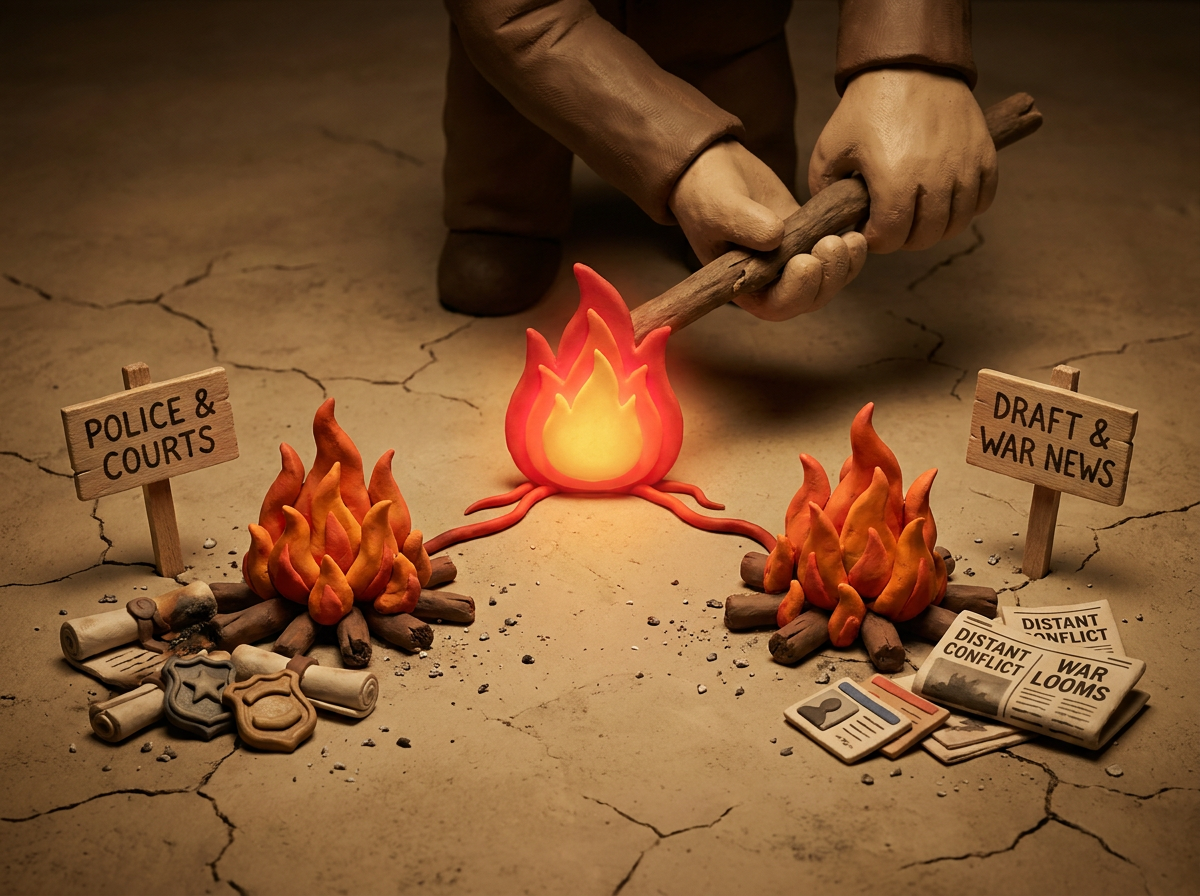
Everything in this series so far has been about institutions managing the backlash to civil rights: appointees, file cabinets, barbed wire, tax law. This installment flips the lens. It's about what happened when people stopped waiting for institutions to fix anything and built armed ones of their own instead. And it's about untangling two groups that get lazily mashed into one undifferentiated "1970s left-wing violence" story, a flattening that both the modern left and the modern right have their own reasons for finding convenient, and that erases what each group was actually responding to in the process.
The Panthers Are a Civil Rights Story
Huey Newton and Bobby Seale founded the Black Panther Party in Oakland in October 1966, and the immediate triggers were local and racial, not international. The police killing of a Black teenager named Matthew Johnson, Malcolm X's assassination the year before, and the broader conditions, poverty, housing discrimination, relentless over-policing, that had already produced the Watts uprising in 1965.
The Ten-Point Program reads less like a break from the civil rights movement and more like its continuation by other means: housing, education, an end to police killings, the same demands the movement had been making for a decade, now pursued through armed self-defense instead of petition and boycott, after a lot of people had concluded petitions and boycotts had taken them about as far as they were going to go.
Even their anti-draft position inverts the framing people usually assume. Vietnam entered Panther politics as a civil rights argument, not the reverse: Black Americans being sent to die for a country that denied them full citizenship at home. That's a civil rights critique wearing an anti-war costume, not an anti-war group that happened to also care about race.
The Weathermen Are Almost Entirely a Vietnam Story
The Weathermen came out of the 1969 collapse of Students for a Democratic Society, a group that started in 1960 focused on civil rights and poverty and pivoted hard toward anti-war organizing as the draft and the body counts climbed after 1965. The Weathermen were the faction that decided legal protest had failed to stop the war and that armed insurrection was the only option left on the table. The name comes from a Bob Dylan lyric. Their manifesto is anti-imperialist Marxism aimed squarely at the war machine.
Their signature action, the October 1969 Days of Rage, was explicitly an anti-war riot, not a racial justice action. To be fair to them, they did fold language about racism and solidarity with Black liberation into their politics, and it's worth taking that seriously rather than dismissing it outright: some of it was genuine ideological conviction, and some of it was borrowing the moral standing of a movement with more public legitimacy than a bunch of mostly white college radicals rioting over the draft. Both things were probably true at once, which is a more honest read than picking one and pretending the other doesn't exist.
1968, the Year Both Fuses Got Lit
Neither group emerged from the other, but they do share a hinge moment. King's assassination in April 1968 convinced a lot of civil rights activists that nonviolence had hit a wall. The same year, Vietnam was cratering LBJ's presidency and radicalizing campuses after the Tet Offensive. Two entirely separate grievances tipped toward armed action within roughly the same twelve months, which is close enough to look like a shared origin from a distance, even though the actual causal chains run through completely different histories.
The State's Hand Wasn't on Both Scales Equally
COINTELPRO targeted both groups, and this is where the series' throughline snaps back into focus: the same apparatus we've spent four installments watching manage the backlash to civil rights turns out to be the same apparatus managing the movements that grew out of civil rights' perceived failures. Same file cabinets, different targets.
But the state's response wasn't symmetrical, and treating it as though it was does both groups a disservice. Fred Hampton's killing in a 1969 Chicago police raid is the starkest, most lethal example of what the state was willing to do to the Panthers specifically. The Weathermen were surveilled and infiltrated too, but nothing in their experience matches a Chicago police squad shooting a 21-year-old organizer dead in his bed. Any framing that treats "the left" as a monolith facing uniform state pressure in this period is quietly erasing that gap.
Why the Flattening Happens
Both today's left and right have their own reasons for blurring the Panthers and the Weathermen into one interchangeable story. It's useful to the right because it inflates the scale and coherence of a unified radical threat, one big scary "the left was committing terrorism" narrative instead of two much narrower, much more specific movements. It's useful to parts of the left, less obviously but just as real, because folding the Panthers into a broader, mostly-white anti-war narrative can launder a civil rights lineage into something that reads as more universally palatable than it actually was, at the cost of flattening exactly what made the Panthers distinct in the first place.
The actual distinction is the payoff here, and it's worth stating plainly: civil rights backlash produced the Panthers pretty directly. Vietnam produced the Weathermen pretty directly. Treating them as interchangeable doesn't just get the history wrong, it erases what each group was actually responding to, and understanding either one honestly requires keeping that apart.
This is Part 5 of The Backlash Machine, tracing a hundred-plus years of the same recurring move: American institutions, progressive and reactionary alike, managing racial hierarchy through mechanisms diffuse and technocratic enough that nobody involved ever quite has to say the quiet part.
Part 1, on Woodrow Wilson, is here. Part 2, on the Sovereignty Commissions, is here. Part 3, on Leander Perez, is here.Part 4, on the IRS and the religious right, is here. Next up: the decade America apparently forgot it was bombing itself.
Like what you've read, but not able to switch to paid? Why not buy me a coffee instead! All money goes to help defray the expense of running the site.