
The Generational Replacement Myth
Series: The Boys Are Not Alright — And Nobody's Fixing It, Part 1 - Looking at why the generational demographic shift is a challenge

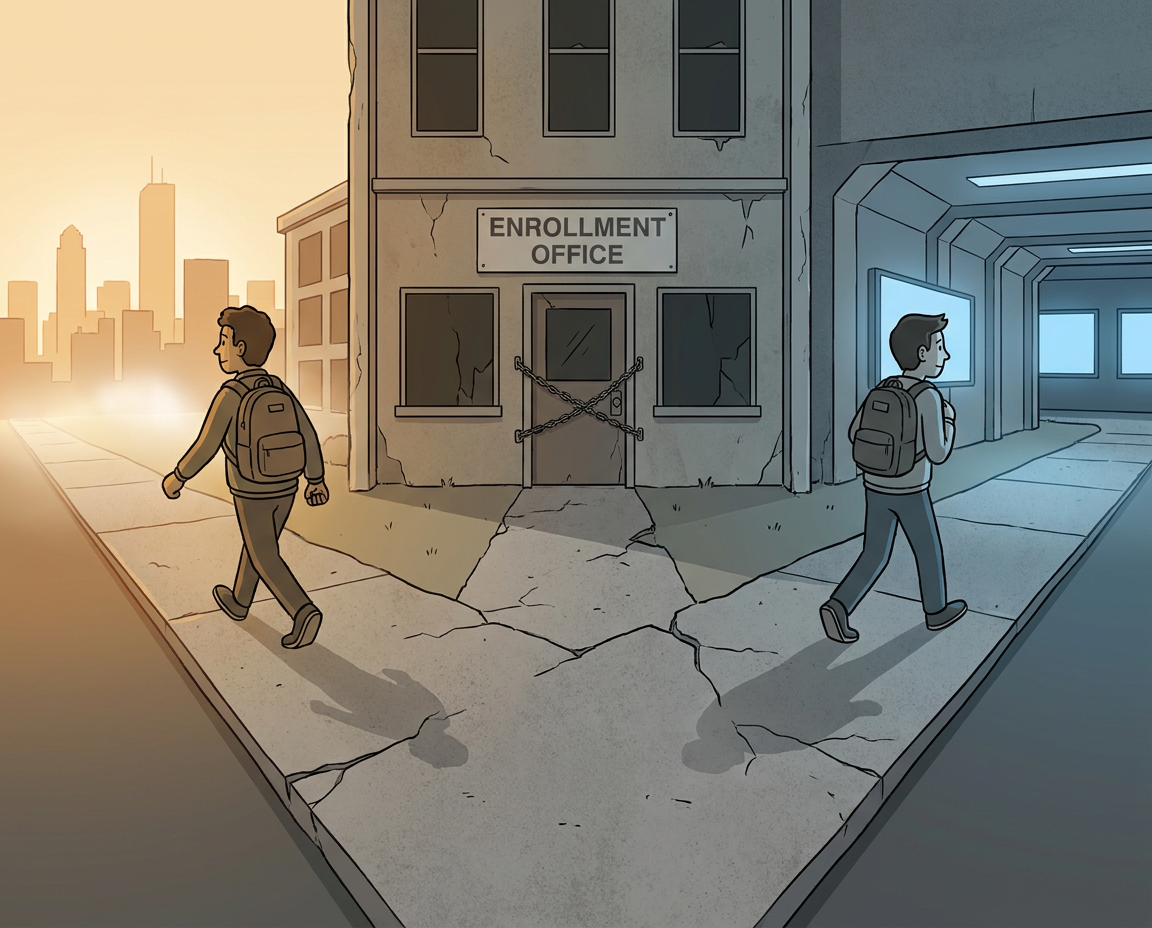
Part 1 of three loosely titled "The Men aren't Alright" the third batch of the Long Arc series.
I believed it. For years, I believed it with the comfortable confidence of someone whose social circle had basically converged on the same conclusion: demographics are destiny, the kids are alright, and the coalition of the future was assembling itself one birthday at a time while the Boomers who built MAGA slowly exited the electorate feet first.
It was a clean thesis. Elegant, even. And the 2024 election results came in and broke it in half.
Not because Trump won — though he did, and the rationalizations that followed were a spectacle in their own right. But because of how he won among young voters, and what the numbers said when you stopped aggregating "youth vote" as a monolithic category and actually disaggregated it by gender. The story that emerged was not the one the demographic optimists had been telling. It was considerably more complicated, considerably less reassuring, and — for a progressive political culture that has systematically avoided this conversation — a bill that has been accumulating interest for a decade and just came due.
The generational replacement thesis isn't wrong exactly. It's incomplete in ways that matter enormously. And the part that's missing is sitting right there in the data, waving its arms, if you're willing to look at it.
What The Thesis Actually Claims
The standard version goes like this: younger Americans are more racially diverse, more comfortable with that diversity, more supportive of LGBTQ rights, more skeptical of institutional religion, and measurably different from their grandparents on the questions of pluralism and democratic norms that the current political fight is actually about. As older, whiter, more culturally conservative voters exit the electorate through mortality, the electorate itself shifts. The math is inexorable. Give it time.
The evidence for the underlying attitudinal claims is real. General Social Survey data on racial attitudes shows consistent generational improvement across decades of measurement. Gen Z scores differently from Boomers on implicit association tests that are harder to game than self-reported surveys. The most racially diverse generation in American history genuinely holds more pluralist views on average than the generation it's replacing.
None of that is wrong. The problem is the "on average."
The Number Nobody Wanted To Say Out Loud
Here is what the 2024 exit data showed, across multiple methodologies and data sources: young women moved left. Young men moved right. Not marginally — substantially, in a pattern that shows up consistently whether you're looking at AP VoteCast, the NYT/Siena polling, or the academic post-election analyses.
The gender gap in political orientation among voters under 30 is now larger than the gap between young voters and old voters. Read that again. The thing that was supposed to be doing the corrective work — generational turnover — is producing a cohort that is internally more polarized by gender than any previous generation, in ways that cut directly against the replacement thesis.
Trump won young men. Harris won young women. The margin between them was not a rounding error.
This is not a domestic American quirk. The same pattern shows up in the UK, Germany, South Korea, and other countries with no direct analogue to American MAGA politics. Which means the explanation is not "Fox News radicalized young men" — at least not entirely. Something structural is happening, at scale, across different political systems and cultural contexts, that is pulling young men and young women in opposite ideological directions with historically unusual force.
The generational replacement argument, honestly stated, now reads: we are replacing one generation with a more progressive young female cohort and a more conservative young male cohort, and the net democratic tailwind is real but significantly smaller than advertised, and potentially shrinking.
That is a very different thesis from the one that's been circulating in liberal political circles for the past decade.
The Manosphere Is A Symptom, Not The Disease
The temptation at this point — and I've watched a lot of progressive commentators fall into it — is to diagnose the young male rightward shift as a radicalization problem. Andrew Tate, Joe Rogan, the incel pipeline, red-pill content farms. If we could just de-platform the bad actors, regulate the algorithms, get young men away from their screens and into healthy communities, the problem would resolve.
This is not wrong as far as it goes. The manosphere pipeline is real, it is doing real political work, and the specific content being pushed at isolated young men is genuinely toxic in ways that deserve sustained attention.
But treating it as the cause rather than a symptom is a category error that conveniently locates the problem somewhere outside the institutions and political culture that are actually responsible for creating the conditions. The manosphere didn't manufacture a population of lonely, economically stranded, purposeless young men out of thin air. It found them where they were — already isolated, already failing in the institutional environments that were supposed to serve them, already getting nothing from the political culture that claimed to speak for the marginalized — and offered them something.
The 'something' it offered is garbage. But the vacuum it filled is real, and filling vacuums with garbage is a lot easier than filling them with something better.
Here is what is actually happening to young men, in numbers that don't require the manosphere to explain:
Young men without college degrees are falling behind women without college degrees economically in ways that are historically new. Not because women took their jobs — because the jobs that provided dignity and decent wages without requiring college credentials largely disappeared, and the replacement economy rewards skill sets and institutional orientations that the credentialing pipeline serves women better than men, for reasons that are genuinely contested but genuinely real.
Male enrollment and completion rates in higher education have been declining relative to women for thirty years, and the gap is widening. The K-12 environment, in ways that serious education researchers across the ideological spectrum have documented, disadvantages the developmental profile that more boys present — extended sitting, heavy verbal processing, emotional regulation demands, minimal physical activity. This isn't destiny. Countries that restructured early education differently don't show the same collapse. Ours does.
The loneliness data is, frankly, alarming. Rates of young men reporting zero close friendships have multiplied. Social isolation, sexual inactivity, absence of community belonging — these are not peripheral lifestyle statistics. They are preconditions for radicalization that every authoritarian recruitment manual in history has understood and exploited.
A political culture that was paying attention would have noticed these trends fifteen years ago and built a response. The progressive political culture didn't, and the reasons why it didn't are worth examining with the same unflinching attention we're supposed to apply to everything else.
The Part That's Going To Piss Some People Off
The activist base of the Democratic Party — the people who show up to meetings, run for local office, staff campaigns, dominate the online discourse, and set the cultural tone of the coalition — is disproportionately composed of highly educated women, disproportionately but not exclusively women of color, with a value system and set of priorities that emerged from specific educational and professional experiences.
That is not a criticism. That cohort has legitimate grievances, genuine moral clarity on a lot of questions, and has done enormous work to move the political conversation in directions that needed moving.
It is, however, a description of a group with specific blind spots. And those blind spots map, with uncomfortable precision, onto the population of young men currently being lost to the resentment pipeline.
The discourse around masculinity in progressive spaces has been, to be blunt about it, bad. Not uniformly — there are people doing serious work on this — but preponderantly, and in ways that have political consequences. "Toxic masculinity" as a framing, whatever its analytical validity, lands on a struggling 22-year-old without a job and without friends as an accusation. The message received — not always the message sent, but the message received — is that his problems are his fault and also he's the problem. That is not a recruitment pitch. That is a reason to look elsewhere for someone willing to take your experience seriously.
The class dimension is consistently underweighted in progressive activist spaces in ways that are not accidental. The dominant demographic in those spaces is highly educated, professionally mobile, and culturally urban. Their intuitive read of "disaffected young man" tends toward cultural diagnosis — he's been radicalized, he has problematic attitudes that need to be corrected — rather than material diagnosis: he is economically stranded in an institutional environment that was not designed for him, is offering him nothing, and is asking him to show up anyway because the alternative is worse.
Both things can be true simultaneously. The cultural diagnosis and the material diagnosis are not mutually exclusive. But the cultural diagnosis crowds out the material one in practice, because the material one requires acknowledging that the coalition's policy agenda and rhetorical priorities have a significant population-sized gap in them, and that gap has been getting wider while everyone was talking about other things.
This is not an argument for abandoning the legitimate concerns of women and minorities to court disaffected young men. It is an argument that a political coalition serious about winning, and about governing, has to be able to hold more than one population's material reality in its head at the same time. The progressive activist base, at this particular cultural moment, is having significant trouble doing that. And the people paying the price for that failure are not the activists.
What The Replacement Thesis Actually Looks Like Now
Honest version: generational replacement is still a real democratic tailwind. It's just a smaller one than the optimists have been selling, it's moving slower, and it's running directly into a counter-current that the institutions responsible for addressing it have largely chosen not to see.
The young women entering the electorate are moving in the direction the thesis predicted. The young men are not, in numbers large enough and with momentum sufficient to meaningfully complicate the arithmetic.
And the mechanisms that are pulling young men rightward — economic dislocation, social isolation, institutional failure, a political culture that has nothing to say to them — are not improving. The data is getting worse, not better. The manosphere is bigger, not smaller. The economic conditions producing male disengagement are structural, not cyclical.
The replacement thesis assumed that the incoming generation would be shaped primarily by its diversity and its comfort with pluralism. It is also being shaped by a crisis of male purpose and belonging that nobody with institutional power is seriously addressing, and that the resentment project is expertly exploiting.
That crisis didn't come from nowhere. In the next post, we're going to talk about exactly where it came from — starting with a parking lot in Silicon Valley that used to be full of students and a building that used to have three shop classes.
Next: The College-For-All Catastrophe — how a bipartisan policy consensus gutted vocational education, inflated a credential bubble, and left a generation of young men with nowhere to go and a political culture happy to tell them whose fault it is.