The Oxidizer
Trump didn't blow up the Republican Party. He removed the rate limit. We're living with the consequences

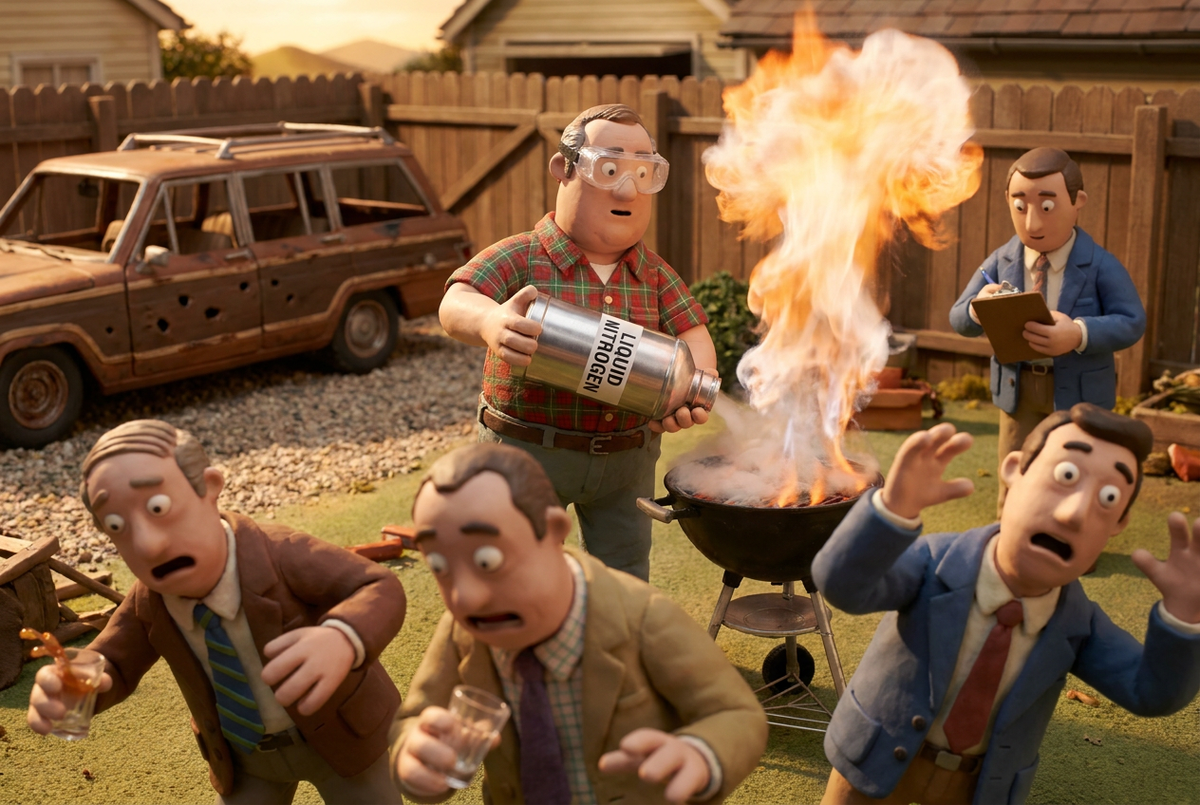
Sometime in the mid-1990s, a Purdue engineer named George Goble decided that charcoal took too long to light.
This is not a problem most people have. Most people accept that lighting a grill involves twenty minutes of standing around holding a beer, which is arguably the point of the exercise. Goble was not most people. Goble was an engineer at a research university with access to a dewar of liquid oxygen, and what he wanted to know was how fast a pile of charcoal could be persuaded to reach cooking temperature if you took the constraints off.
The answer turned out to be about three seconds.[1]
The pictures are still out there, and they are worth your time — sixty pounds of briquettes going from cold to incandescent in roughly the interval it takes to say the word "incandescent," accompanied by a fireball tall enough that Goble's writeups include notes about standing well back and not doing this. The engineering community's reaction at the time was a kind of delighted horror, which is the correct reaction, and which is also more or less the reaction the American commentariat has been having since roughly the summer of 2015.
Here is the part that matters. Goble did not add fuel. The charcoal was already there. Sixty pounds of carbon, stacked, dry, and perfectly willing. He did not add heat, in any meaningful sense; charcoal will light off a match. What he added was the one thing the reaction had been missing, which was permission to proceed at speed.
Ordinary air is about twenty-one percent oxygen. That number is why a charcoal fire smolders for an hour instead of detonating. Every backyard fire you have ever built has been running at a small fraction of its theoretical rate, not because it lacked fuel or ignition, but because the atmosphere doles out the oxidizer stingily and the reaction can only go as fast as it gets fed. Take that constraint away and the fuel does not become different fuel. It just stops waiting.
I want to talk about what the Republican Party was made of in 2014, and about a story that a particular class of person has been telling ever since about what happened to it.
The Gasoline Story
The story goes like this, and I want to state it in its strongest form, because the strong form is the one people actually believe.
Before 2015, the argument runs, there was a normal political party. It was conservative, and you may not have liked it, but it was operating inside a recognizable set of rules. It had a foreign policy establishment and a tax policy shop and a bench of governors. Its internal fights were about marginal rates and entitlement reform and whether the defense authorization was adequately funded. Then an outsider arrived — a game show host, a real estate marketing operation with a person attached — and poured gasoline on it, and the resulting fire consumed the party from the inside. The people who had been running the thing did not see it coming. How could they? Nothing in their model predicted him.
The corollary, always: absent Trump, we would be having a boring argument about the carried interest loophole right now.
You hear this from the Never Trump professionals, who have built a functioning media sector on it. You hear it from center-left Democrats, who find it congenial for reasons of their own — it makes the crisis a personnel problem rather than a structural one, and personnel problems have the great advantage of being solvable by an election. You hear it in the passive voice on cable, where the party "was transformed," a construction that carefully avoids naming an agent.
It is a comfortable story. It is also, as chemistry, incoherent.
Wrong on Chemistry
Gasoline is a fuel. If you pour gasoline onto a fuel-rich, oxygen-starved fire, very little interesting happens, as anyone who has ever emptied a can of starter fluid onto a choked grill can confirm. You get smoke, you get a brief flare where the vapor meets open air, and then you get the same sullen orange glow you had before, because the reaction was never fuel-limited in the first place. Adding more of the thing you already have plenty of does not accelerate anything. It just makes your food taste like petroleum distillates. Yuck.
The people telling the gasoline story picked that metaphor because it flatters them. Fuel is an input. Fuel is something added from outside, by someone else, to a pile that was sitting there minding its own business. The metaphor smuggles in the entire alibi: we built a woodpile, somebody else showed up with an accelerant, and how were we to know.
But the woodpile is the whole story, and here is the part the gasoline framing exists to obscure: fire is oxidation. But so is rust.
They are the same reaction. Iron plus oxygen yields iron oxide, and it does not matter whether that happens in a flash of steel wool in a pure-oxygen jar or over thirty years in a driveway in Jamestown, New York. Same reagents. Same product. Same energy released per gram. Enthalpy is a state function — the chemistry does not care what path you took to get there, only where you started and where you ended up. The only variable that changes is rate.
This is not a cute rhetorical move. It is the argument.
The Republican Party did not begin oxidizing in 2015. It had been oxidizing since roughly 1980, at a rate slow enough that nobody had to look at it or acknowledge it. Corrosion is not a spectacle. Nobody watches rust happen. You see the rocker panel one spring and there is a hole in it, and there was never a day when the hole appeared, and if you go looking for the moment it happened you will not find one, because there wasn't one.
Then, for a while, it smoldered. A coalition burning grievance at a sustainable rate — hot enough to produce turnout, banked carefully enough to keep producing it next cycle. That is the metabolic phase, and it is the subject of the second half of this argument, so I will leave it there for now except to say that a body oxidizing sugar at ninety-eight point six degrees is running the identical reaction as a house fire, and the difference between the two is entirely a question of management.
And then, in 2015, flashover.
One reaction. Three rates. Same products throughout.
Which brings us to the flame arrestor. Because the thing the Republican establishment actually was, functionally, for about thirty-five years, was not a fire prevention system. It was a rate governor. Its job was to keep the reaction slow enough to remain useful — to metabolize the grievance rather than combust it. And the reason we know this is that the establishment kept feeding the fire, deliberately, and then complaining about the temperature.
The clearest single instance is Sarah Palin. Palin was not a grassroots insurgency that overwhelmed a resistant party elite. Palin was selected. Bill Kristol met her on a Weekly Standard cruise to Alaska in 2007 and spent the following year as one of the most persistent and public advocates for putting her on a national ticket.[2] He got what he asked for. Eight years after that, he founded a publication (The Bulwark) dedicated to the proposition that this kind of politics represented an alien invasion of his party. The Weekly Standard itself folded in 2018.[3]
That is not a man who failed to see it coming. That is a man who built the delivery mechanism and then disowned the payload.
Wrong on Evidence
Set the metaphors aside for a moment and run the simplest possible test. If Trump had been the fuel — if he had introduced something genuinely foreign into the reaction — then the outputs should look foreign. What actually came out?
The signature legislative achievement of the first term was the 2017 tax law. That is a Paul Ryan document. It is the bill Ryan had been describing in white papers and PowerPoints since he was a backbencher, and its passage is the closest thing to a career capstone that a Speaker of the House has had in decades. Ryan announced his retirement four months later.[4] He got the thing. The thing was never in danger.
The judicial appointments came off lists supplied by the Federalist Society, vetted through a pipeline that Leonard Leo had spent thirty years constructing, and staffed the federal bench with jurists whose views were formed in the Reagan restoration and would have been entirely legible to it.[5]
The deregulatory agenda was Heritage Foundation boilerplate. Heritage put out its policy shopping list, as it has every four years since 1981, and then cheerfully published a scorecard claiming credit for how much of it got enacted.[6]
Where the heterodoxy is real, it is narrow and specific: trade and foreign policy. Tariffs are now the settled Republican position, and the free-trade consensus that ran from Reagan through both Bushes is simply gone. The neoconservative foreign policy project lost, and lost decisively. Those are genuine breaks and I do not want to minimize them. But notice which faction of the old coalition each of them belonged to, because that turns out to matter enormously, and it is the hinge of the second half of this argument.
Here is the summary judgment. The claim that Trump destroyed the Republican Party is at its very weakest precisely where the party got exactly what it had been asking for since 1980. The tax bill passed. The judges were confirmed. The regulations were rolled back. If this was a conflagration, it was a remarkably selective one, and we should probably ask what determined the selection.
The Part I'm Deferring
One more piece before the turn, stated flatly and defended later.
The base concluded, somewhere in the Obama years, that its leadership was not serious about the things it had spent thirty years promising. The symbolic commitments kept not arriving. Roe stood for forty-nine years, through multiple Republican trifectas, until a Court finally overturned it in 2022. Immigration bills died on schedule in 2006, and 2007, and 2013. Same-sex marriage was settled nationally in 2015 by a majority opinion written by a Reagan appointee.
The base looked at that record and concluded it was being managed rather than represented.
The base was correct. That is the second essay. But you need it in hand before the next section makes sense, because it explains why a reaction that had been carefully banked for three decades was so ready to go when the constraint came off.
The Alibi
Now the science fiction, and I promise this is going somewhere.
Isaac Asimov's Foundation novels run on an invented discipline called psychohistory. The premise is a straight lift from the kinetic theory of gases: you cannot predict the path of any single molecule, but with enough molecules in the box, pressure and temperature become perfectly predictable. Scale up to quadrillions of people and the same thing happens. Individuals become noise. The aggregate becomes mathematics.
Hari Seldon uses this to chart a thousand-year plan through the collapse of a galactic empire. The plan advances through forced turning points called Seldon crises — moments when the accumulated pressure of the structure narrows the available options down to one, and the society is squeezed through the gap whether it wants to go or not. The crucial feature of a Seldon crisis is that it is generated by the system. It is not an accident or an intrusion. It is the plan working correctly. The pressure that produces it was built up by the society's own arrangements, over decades, in full view of anyone who cared to look.
Then, partway through the second book, the Mule arrives. The Mule is a mutant — a genuine biological one-off with the ability to reach into people's minds and adjust their loyalties directly. He is not predicted by psychohistory and he cannot be, because he is a statistical singularity, an individual who matters in a system built on the premise that individuals don't. The Plan comes apart. It takes two novels and a hidden order of telepaths to put it back together.
Asimov needed the Mule to be a mutation. Nothing generated by the structure could have broken the structure. That is the entire narrative function of the character.
Hold onto that sentence, because it is the Never Trump position in its entirety.
That is what the gasoline story is actually claiming. Not merely that Trump was destructive — he was — but that he was exogenous. Unpredictable in principle. Outside the model. And the reason that framing is so attractive to the people who spent thirty years running the model is that it is not a description. It is an alibi. If the man was a mutation, then the plan was sound, the architects were competent, the woodpile was just a woodpile, and the whole thing was a run of bad luck that a different nominee in 2016 would have spared us.
He was not a mutation. He was a Seldon crisis — the failure the arrangement itself generated, arriving roughly on schedule, in a party whose own management had spent three and a half decades building the pressure that produced it. The individual was very nearly interchangeable. Somebody was going to walk into that room with a bucket eventually.
Which raises the question the second essay has to answer, and which the first one has been circling: if the pile was that ready, and the pressure was that legible, why did the people whose entire profession was reading the pressure not see it?
They saw it. They were stacking it.
Part two — on what was actually burning, why it burned selectively, and why the people who cast themselves as the hidden remnant preserving the true tradition have the story exactly backwards — runs next week.
Like what you've read, but not able to switch to paid? Why not buy me a coffee instead! All money goes to help defray the expense of running the site.
Notes
[1] Goble's own writeups of the experiments are archived and worth reading in full, in part because the safety disclaimers escalate with each iteration. He was, at the time, a systems engineer in Purdue's engineering computer network group: https://www.bkinzel.de/misc/ghg/index.html
[2] The Alaska cruise and Kristol's subsequent advocacy have been reported extensively, including by writers who were on the trip: https://www.thedailybeast.com/palins-talent-scout/
[3] The Weekly Standard ceased publication in December 2018: https://en.wikipedia.org/wiki/The_Weekly_Standard#History
[4] Ryan announced he would not seek reelection in April 2018. The Tax Cuts and Jobs Act was signed the previous December: https://leadershipconnect.io/congress/speaker-paul-ryan-announces-retirement/
[5] On the construction of the Federalist Society judicial pipeline, see https://yaledailynews.com/articles/how-the-federalist-society-shaped-americas-judiciary
[6] Heritage's own accounting of how much of its Mandate for Leadership agenda was adopted is a useful document precisely because it is a boast: https://en.wikipedia.org/wiki/Mandate_for_Leadership