The Producer Cast His Girlfriend, and Other Things That Killed a Great Show
Linda Thorson never got the chance to fail on her own merits. The show had already done that for her before she read a single line. Here's how The Avengers actually ended, twice.

Diana Rigg left at the top, on her own terms, with a Bond film waiting. That's Part 2. What happened after is a different kind of story, one about what occurs when the people who understood a show step away and the people who replace them do not.
When the Architects Walked
Clemens and Fennell built the era everyone remembers. When Rigg left, they didn't want to keep building it.
Brian Clemens and Albert Fennell had run the Emma Peel years, and by most accounts they weren't eager to continue once Rigg was gone. ABC brought back John Bryce, a producer from the earlier Cathy Gale era, to find and shape her replacement. Bryce wanted to pull the show back toward a more grounded, realistic register, a reasonable instinct on paper. What he did with the casting process was not.
The Audition of One That Mattered
Roughly 200 actresses were seen. The part went to the producer's girlfriend.
Bryce auditioned around 200 women for the role. He cast Linda Thorson, who he was dating at the time. He then decided she needed to be blonde for the part. The dye job damaged her hair badly enough that she wore wigs to cover it for the first six months of filming.
Production fell behind schedule. Bryce, a strong producer on videotape, had no real experience with the single-camera film production the show now required. ABC, which was paying enormous money for a guaranteed sale, was not pleased with what they were seeing. Three episodes in, Bryce was let go. Clemens and Fennell were hurriedly recalled to save a show that was, by every account, actively falling apart.
That's not a casting failure. That's a nepotism failure with a casting-shaped hole where the accountability should be.
What Clemens and Fennell Actually Inherited
They didn't write Tara King as Steed's subordinate. They inherited her that way and had to work with what was already on the page.
By the time Clemens and Fennell retook the wheel, Tara King already existed as a character: a naive trainee agent, fresh out of training, infatuated with Steed from the outset. That's a fundamentally different proposition than Cathy Gale or Emma Peel, both of whom were introduced as Steed's established equals. Tara was introduced as his responsibility.
This wasn't a creative choice made by the people who'd proven they understood the show. It was a structural decision baked in during the Bryce interregnum, and the returning production team had already-shot footage and a locked characterization to build around rather than tear up and start over. The show's foundational dynamic, equal partners who happened to also be devoted to each other, was broken before the people capable of fixing it were even back in the building.
Give Thorson the Credit She's Never Gotten
She was 21, thrown into an impossible situation, and has spent decades as the scapegoat for a mess she didn't create.
Worth sitting with what the publicity machine actually did to her. Contemporary coverage of her casting leaned hard into her measurements and her looks rather than her competence, a sharp departure from how Blackman and Rigg had been sold to audiences. One widely cited detail from the press packet at the time: she was pitched as being "38 inches elsewhere." Wikipedia
That's the whole tragedy in three words. Gale got sold on judo. Peel got sold on wit and a PhD. Thorson got sold on a tape measure.
She was young, inexperienced, and walked into a production that had just fired its previous producer for incompetence three episodes before she'd found her footing. By most later accounts she grew into the role once the writing settled down. She's spent sixty years as the answer to "what went wrong with The Avengers," when the honest answer is a producer who couldn't separate his professional judgment from his relationship.
Mother, and the Slide Into Actual Camp
This is where the show stops being stylized and starts being a cartoon of itself.
Mother, Steed's wheelchair-bound superior, was introduced as a one-off guest role in the same episode that brought in Tara King. ABC liked him enough to ask for a recurring version, so Patrick Newell joined the regular cast. Mother later acquired a silent assistant named Rhonda, who appeared in eighteen episodes and never once spoke a line.
That's the tonal shift in miniature. The Peel era's stylization never winked at you. Mother is pure wink, a comic grotesque built for laughs rather than atmosphere. Good television can survive one broad character. The problem is the show kept leaning further into the bit rather than away from it.
The End, Not With a Bang
Scheduled against two hits in one season. That's not a fair fight and everyone involved knew it.
By its final American season, The Avengers was scheduled against Gunsmoke on CBS and the first half of Rowan and Martin's Laugh-In on NBC, both of which were legitimate top-ten hits. The show never recovered its footing after the Bryce chaos, and against that competition it didn't stand a chance. ABC cancelled it in 1969. It wasn't a dramatic collapse. It was a show that had already lost its center of gravity getting quietly outcompeted.
Seven Years Later, a Champagne Commercial
The New Avengers exists because a French TV executive liked a commercial. I'm not making that up.
The genesis of The New Avengers is genuinely strange. In 1975, Macnee and Thorson appeared together in a French champagne advertisement. The French television executive who produced it, impressed by what he saw, learned from Clemens that no British network would back a new Avengers series. He decided to fund one himself. Clemens, Fennell, and composer Laurie Johnson formed a production company backed by roughly £3 million in French money, since the British film industry had passed on the opportunity entirely.
Worth sitting with that for a second. The show that's considered a quintessentially British cultural artifact only got revived because British investors said no and a French champagne executive said yes.
Lumley Deserved Better Scaffolding, Even Though the Casting Was Actually Rigorous This Time
Clemens ran a real process for Purdey. That's the one thing this era got structurally right, and it still wasn't enough.
To his credit, Clemens ran nothing like the Bryce process for casting Purdey. By his own account he considered roughly 700 candidates, interviewed 200, read scripts with 40, and screen-tested 15 before landing on Joanna Lumley. Whatever else went wrong with The New Avengers, the casting process for its female lead was the opposite of what had happened to Thorson.
Purdey was also a genuinely well-conceived character, a former dancer whose physicality Lumley used well, with real wit and confidence. Clemens described his thinking at the time as building toward a character "so sure of herself that she can put her bra back on again," which is of its era but does gesture at real intent to build someone self-possessed rather than decorative. Nostalgia Central
The problem wasn't Lumley or the writing around Purdey specifically. It was everything the character had to operate inside.
Gambit, and the Admission Nobody Said Out Loud
Adding a second male lead to handle the physical stuff is a quiet confession that Steed can't anymore.
Gareth Hunt's Mike Gambit was added to the format specifically to free Macnee, now in his early fifties, from physically demanding stunt work. That's a reasonable production decision on its own. But it's also, structurally, an admission that the format's central figure could no longer do the thing the format required of him. Steed becomes more supervisory, less active, and the show never quite figures out how to make that feel like a choice rather than a limitation.
The last four episodes were filmed in Canada for financing reasons. Clemens didn't even travel for them and later called them the worst episodes of the run. He and Fennell both felt the production had lost the continuity that made the London-based version work. Macnee agreed.
A Brief, Necessary Word About 1998
I promised I wouldn't dwell on this. I'm keeping that promise. Barely.
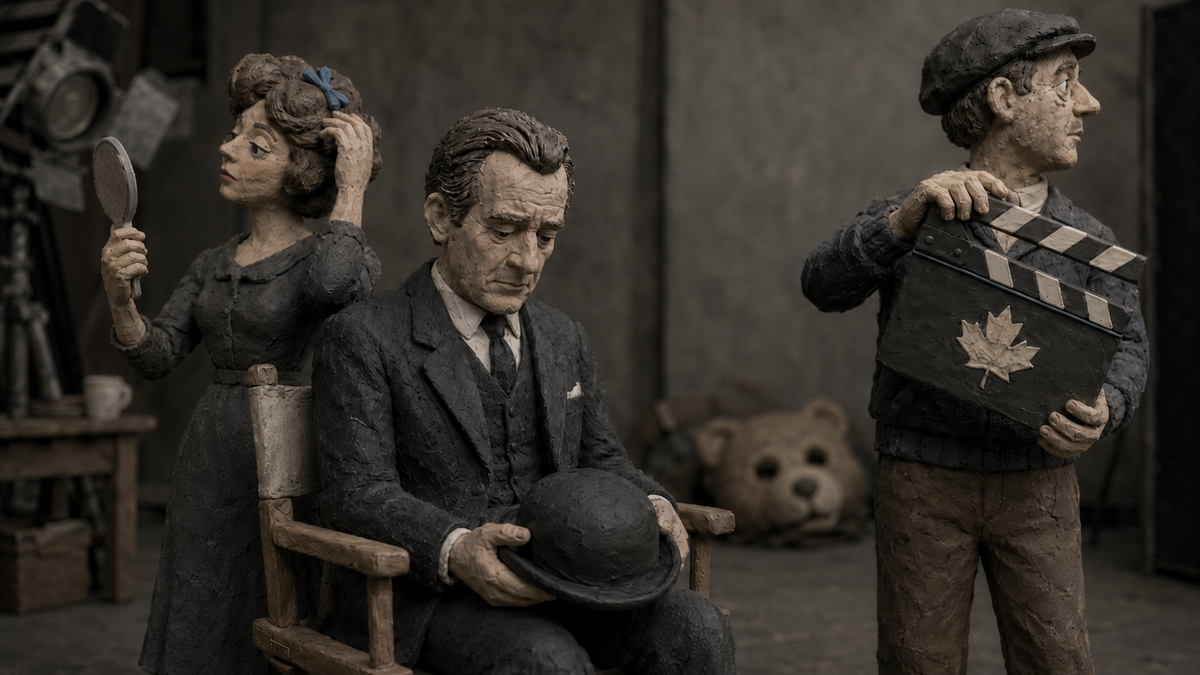
The 1998 film exists, and the kindest thing to say about it is that Sean Connery spends a scene in a teddy bear costume as the villain, addressing a room full of other people in teddy bear costumes, and this is presented with a completely straight face. The film cost $60 million, made $54.7 million, and was met with reviews that were not kind. Ralph Fiennes and Uma Thurman are both better than the material deserves. It does not matter. Nothing could have saved this.
That's all it gets. Moving on.
Where Rigg Landed, and Why That Matters Here
She found her way back to the spirit of the character without ever being trapped by it again.
Decades later, Rigg played the magnificent Mrs. Bradley in a criminally short-lived BBC series, unconventional, sharp-tongued, entirely herself. It's worth ending this series there rather than on Canada or bear suits, because it's a reminder of what the whole run was actually capable of when the right people were making the decisions. Gale, Peel, and later Mrs. Bradley all share the same DNA: competence that doesn't apologize for itself.
Thorson and Lumley deserved productions capable of protecting that same DNA. Neither entirely got one. That's not a verdict on either of them. It's a verdict on the people who kept almost getting it right and then getting distracted, underfunded, or nepotistic at exactly the wrong moment.
The bowler hat, the leather, and the long goodbye. Somewhere in there is a show that was, for a few years, genuinely the best thing on British television. It's worth remembering it that way, even when accounting honestly for everything that came after.