
The Useful Fiction Act I: The Accident
The Middle Class. It resonates, and it is almost a God given American right, but what is it really? Act I of 4 on the Middle Class.

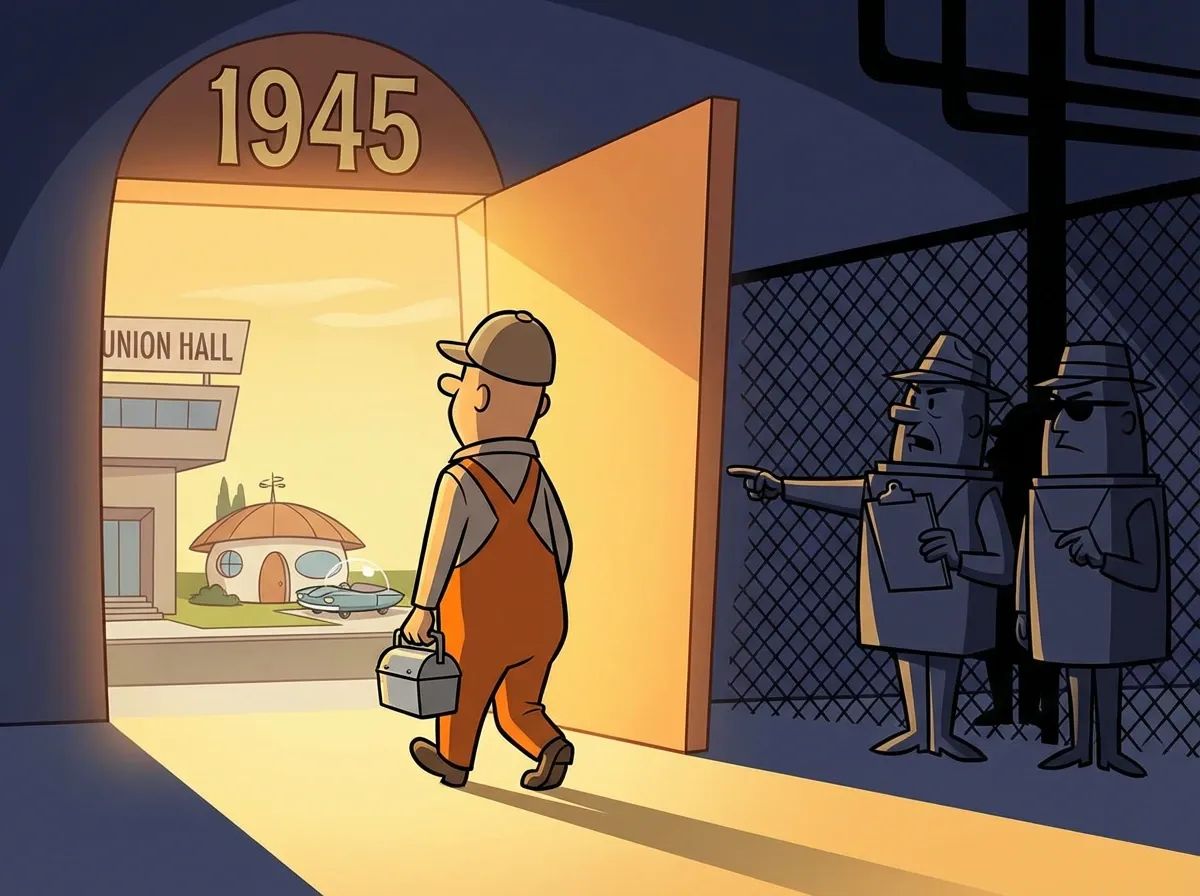
Prelude: My entire life, I have heard politicians, pundits, and even ordinary people opine about the "middle class", as if it was a God given right along with Guns, Apple Pie and Chevrolet Trucks for 'muricans
This is part one of 4 of a series where I begin with some original work I did over a decade ago (that is "pre-Trump", and go much deeper into the rabbit hole.
There is a phrase that gets deployed constantly in American political life, by people of every stripe, with the earnestness of someone reciting scripture: the middle class. Politicians build careers on it. Pundits narrate its struggles. Campaigns are constructed around its anxieties. Both parties claim to be its champion, its protector, its last best hope against the forces arrayed against it.
Nobody, and I mean nobody in that conversation, wants to deal with the awkward fact sitting at the center of it: the American middle class as we understand it was not designed. It was not the inevitable product of democratic values, or the genius of free markets, or the natural flowering of a fair society. It was an accident of history – a specific, contingent, time-limited set of circumstances that produced something that had never really existed before, that nearly everyone in power resisted at the time, and that began dying almost as soon as it was born.
I've been sitting on this thesis for over a decade, and the evidence has only gotten more clarifying since. This is the first in a series of four posts unpacking how the middle class happened, why it was always contested, who killed it, and – most importantly – how both parties turned its corpse into the most effective political prop in American history.
Let us start at the beginning. Which, despite what your high school civics class implied, is not where you might expect.
Before the Accident: Who Got to Be Somebody
For most of recorded Western history, the social structure was not complicated. You were born into it, you died in it, and the people above you worked actively to ensure it stayed that way. The tools for keeping the mass of humanity in its place were elegant in their simplicity: limited literacy, theological justification, and the ever-present understanding that stepping out of your assigned role had consequences.
The Church was essential to this architecture. Not because clergy were uniquely villainous – they weren't, particularly – but because the theological framework they administered conveniently explained why your miserable station in life was actually God's plan, and suggested that patience in this world would be rewarded in the next. The ruling class provided the swords. The clergy provided the story. Together, they kept things remarkably stable for about a thousand years.
The first real crack in this arrangement was the Protestant Reformation, and specifically the thing Max Weber later called the Protestant work ethic – the radical idea that individual labor and earthly success could be signs of divine favor. This was a bigger deal than it sounds. If God might be signaling his approval through your prosperity, then prosperity becomes something you can actively pursue. The merchant class of 18th century Britain didn't invent capitalism, but they were the first group to build a cultural identity around the idea that working hard and accumulating wealth was respectable rather than shameful. That a man could rise.
This is the precursor. Not the middle class itself – the 18th century merchant was still a razor thin slice of society, wholly dependent on proximity to power and capital – but the first ideological crack in the wall that said your birth determined your ceiling. It matters. But it is emphatically not the story of the broad American middle class that politicians invoke when they need your vote.
That story starts in 1941, and it starts with military necessity.
The Real Engine: Why the War Changed Everything
Here is the thing about World War II that doesn't get said clearly enough: the United States did not win it through courage, democracy, or moral clarity alone. It won it by out-producing the Axis powers so overwhelmingly that the outcome became, at some point, mathematically inevitable. By 1944, American factories were producing more military equipment than all of the Axis nations combined. That didn't happen by accident either. It happened because the federal government essentially nationalized industrial production, poured money into it, lots and lots of money, and needed millions of workers to run it right now.
And this is where the 'accident' happens.
When you desperately need workers – not theoretically, not eventually, but today, because the alternative is losing a war – the balance of power between labor and capital shifts. You cannot threaten to fire a steel worker and replace him when every able-bodied man in the country is either in a factory or on a beach in the Pacific. You cannot move production overseas. You cannot import cheaper labor. The workers were, for one of the very few times in American history, genuinely, structurally irreplaceable. And they knew it.
Union membership more than doubled during the war – from 7 million workers in 1940 to 14.5 million by 1945. This wasn't primarily ideology. It was leverage. Workers organized because they had the power to do so, and because the federal government, which needed production above everything else, was willing to recognize and protect that organization in ways it never had before. The War Labor Board. The no-strike pledge that, crucially, came with wage protections in exchange. The explicit acknowledgment that labor was a partner in the war effort, not a cost to be minimized.
The capital class accepted all of this because they had no choice. Their profits, it should be noted, were also extraordinary -- the war was very good for American industry. But the arrangement was one they tolerated, not one they embraced. That distinction is going to matter a lot in the posts that follow.
The Golden Bracket: What the Accident Built
The war ended. The workers did not go back to where they were before.
What followed was, by any reasonable historical standard, the most broadly shared prosperity in American history. GDP grew from $228 billion in 1945 to nearly $1.7 trillion by 1975. Collective bargaining tripled weekly manufacturing wages between 1945 and 1970. Union density peaked at roughly a third of the non-farm workforce through the mid-1950s. The GI Bill sent a generation to college that had no expectation of going, and when they came home they bought houses in suburbs that hadn't existed, drove cars that Detroit was printing by the millions, and built a consumer economy that the world had never seen.
This is the Golden Bracket – roughly 1945 to 1973, when the oil shock and stagflation broke the back of the postwar consensus. And it is important to be clear about what made it work, because the explanation matters enormously for everything that comes later.
It was not the market. The market, left to its own devices, had produced the Gilded Age, the robber barons, and eventually the complete immolation of the economy in 1929. It was not the inherent virtue of American employers, who fought unionization at every available opportunity and continued to do so throughout the postwar period where they could get away with it. It was not some unique genius of the American character, a phrase that should always make you reach for your wallet.
What made it work was power. Specifically: workers had it, in a specific historical moment, for specific historical reasons, and they used it. Union contracts locked in wages and benefits. Regulations constrained the worst behavior of capital. A tax structure that still bore the imprint of the New Deal kept the highest incomes from compounding into dynasties quite as fast as they would otherwise.
The prosperity was real. But it rested on an institutional architecture that had been built under duress and that was, from the moment the guns went quiet, under sustained attack.
Here is what your civics class didn't tell you: the Taft-Hartley Act passed in 1947. Two years after the war ended. Before most of the GI Bill veterans had finished their first semester of college. Taft-Hartley gutted some of the most powerful union tools, allowed states to pass right-to-work laws, and began the slow process of making the legal environment for organized labor hostile rather than neutral. President Truman vetoed it. Congress overrode him. Capital had not waited for the body to cool. It was already working.
The Accident and Its Enemies
This is the through-line that Act I is trying to establish, because it's the thing that gets lost in every contemporary argument about the middle class: the prosperity was real, and the forces trying to dismantle it were also real, and they were organized, and they started in 1947.
The postwar middle class was not the natural state of capitalism. It was a specific historical outcome, produced by a specific set of conditions -- war-driven labor scarcity, New Deal institutional architecture, high union density, constrained capital movement -- that were always fragile and always contested. The capital class accepted the arrangement because the alternative was worse, not because they believed in it.
By the late 1940s, they were already building the infrastructure to undo it. The US Chamber of Commerce, the National Association of Manufacturers, the early iterations of what would become a massive network of think tanks, legal organizations, and political funders – all of it beginning to coalesce around a simple project: getting back to the arrangement that existed before the war, where capital set the terms and labor took what it was given.
They were patient. They were organized. And they were very, very well funded.
That's Act II's story. But before we get there, sit with the irony for a moment:
Every politician who has ever stood at a podium and promised to fight for the middle class is fighting, whether they know it or not, for the preservation of something that was never supposed to exist in the first place. An accident. A specific set of historical conditions that produced an outcome nobody designed and that the people with the most power in the system spent the better part of eighty years trying to reverse.
The accident happened. It was real. People built lives on it that their parents could not have imagined and their children are struggling to maintain.
And almost from the first day, someone was working to clean it up.
Next: Act II – "The Long Game." The Powell Memo, the libertarian infrastructure build, and Reagan as the moment the bill comes due.
 Share on Bluesky
 Share on Threads
 Share on Facebook
 Share on Mastodon
 Share on Reddit
 Share on Email