The Useful Fiction - Act III: Et tu donkey?
If you think that the Democrats are the party of the middle class, you're fooling yourself. But since the 1980's they've gotten on the gravy train, feeding at the trough with the Republicans

In Act II, we watched capital play the long game with patience and discipline – the Powell Memo as strategic blueprint, Heritage Foundation as the idea factory, Reagan and PATCO as the moment the signal went out to every employer in America that the rules had changed. By 1989, union density was in freefall, the link between productivity and wages was already broken, and the institutional architecture that had made the Golden Bracket possible was being dismantled piece by piece.
You'd think this is where the Democratic Party rides in.
You'd be dead wrong.
What actually happened is one of the more spectacular acts of political self-dealing in modern American history, and it happened in broad daylight, and the people who did it told themselves – and anyone who would listen – that they were saving the party. Perhaps they even believed it. That's almost the worst part. Buckle in, it's time to look at my own tribe with a critical eye.
The Setup: What Democrats Were Supposed to Be
Let's be clear about what the Democratic Party was, at its best, supposed to stand for. Not what it claimed to stand for, but what the institutional architecture actually delivered. The New Deal coalition that Roosevelt assembled in the 1930s was built on a specific theory: that organized labor, combined with government regulation of capital, could produce broadly shared prosperity in a way that markets left to themselves demonstrably could not. The evidence was everywhere. The regulated, unionized economy of the postwar years produced something the unregulated economy of the Gilded Age never had: a working class with enough money to participate in consumer society, enough security to plan more than a month ahead, and enough political power to make demands of both employers and government.
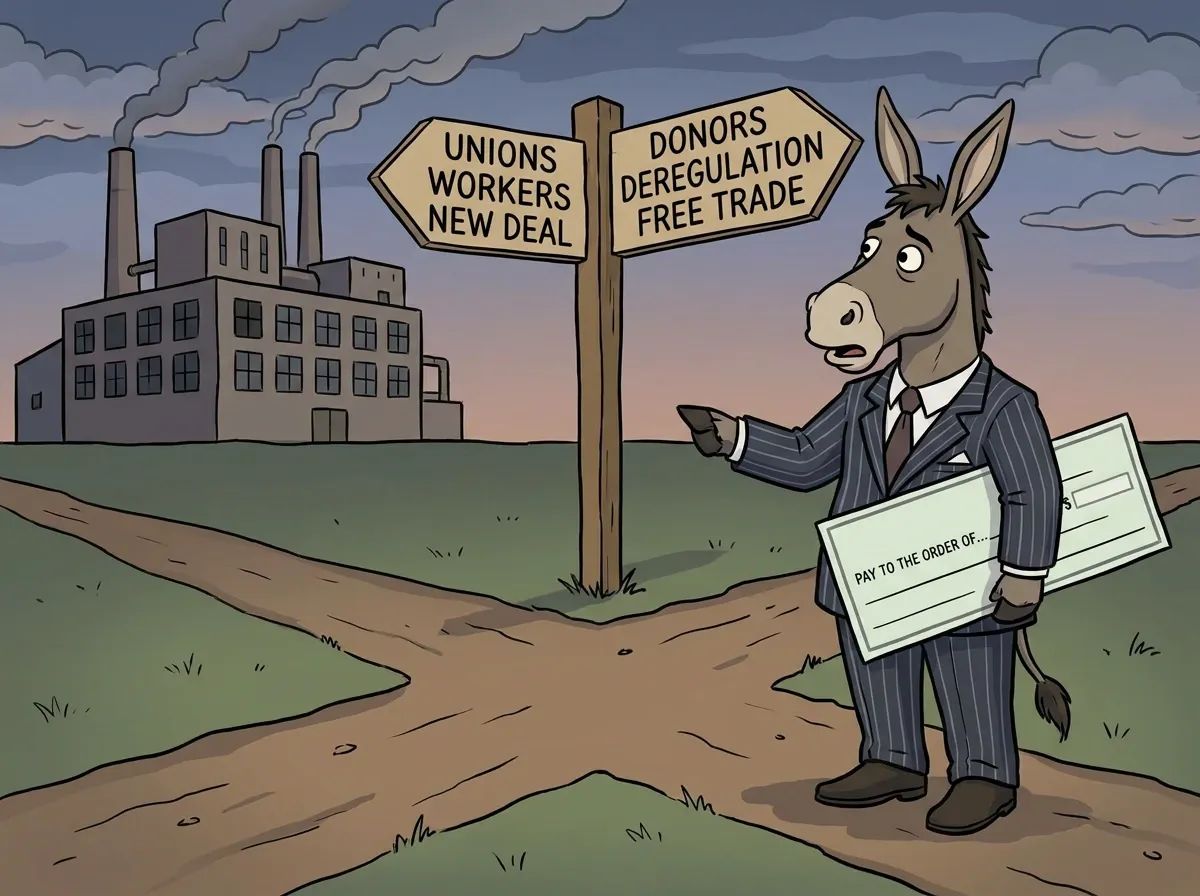
That's what the party was for. That was the deal. The donors were the unions. The constituency was workers. The policy agenda flowed from that alignment in a reasonably coherent direction.
Then Reagan happened (yeah, that motherfucker, again). Mondale got obliterated in 1984 – 49 states, 525 electoral votes, one of the most comprehensive drubbings in presidential election history – and the Democrats did what parties do after a catastrophic loss: they looked for someone to blame, naturally they found the wrong answer, and institutionalized it.
Tony Coelho and the Original Sin
Before we get to the institutional capture, we need to talk about Tony Coelho, because Coelho is the fulcrum.
Coelho was a California congressman who took over the Democratic Congressional Campaign Committee in 1981 with a simple diagnosis: the party was broke and the corporate PACs were going to Republicans. His solution was equally simple, and it is worth quoting him directly on it. When he approached business PACs that had been writing checks exclusively to Republicans, Coelho told them: "You people are determined to get rid of the Democratic Party... We're in power. And I suggest you deal with us. Or at least cover your tail."
That's not a policy argument, it is a protection racket with better suits.
Coelho spent the 1980s systematically marketing the once pro-labor Democratic Party as increasingly pro-business, opening up DCCC fundraising to defense contractors, oil producers, venture capitalists, and anyone else with a check and something they needed from a Democratic House. The access was real. So were the implicit obligations that came with it. His finance director at the DCCC was Terry McAuliffe (roll eyes), who would later become one of Bill Clinton's most important fundraising wizards (srsly, you can't make this shit up). This is how institutions reproduce themselves: not through conspiracy, but through the perfectly normal process of the people who learned the system going on to run the system.
Coelho eventually resigned from the House in 1989 under the cloud of a campaign finance ethics investigation (what a fucking shock...) The practices he institutionalized did not resign with him. [1]
The DLC and the Rebranding of Surrender
In the same year Coelho took over the DCCC, a broader ideological project was taking shape. The 1984 Mondale disaster accelerated it into an institution. In 1985, Al From -- a policy operative who had concluded that the Democratic Party's problem was too much labor, too much government, too much left -- founded the Democratic Leadership Council with a roster that reads like a preview of the next two decades: Joe Biden, Bill Clinton, Dick Gephardt, Al Gore, Sam Nunn.
All I need are a stack of TPS reports... (IYKYK)
The DLC's pitch was that Democrats needed to win back the "forgotten middle class" by moving to the center on economics – which, translated from the consultants' dialect, meant moving away from unions and toward the donor class. According to Bill Curry, an advisor to Clinton, the explicit internal goal was stark: "the whole point of [the DLC] was to exterminate the progressives."[2]
The organization's actual funders tell the story more cleanly than any white paper. The DLC's top donors included ARCO, Chevron, Merck, DuPont, Microsoft, and Philip Morris, which kicked in $500,000 while Joe Lieberman chaired the organization. This is the group that was going to win back the working class. With tobacco money.
Thomas Frank, whose What's the Matter with Kansas? remains the most clear-eyed autopsy of this period, nailed the DLC formula: "stand rock-solid on, say, the pro-choice position while making endless concessions on economic issues, on welfare, NAFTA, Social Security, labor law, privatization, deregulation and the rest of it." The cultural left got the party's symbolic commitments. Capital got its policy agenda. Workers got told to be grateful that at least their party believed in a woman's right to choose.
This is not a cynical reading. This is just what happened. Fucking sucks, doesn't it?
Clinton: The DLC's Greatest Achievement
Bill Clinton was, by any fair accounting, a genuinely (or generationally) talented politician. He could read a room, synthesize policy, and connect with voters across demographic lines in a way that made most of his contemporaries look like they were reading from cue cards. None of that makes what his administration did to the Democratic Party's relationship with the working class any less worth examining.
NAFTA was signed in 1993. Clinton sold it as a job creator. The actual effect was to give every employer in a mobile industry – manufacturing, in particular – a credible threat to use against union organizing drives. A Wall Street Journal survey in 1992 found that a quarter of corporate executives surveyed admitted they planned to use NAFTA as a "bargaining chip to hold down wages." After NAFTA passed, plant-closing threats during union certification elections nearly doubled. You don't have to believe NAFTA was entirely responsible for the subsequent collapse of manufacturing employment to notice that handing management a permanent "we'll move to Mexico" card made organizing very much harder than it was before.
In 1999, Clinton signed the Gramm-Leach-Bliley Act, which repealed the Glass-Steagall provisions separating commercial and investment banking -- a New Deal firewall that had kept the financial sector from eating the broader economy for sixty-six years. The financial sector had wanted this for decades. They got it. Nine years later, the architecture that Gramm-Leach-Bliley helped enable blew up the global economy. The working class absorbed most of the damage. The financial sector got bailed out.
Clinton also deregulated derivatives trading – the instruments at the center of the 2008 collapse – over the explicit objection of Brooksley Born, who ran the Commodity Futures Trading Commission and was trying to regulate them before they became systemic. The Clinton Treasury Department, led by Robert Rubin (Goldman Sachs) and later Larry Summers, blocked her. Born was right. They were wrong. Nobody who was wrong lost their job or their reputation in any meaningful way.
Meanwhile, the 1994 Crime Bill – also Clinton – accelerated mass incarceration in a way that devastated Black working-class communities in particular, pulling fathers and sons out of the labor market and into a prison system that conveniently exempted itself from minimum wage requirements. The DLC called this "being tough on crime." The communities it hit called it something else.
To be precise: Clinton's economy was good by the numbers. GDP grew. Unemployment fell. The budget went into surplus. The 1990s looked, from the data, like prosperity.[3] What the aggregate numbers obscured was the distribution. The gains of the Clinton boom went disproportionately to the top. The structural changes he signed into law – financial deregulation, trade liberalization, labor law indifference – guaranteed that the next economic shock would fall disproportionately on the bottom. Which it did, in 2008. Right on schedule.
Citizens United: Changing the Locks
By 2010, the Democrats had spent twenty-plus years paying lip service to working-class priorities while cashing checks from people whose interests were orthogonal to those priorities. I've covered the Macomb County math – Kennedy 63%, Reagan 66% – and what it means in a recent companion piece. The short version is that working-class voters noticed, even if they couldn't always articulate exactly what they noticed. The party that was supposed to be theirs felt like it belonged to someone else. Because it did.
Citizens United didn't cause that. But it made the condition permanent.
The Supreme Court's 5-4 decision in January 2010 struck down limits on corporate independent expenditures and opened the floodgates for what we now blandly call "dark money" – the billions of dollars in undisclosed corporate and billionaire spending that have made American elections into something that would not be recognizable to anyone who was taught what democracy was supposed to look like. From 2010 to 2022, super PACs alone spent approximately $6.4 billion on federal elections. In 2024, just 100 billionaire donors poured $2.6 billion into the race – nearly 20% of total spending.
Here is the thing about Citizens United that doesn't get said clearly enough: it didn't just affect Republicans. Both parties now run on dark money. Both parties are now structurally accountable, first and most directly, to the donor class. The Democrats, to their credit, spent several years loudly criticizing the decision. Then they figured out how to raise more dark money than Republicans and stopped talking about it quite as loudly. This is not a hypothetical: Democrats outspent Republicans in dark money in the 2018 and 2020 cycles. The party of campaign finance reform found the same ATM the other guys were using and decided access was more important than principle.
You cannot simultaneously be the party of working people and be structurally dependent on the people whose interests are opposed to working people. You can say you are. You can run ads saying you are. You can give genuinely moving speeches about it. You can believe it, in the quiet moments, when you're not on the phone with your bundlers. But the policy agenda flows from the money. It always has. The Democrats learned this from the Republicans, and then learned it better, and now neither party can credibly claim the working class as its true constituency.
The Punchline
So here is where we are, roughly forty-five years after Tony Coelho walked into his first business PAC meeting with a protection racket dressed up as pragmatism:
The party of FDR now raises more money from corporations and wealthy professionals than the party of Wall Street does. The party that broke the unions, deregulated the banks, and opened the trade doors is the one that still runs on the legacy of the New Deal. The party that was supposed to be the institutional check on capital's dominance over labor has become, in structural terms, another vehicle for capital's dominance over labor – just with better vibes and a stated commitment to reproductive rights.
None of this required anyone to be villainous. It required Tony Coelho to be pragmatic about fundraising. It required Al From to draw the wrong lesson from 1984. It required Bill Clinton to believe that free trade and financial deregulation were akshually good policy, and that a rising tide really would lift all boats[4]. It required a generation of Democratic consultants and donors and operatives to make individually rational decisions that added up to an institutional betrayal.
The working class noticed. It took them a while to figure out what to do about it. When they did, the answer they arrived at was the subject of considerable pundit bewilderment, because the answer was fucking Donald Trump. Which tells you something about how completely both parties had screwed the pooch.
That's Act IV's story. The capstone. Both parties now fully fluent in the language of the middle class, both parties now structurally serving something else, and the system that makes this not just possible but self-sustaining and essentially irreversible through normal political channels.
It is not a hopeful story. But it is an accurate one.
Next: Act IV – "The Political Fiction." The capstone. How the language survived the interests, why the system is self-sustaining, and what it means that this is what winning looks like – if you're the right people.
"The Useful Fiction" is a four-part series. Act I: The Accident | Act II: The Long Game
1 - I was truly shocked about this hard turn right in the insitutions of my "tribe", I am increasingly of the opinion that we should burn this fucker to the ground
2 - it is eerie how similar this argument is to what copium the Never Trump punditocracy is pushing.
3 - in particular, the Tech industry really became dominant. I am working on a multipart series on how Tech in specific, and white collar workers in general, self inflicted their futures by not organizing. It will be fascinating.
4 - I swear the frequency with which I hear the Never Trump people utter this trope is really painful. It was never true, it was always a justification to pump money to the upper echelons of society, and the plebes bought it hook line and sinker
 Share on Bluesky
 Share on Threads
 Share on Facebook
 Share on Mastodon
 Share on Reddit
 Share on Email