The Useful Fiction Act IV: The Political Fiction
Closing out, the accident that created what we call the middle class is about over. Sure, politicians will pontificate, but neither party is willing to do the work to keep it going.

If you've read the first three acts of this series, you know the story so far. A postwar accident produced the broadest middle class in American history. Capital, which never wanted it, spent thirty years patiently building the infrastructure to dismantle it. The Republican Party became the delivery mechanism. The Democratic Party, which was supposed to be the institutional check on all of this, decided somewhere around 1981 that the donor class was a better constituency than the working class, and has been making peace with that decision in various creative ways ever since.
This is the capstone. The part where we zoom out from the specific acts of betrayal – the Powell Memo, PATCO, NAFTA, Glass-Steagall, Citizens United – and look at what the system has actually produced. Because the remarkable thing, the thing that should make you set your drink down, is not that the middle class has been hollowed out. It's that the language of the middle class has been perfectly preserved even as the interests were gutted. The phrase survives because it has to. The reality is optional.
The Scoreboard, Fifty Years On
Let's start with some numbers, because the numbers are clarifying in a way that rhetoric never quite is.
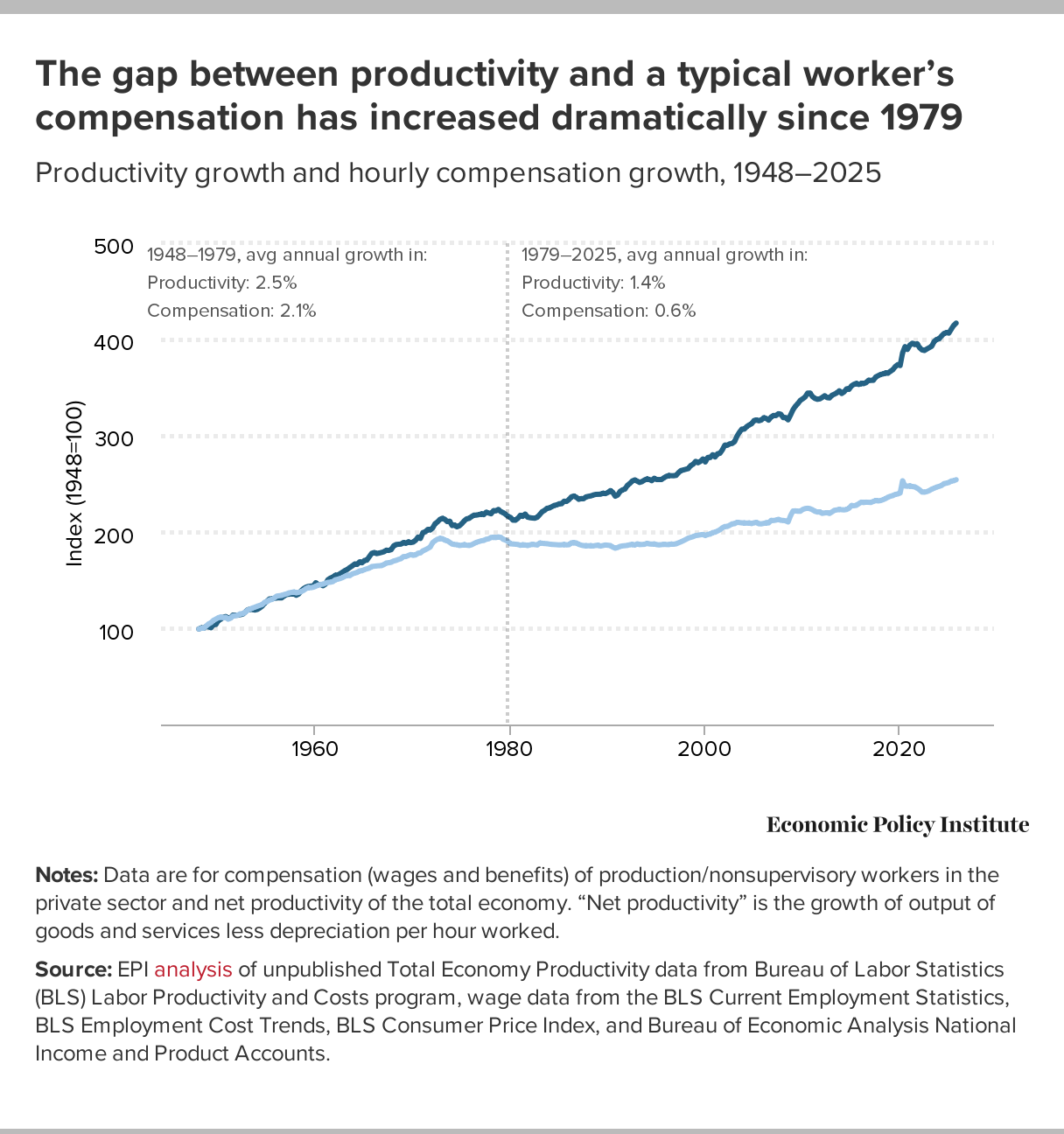
From 1979 to 2024, worker productivity increased 80.9 percent. Average hourly compensation, adjusted for inflation, increased 29.4 percent. The economy got dramatically more efficient. The people doing the work got roughly a third of what they should have gotten if the postwar relationship between productivity and wages had held. The rest went somewhere. It went to shareholders, to corporate profits, to the top of the income distribution, which is to say it went to the people who own things rather than the people who make things.
As of the first quarter of 2024, the top 1 percent of households hold 30.5 percent of the country's total wealth. The bottom 50 percent hold 2.5 percent. In 1980, the top 1 percent's share of national income was around 12 percent. By 2014, it had risen to 20 percent -- a level not seen since the Gilded Age, before the New Deal, before the war, before the accident. We have, in the span of roughly forty years, undone the distributional achievement of the entire postwar era and returned to something that looks like 1928. Just with better smartphones.
Union membership stands at about 10 percent, down from over 30 percent at the postwar peak. In the private sector it's below 6 percent – lower than it was before the National Labor Relations Act existed. The institutional architecture that produced the Golden Bracket is gone. Not weakened. Gone.
Meanwhile, in the 2024 election, just 100 billionaire donors poured $2.6 billion into federal races -- roughly 16.5 percent of all political spending. In 2000, billionaire election spending was $18 million. That's not inflation. That's a structural transformation of who the political system is actually answerable to, completed in roughly one generation.
This is the scoreboard. This is what the long game produced. And here is the thing that makes it interesting rather than just depressing: none of this stopped either party from talking constantly, fluently, and with apparent sincerity about the middle class.
The Language Racket
In the 2024 election, Kamala Harris stood at the Economic Club of Pittsburgh and said she intended to "grow America's middle class" and that "when the middle class is strong, America is strong." Donald Trump, in the same election cycle, described his entire economic program as a middle-class rescue operation – tariffs as job protection, tax cuts as relief for working families, the whole package wrapped in the language of the forgotten worker.
Both of them were doing this while 100 billionaires spent $2.6 billion trying to influence the outcome. Both of them were doing this in a campaign finance environment created by Citizens United, which means both of them had structural obligations to donors whose interests are more or less orthogonal to the middle class they were both claiming to champion. And both of them, after the election, went on to serve those donors in the ways that donors expect to be served.
Trump's signature first-term economic accomplishment was the 2017 Tax Cuts and Jobs Act. The White House predicted it would deliver workers an average raise of $4,000 a year. The actual wage boost averaged $750, according to research from Harvard, Princeton, and Chicago Booth. The corporate tax rate was cut permanently from 35 percent to 21 percent. A 2024 study by the Joint Committee on Taxation found that in response to the corporate provisions, the top 10 percent of earners saw wage increases while the bottom 90 percent did not. The individual provisions were originally set to expire at the end of 2025 -- which, if you were keeping score at home, would have been the moment the argument about who actually benefited became impossible to avoid.
They did not expire. On July 4, 2025, Trump signed the One Big Beautiful Bill Act, which made those individual provisions permanent. The OBBBA is worth sitting with for a moment, because it is the thesis of this entire series expressed as legislation. It locked in tax cuts that disproportionately benefit the wealthy. It financed them, in part, by cutting Medicaid, SNAP, and ACA subsidies – the programs the working class actually depends on when the economy doesn't deliver. It added somewhere between $3.7 and $5.1 trillion to the deficit over the next decade, a bill that will eventually come due in the form of pressure to cut the remaining social programs that working people use. And it was sold, from the signing ceremony on the Fourth of July to every cable news hit that followed, as a middle-class tax relief bill.
This was sold to the working class. It was delivered to the donor class. The working class was told it was for them. They were told this by a man who genuinely believed it, which in some ways makes it worse.
The Democrats are not exempt from this analysis, because they can't be. As we covered in Act III, the party of FDR now raises more money from corporate donors and wealthy professionals than the party of Wall Street. The structural dependency is different in some details and identical in its logic. Both parties need the money. The money comes from the same class of people. The policy agenda flows from the money. The language of the middle class is the wrapping paper, not the gift.
The Machine That Runs Itself
Here is the part that I want to be crystal clear about, because it's where the analysis usually goes wrong: this is not a conspiracy.
There is no room somewhere with rich people in it deciding to screw the working class. What there is, instead, is a system of interlocking rational actors each making sensible decisions in their own interest that add up to a collective outcome that serves capital and costs labor. The mechanism doesn't require villainy. It requires the ordinary human tendency to do what the incentives reward.
Politicians need money to run. The money comes from donors. The donors have preferences. The politician responds to those preferences, not because they're corrupt in any dramatic sense, but because that's how the system works and everyone in it understands the terms. A consultant advises the politician. The consultant's career depends on winning. Winning depends on money. The consultant recommends positions that attract money. A think tank produces research. The think tank's funding comes from foundations and corporations with policy preferences. The research reflects those preferences in the respectable language of academic analysis. The research gets cited in congressional testimony. The testimony shapes legislation.
Lather, rinse, repeat.
No villain required. Just rational actors in a system that was deliberately constructed over fifty years to produce exactly this result. Powell and Weyrich and Coors and Koch didn't need a conspiracy because they built something better: a machine that runs on normal human behavior and produces their preferred outcomes as a byproduct.
The working class is not the constituency. They are the audience. The language of the middle class is the show.
The Ol' Switcheroo: Identity for Material Interest
There's one more component to this, and it's the most uncomfortable one for people on both sides.
When you systematically strip a class of people of their material interests – when you gut the unions, offshore the jobs, deregulate the banks, let wages stagnate for fifty years – you don't eliminate their need for political identity. You just detach it from the material conditions that used to anchor it. Into that detachment rushes something else. Culture. Tribe. The feeling that someone, somewhere, is being held accountable for the loss of something that used to be real.
The Republicans figured this out first. The Southern Strategy was an early proof of concept: you can get working-class white voters to vote against their economic interests if you give them a compelling enough cultural villain. By the time the DLC Democrats had completed their transformation in the 1990s, both parties were running basically the same play – just with different villains. Republicans offered immigrants, welfare queens, coastal elites. Democrats offered racists, gun owners, rural deplorables. Neither party was offering the thing that would have actually required them to give something up: a genuine restoration of labor power, a real constraint on capital, a tax structure that would reverse the fifty-year transfer of wealth upward.
Identity politics, in this reading, is not a cause of the problem. It's a symptom. It's what fills the space where material interest used to live. And it's genuinely useful to the donor class, which benefits enormously from a working class fighting about cultural identity rather than organizing around economic interest. A factory worker arguing with his neighbor about immigration is not organizing a union. A laid-off autoworker arguing online about trans bathroom policy is not demanding trade policy that would reopen the plant.
The culture war is not a distraction from the class war. It is the class war, conducted by other means, in a terrain that's been carefully prepared to make sure the right side keeps winning.
Neither party wants to talk about this clearly, because talking about it clearly would require admitting what the system actually is and who it actually serves.
The Crowning Achievement
Let us end where the series began: with the accident.
The postwar middle class was not designed. It was a specific historical outcome, produced by specific conditions, that gave working people something they'd never really had before: enough money, enough security, and enough institutional power to participate in the economy as something other than a cost to be minimized. Capital never wanted it. Capital organized against it from 1947 forward, with patience and discipline and resources that labor couldn't match once the wartime leverage was gone.
Seventy-five years later, here is what that project has achieved:
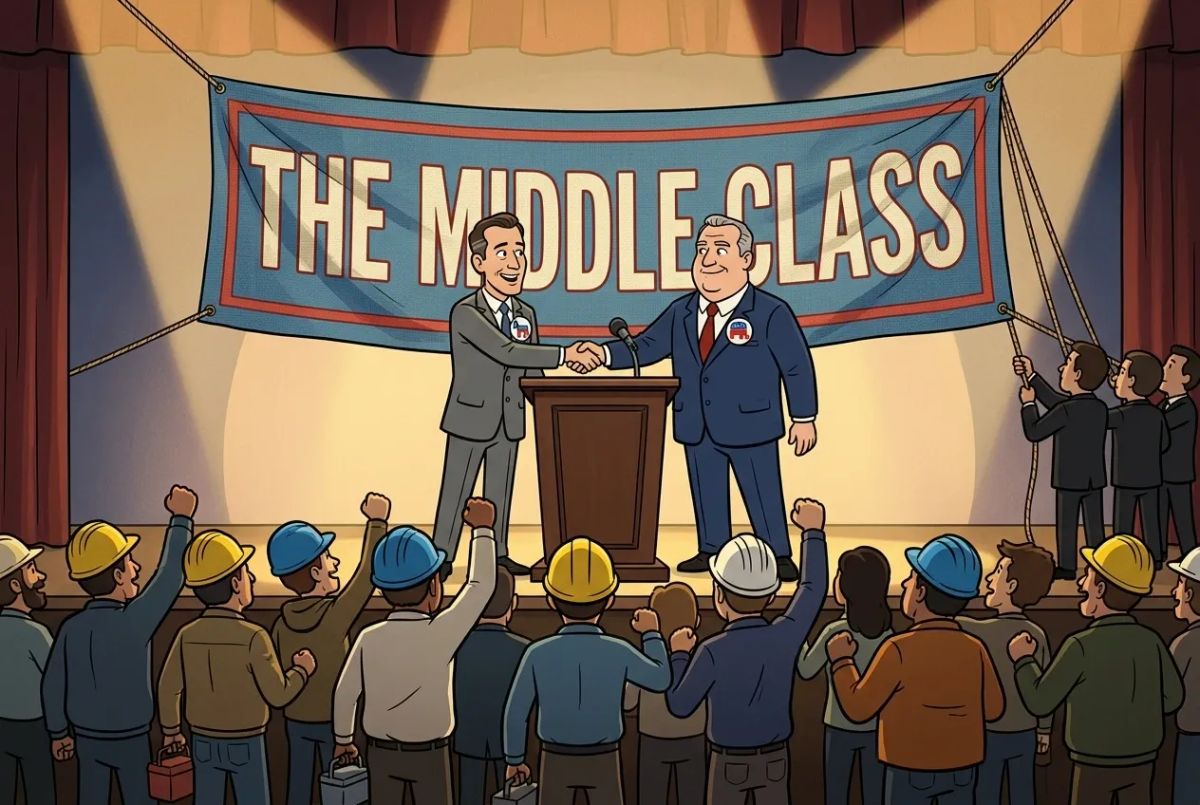
The language of the middle class is everywhere. "Middle class" is the most invoked demographic in American political speech. Both parties claim to fight for it. Both parties build their campaigns around its anxieties. Every election cycle produces a new round of middle-class rhetoric, middle-class promises, middle-class imagery. The phrase has never been more central to American political identity.
The interests of the middle class are almost nowhere. The institutional architecture that produced broadly shared prosperity -- high union density, regulated capital, progressive taxation, constrained capital mobility -- has been systematically dismantled. Productivity grew 80 percent since 1979. Wages grew 29 percent.
The top 1 percent holds more national wealth than the bottom 90 percent combined[1]. The political system is structurally accountable to a donor class whose interests are opposed to the working class. The legal architecture, courtesy of Citizens United and its progeny, makes any serious reform essentially unreachable through normal political channels.
This is what winning looks like, if you're the right people. Not a dramatic overthrow. Not a visible coup. Just the quiet, patient, well-funded, multi-decade replacement of a real thing with a useful fiction. A fiction that is still being told, fluently and sincerely, by politicians of both parties, in every election, about a middle class that is invoked constantly and served almost never.
The accident happened. It was real. People built lives on it. And almost from the first day, someone was working to clean it up.
By any honest accounting, they have largely succeeded.
Coda
Reader BusyBusyBee sent this cartoon that is as true today as it ever was:
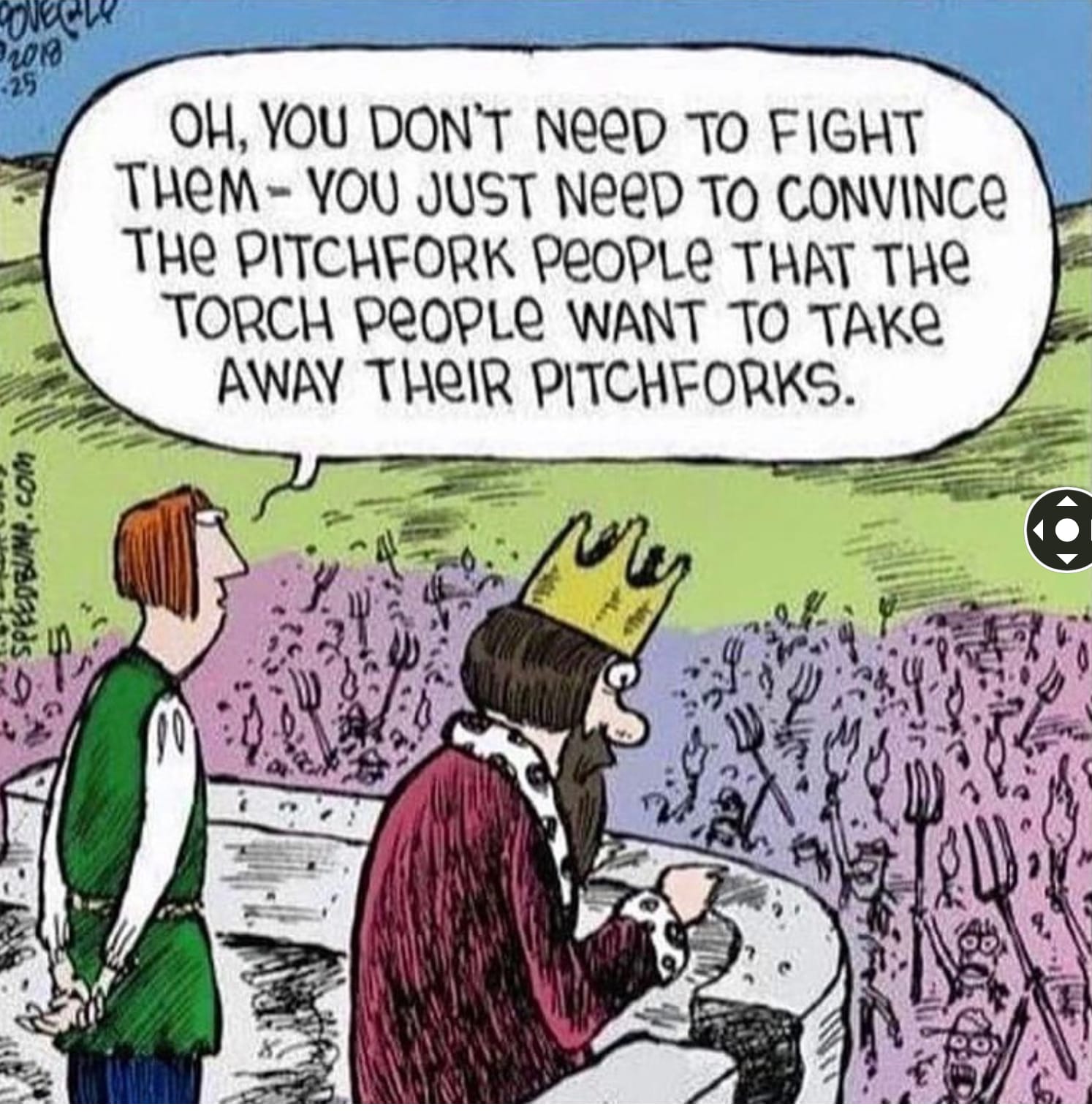
"The Useful Fiction" is a four-part series. Act I: The Accident | Act II: The Long Game | Act III: Et Tu, Donkey?
1 - note that the metric in this statement is how many people it would take to equal the holding of trhe top 1%. The top 1% holds ~ 30.5% of the total wealth of the nation, and to assemble the cut off for the rest of us, it would take 90% of the total population to amass that 30.5%
That is a pretty damning indictment of the level of our income and wealth inequality
 Share on Bluesky
 Share on Threads
 Share on Facebook
 Share on Mastodon
 Share on Reddit
 Share on Email