Bonus Post: The Podcast Class Discovers the Streets (From Their Studios)
Listening to the latest TNL this AM got my hackles up. The question of why aren't more people mobilizing really spiked my cortisol.

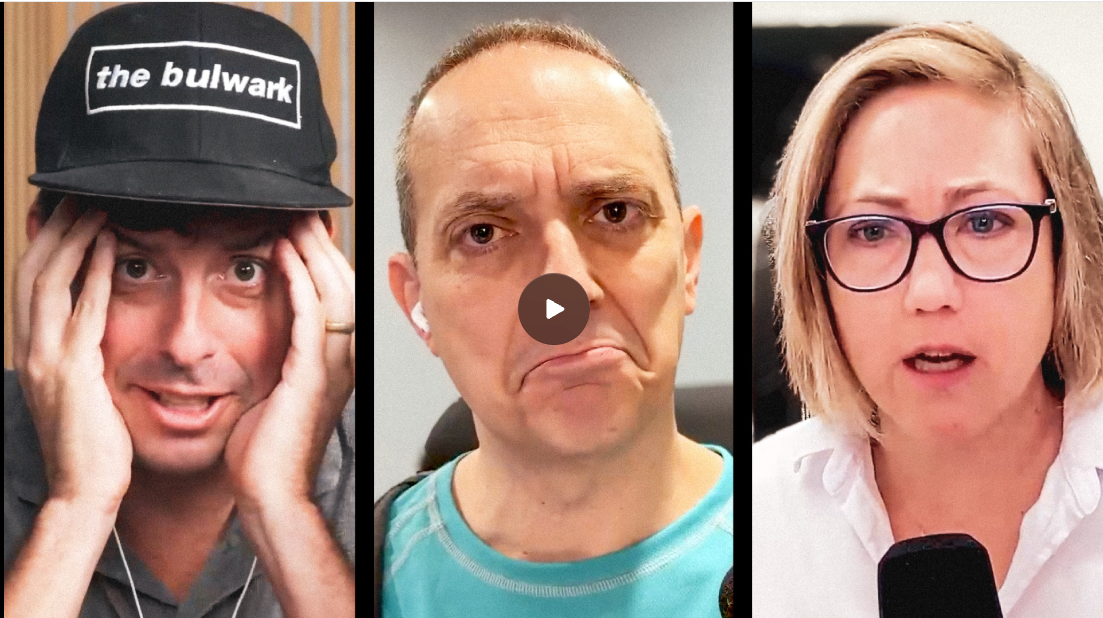
There's a bit on the Bulwark's Next Level podcast from today (May 13, 2026) that I cannot stop thinking about, and not in the good way. Bonus post!
Sarah Longwell — who is smart, who is right about a lot of things, and who I generally respect — spent a meaningful chunk of a recent episode wondering, out loud, with genuine puzzlement, why young people aren't taking to the streets. Why, she mused, is it only the boomers out there with their cardboard signs? Where is the energy? Where is the youth? Why are they not rising up?
Sarah Longwell was, at the time of this musing, sitting in a podcast studio.
I'll let that marinate.
To be fair, she also said she's "in the streets." Which — okay. I don't know what streets Sarah Longwell is in. I know she runs a polling and research organization. I know she hosts multiple podcasts. I know she writes pieces and appears on television and has a full and productive media career. What I do not know is what the fuck streets she is personally in, because the evidence presented in this podcast suggests the streets she is in are mostly metaphorical. (Okay, she mentioned that she drives by these Boomers on Connecticut avenue with their signs - tres lame)
This is not a personal attack. Really (I get hate when I say anything remotely negative about Sarah.) It's a genre observation. "Why isn't everyone in the streets" is what media-class political commentators say instead of being actually in the fucking streets. It's the op-ed version of "someone should really do something." It discharges the obligation of caring by articulating the caring, beautifully, into a microphone, for subscribers.
Bill Kristol — Bill fucking Kristol, architect of the Iraq War, the man who gave us Sarah Palin as a viable national figure — actually went to a No Kings protest. They mentioned it specifically. As an example. As a notable data point. That's how low the bar is. A 73-year-old neocon showed up to a permitted rally and it was remarkable enough to discuss on a podcast.
Here's what the Bulwark crew, to their credit, do understand: the boomers are out there because they saw mass protest work. Vietnam. Civil Rights. They have lived memory of demonstrations that moved actual power. The implicit theory is that if young people just understood this, they'd get their asses off the couch.
What they don't reckon with is that the technology their generation built — the podcast, the Substack, the viral tweet thread — is precisely the thing that replaced the street. Longwell built a media company. Her audience consumes political content. From couches. Because that's the product she sells. And then she sits in her studio and wonders why nobody is outside, marching and grabbing that attention.
There's also a structural problem with the "just go protest" prescription that the Bulwark vibes-checks without quite examining. In France — and bear with me here — when farmers are pissed about fuel costs, they drive their fucking tractors to the highway and block it. The instrument of disruption is already in their hands. The coordination cost is approximately zero. There's no permit. There's no Facebook event with a "Going / Maybe / Not Going" button. There are tractors, and there is a road, and there is rage, and those three things combine immediately.
American protest has been professionalized into impotence. You need a nonprofit to organize it. You need a permit from the city. You need a date that clears everyone's Google Calendar. You need a designated route that doesn't inconvenience anyone important. By the time it happens it's a Saturday afternoon civic performance that powerful people can wait out over a long lunch. Jeff Landry is not up at night because a permitted march with a PA system happened in Baton Rouge and ended by 3pm so everyone could get home for dinner.
The protests that actually bite — the anti-ICE actions in Minnesota, the hospital workers' strikes — work because they're local, specific, have a concrete ask, and impose a real cost on a specific accountable actor. That's a completely different mechanism than "let's all go to Washington with signs." One is surgery. The other is vibes.
Sarah's 3.5% figure — the political science finding that 3.5% of the population in the streets is enough to force change — comes from Erica Chenoweth's research, which is real work and not bullshit. But it's research drawn almost entirely from authoritarian regimes where the movement is trying to withdraw consent from an illegitimate government. Serbia 2000. Philippines 1986. The mechanism works because the target has a legitimacy problem that protest can crack open.
In a high-sort American democracy, the people you need to move aren't a tottering regime — they're median voters in competitive districts who already have a party identity and who will interpret your protest through their partisan priors within about 45 minutes of the first TV camera showing up. The "this is righteous" signal and the "this looks scary" signal leave the same protest and arrive at different voters simultaneously, and in 2025, you already know which signal reaches which voter.
The Bulwark people are not cynical. They're not grifters. They genuinely believe what they're saying. But there is a specific and well-documented condition that afflicts the Washington and New York media class where "we should do something" is considered fully discharged by saying "we should do something" with sufficient eloquence, to a sufficient audience, with good production values.
The streets aren't empty because people don't care. The streets are empty partly because the most influential voices telling people to care built their entire careers on a technology that made going outside optional.
Pura Vida, I guess.