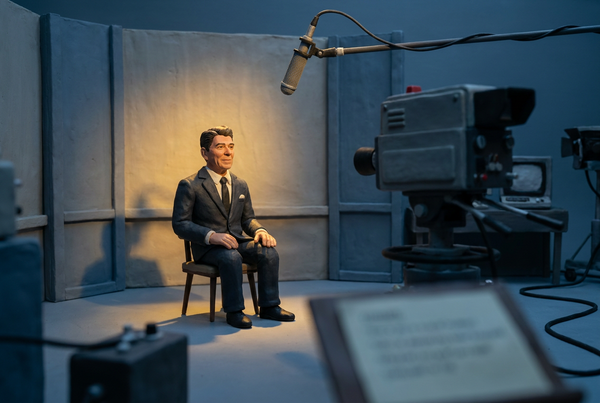
This Fucking Guy: Peter Thiel
Billionaire Victims Club, Vol. 2. - Europe has looked through Palantir and seen whose face is on the other end. Not the Antichrist. Just Peter Thiel, 58, looking older than his years, spending $40k a quarter on young people's blood, waiting for the lockup to expire.

On May 8th, 2026, Donald Trump signed financial disclosure documents revealing that he had personally traded Palantir Technologies stock in March — buying shares in a company founded by the man who made his Vice President, while that company was simultaneously landing federal contracts worth over a billion dollars from his own administration. Three weeks after those purchases, Trump posted on Truth Social: "Palantir Technologies (PLTR) has proven to have great war fighting capabilities and equipment. Just ask our enemies!!! President DJT." It is believed to be the first time a sitting American president has endorsed a publicly traded company by its stock ticker symbol. Palantir shares moved briefly upward before closing lower. The whole loop — the founder, the VP, the contracts, the trades, the endorsement — happened so openly that it barely registered as news. That's not a story about corruption. That's a story about how thoroughly one man has embedded himself inside the architecture of American power, so completely that the usual categories of conflict and interest no longer quite apply. The man is Peter Thiel, and this is how he operates.
I. The Theology
If Musk is the chaos — impulsive, loud, perpetually aggrieved on the timeline — Thiel is the architecture. He doesn't need to post seventeen times a day. By the time most people figured out who he was, he'd already written down what he actually believed, in plain English, in a 2009 Cato Unbound essay: "I no longer believe that freedom and democracy are compatible." That sentence isn't a gaffe. It isn't a youthful indiscretion. It's load-bearing for everything he's built since. In the same essay, he identified women gaining the right to vote as a blow to libertarianism. He was 41. These are considered positions.
The philosophical infrastructure underneath that essay runs through two sources worth knowing. The first is René Girard, the French academic whose "mimetic theory" Thiel absorbed during his Stanford years — the idea that human desire is fundamentally imitative, leading to rivalry, scapegoating, and violence. Girard is legitimate and interesting. Thiel has funded Girard scholarship and cited him constantly. The second source is Carl Schmitt, whose "political theology" provides the geopolitical frame Thiel grafts onto Girard. Carl Schmitt was a member of the Nazi Party who provided intellectual scaffolding for Nazi law. That's the foundation. Not a metaphor, not hyperbole: a literal Nazi jurist is load-bearing in Peter Thiel's worldview.
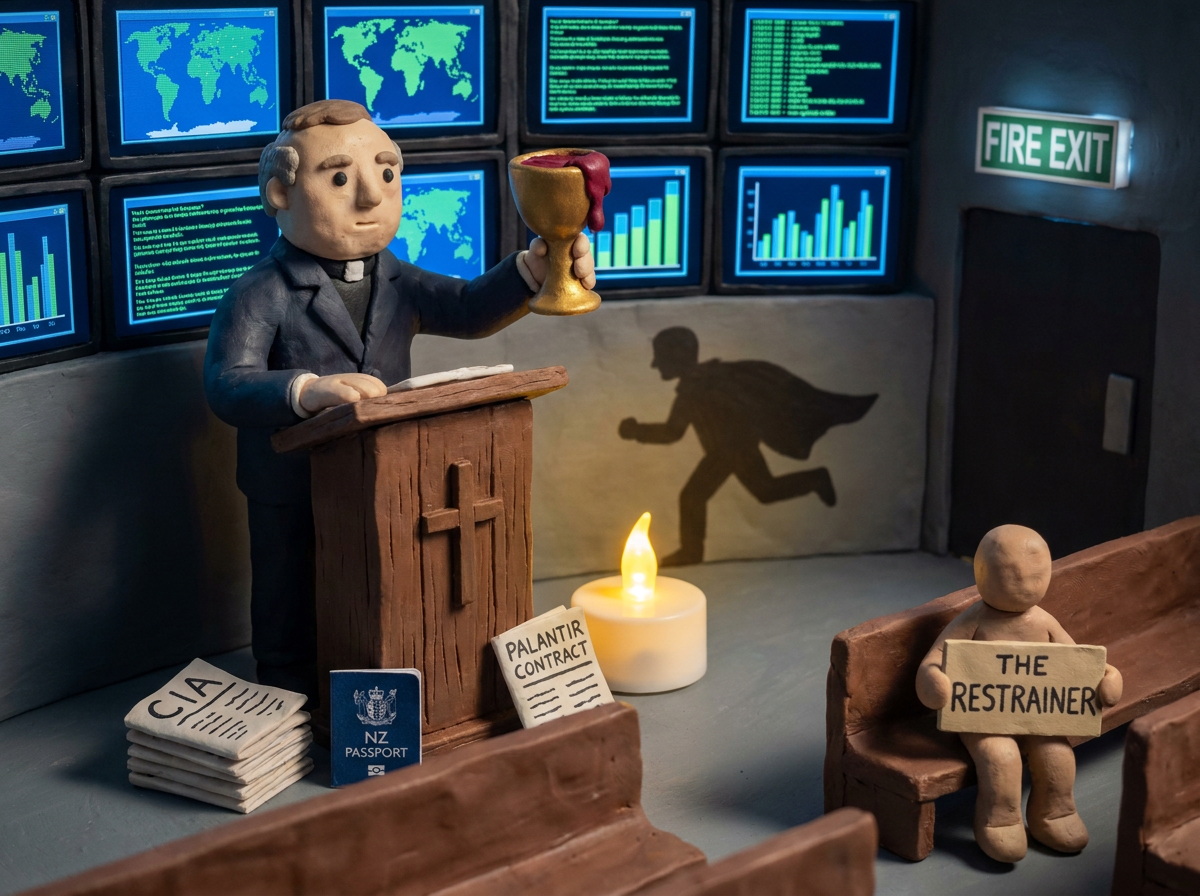
From 2024 through 2026, Thiel converted this framework into a lecture series — sold out at $200 a ticket in San Francisco, then staged at the Palazzo Taverna in Rome, within walking distance of the Vatican. The subject was the Antichrist. The core argument, drawn from Russian philosopher Vladimir Soloviev and 19th-century theologian John Henry Newman, is that the Antichrist isn't necessarily a literal figure but a system: global institutions, regulatory consensus, "peace and safety" politics, AI safety researchers, Greta Thunberg, Bill Gates. All of them, in Thiel's telling, are unwitting foot soldiers for homogenizing stagnation — the elimination of dissent, the eradication of failure, the death of genuine progress. The specific biblical concept he keeps returning to is the Katechon — the Greek term for "the restrainer" that holds back the end times. And what does Thiel identify as the modern Katechon? Sovereign nation-states. Disruptive technology companies. Specifically his own.
Let that land for a second. His surveillance company — the one currently running a billion-dollar ICE deportation contract, the one reportedly helping identify targets in the Iran conflict, the one that the Vatican dispatched actual theologians to critique — is, in Peter Thiel's theological framework, what stands between civilization and the Antichrist. Criticizing Palantir is therefore, eschatologically speaking, serving the devil. The persecution complex doesn't get more baroque than this: it's not just that his critics are wrong, it's that they're cosmically on the wrong side.
The Vatican did, in fact, send priests to critique him. The Italian theologian Father Paolo Benanti, a Franciscan friar and member of the UN Advisory Body on AI, published a piece in Le Grand Continent calling Thiel's teaching "a sustained act of heresy" — not in the fire-and-brimstone sense but in the original Greek: taking one partial truth and elevating it to an absolute principle, stripping away everything else. What Thiel does with Girard, Benanti argues, is extract the diagnostic elements — mimetic rivalry, scapegoating, the mechanisms of social collapse — and discard the redemptive dimensions entirely. He kept the theory of how everything goes to hell and threw away the part about how it doesn't have to. Which is, if you step back, also exactly what he does with every institution he touches.
One more thing about the theology: Thiel is a gay man, married to another man, who spent $15 million electing a Vice President now presiding over an administration actively rolling back LGBTQ rights, and who lectured on Christian apocalyptic theology in a building down the street from a church that has traditional views on his marriage. The priests dispatched to critique his theology would presumably also have traditional views on his personal life. There's a knot here I'm not going to fully untie in this post, but it's worth naming, because it's part of the portrait of a man who has spent his entire career extracting what's useful to him from every system he enters and discarding what isn't — including, apparently, the parts of his own identity that complicate his political program.
II. The Blood
Speaking of discarding limits: Peter Thiel has announced he wants to live to 120. He has taken human growth hormones, investigated calorie-restricting diets, signed up with Alcor Life Extension Foundation — a nonprofit that freezes human corpses in hopes of future resurrection — pledged $7 million to the Methuselah Foundation, which wants to make "90 the new 50 by 2030," and backed twelve longevity companies through his venture and nonprofit infrastructure. His stated philosophical position on mortality is that "nothing can be further from the truth" than the idea that death is natural, and that while evolution is accurate as science, he believes we should try to escape or transcend it.
And then there's the blood. In a 2016 Inc. magazine interview, Thiel said on record that he was "looking into parabiosis stuff" — the practice of transfusing blood plasma from young donors into older recipients as a potential longevity treatment — and that he found the mouse research "really interesting." His company had made contact with Ambrosia, a California startup running trials in which participants over 35 received transfusions from donors under 25 at $8,000 per treatment. When asked whether the FDA should study the practice, Thiel's position was that regulatory involvement was unnecessary because, in his words, it's "just blood transfusions." The anti-regulatory libertarian who built the world's premier government surveillance company drawing the line at FDA oversight of experimental blood infusion procedures he personally wants. The consistency is almost admirable.
What makes this section sing, though, is the Gawker detail. Before Thiel spent years funding Hulk Hogan's lawsuit to litigate Gawker out of existence — a campaign he later confirmed publicly and framed as a principled free-speech intervention — Gawker reported receiving a tip that Thiel was spending $40,000 per quarter on blood infusions from a twenty-something. The outlet that published the rumor about the blood drinking is the one he subsequently destroyed. He later invested in Objection.ai, a startup that evaluates claims made by journalists. The arc from Gawker to Objection.ai is not a coincidence. It's a program: destroy the outlet, then fund the software that pre-emptively discredits the next one.
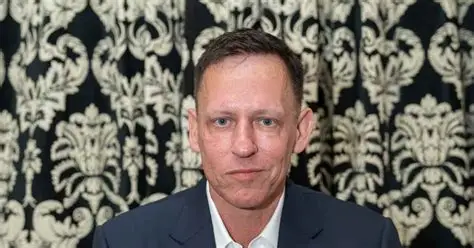
For a man spending this kind of money and philosophical energy trying to reverse biological time, the results are, diplomatically put, not yet visible from the outside. He is 58 years old.
III. The Luck Audit
Now the math.
PayPal. The company Thiel is credited with building was the product of a forced merger between his Confinity and Elon Musk's X.com, a deal the board pushed through against the preferences of both founders. The actual engine of PayPal's value — the fraud detection system that made it trustworthy enough to handle real money at scale — was built by Max Levchin, not Thiel. What Thiel contributed was management, fundraising, and the willingness to do the eBay deal when it came. That is genuinely valuable. It is not the same as building the thing. The deal with eBay closed in October 2002. Thiel walked out the same day.
There is also a tax story here that deserves more attention than it gets. Thiel used a Roth IRA — the middle-class retirement vehicle Congress designed to help ordinary Americans save modestly, subject to strict income and contribution limits — to purchase PayPal founders' shares at $0.001 per share, far below their actual value, effectively stuffing an enormous paper gain into a tax-exempt account before anyone could establish fair market value. When eBay acquired PayPal, he sold those shares inside the Roth, paying no taxes on the gain. By end of 2002, the account was worth $28.5 million. By 2019, ProPublica found it had grown to over $5 billion — tax-free. A tax law professor who reviewed the filings at ProPublica's request called the initial purchase indefensible. Thiel has publicly condemned confiscatory taxes and bankrolled anti-tax PACs throughout his career. His Roth IRA is $5 billion. Yours is not.
Facebook. In 2004, Thiel wrote a $500,000 check for a 10.2% stake in a dorm-room social network for Ivy League undergrads, written by a student whose Harvard peer network handed him his first engineers, his first users, and his first social graph in a closed environment no garage startup could replicate. Facebook's IPO was May 2012. In August 2012, immediately upon the conclusion of the early investor lock-up period, Thiel sold almost all of his remaining stake for just over $395 million, on top of $638 million at IPO, for a total return north of $1 billion from his initial half-million investment. The word "immediately" in the contemporaneous reporting is doing real work. Not gradually. Not with any particular strategic timing. The day the lockup lifted.
Palantir. In 2003, Thiel co-founded a big data analysis company and secured its first major outside investment from In-Q-Tel — the venture capital arm of the Central Intelligence Agency. Let me restate that with the proper emphasis: the most prominent libertarian anti-government ideologue in American technology built his signature surveillance company on intelligence agency seed money. Let that marinate for a moment. The company named after a Tolkien[1] seeing-stone, the one that now holds over a billion dollars in ICE and Defense Department contracts under the current administration, that European governments are now fleeing over data sovereignty concerns, started as a CIA-funded startup. There is no universe in which this man gets to position himself as an outsider disrupting entrenched power. He is the entrenched power. He has been the entrenched power since before the company had its first non-CIA customer.
IV. The Exit Pattern
Run the tape and the behavioral signature is unmistakable: PayPal, walk out the day the deal closes. Facebook, sell the morning the lockup expires. The pattern matters because Thiel has built an entire intellectual brand — his book, his fellowship, his lectures — around the idea of commitment to building things that last. Zero to One argues that the only companies worth founding are ones that create something genuinely new, something durable, something with no direct competitors. The book has sold millions of copies. It is assigned in business schools. It is the text that twenty-five-year-olds read before their YC interviews to sound like they understand what they're doing.
It is advice Thiel does not follow. Every institution he enters, he extracts the useful parts — the network, the capital, the credibility — and exits at the first available moment. PayPal: took the money, left the same day. Facebook: wrote the check, sat on the board for seventeen years of compounding value, sold immediately at lockup. Democracy: took the institutional framework that let him build wealth, then wrote the essay explaining why it's incompatible with freedom. Christianity: took Girard's theory of sacrifice and social collapse, discarded the redemptive half, staged a theology lecture tour. The Roth IRA: took the tax vehicle designed for ordinary savers, stuffed it with founders' shares at a fraction of their value, grew it to $5 billion tax-free. In every case the pattern is identical. He is not a builder. He is a very sophisticated extractor.
V. The Vance Trade and the Close
The one place Thiel hasn't exited is JD Vance, and it's instructive. He mentored Vance, employed him at Mithril Capital, introduced him to Trump when Vance's past criticisms of Trump made the relationship politically inconvenient, and then wrote a $15 million check for Vance's 2022 Ohio Senate race — the largest single donation to a Senate candidate in American history. That investment is now the Vice Presidency of the United States. Measured purely as a return on political capital deployed, it is the most successful investment Peter Thiel has ever made, better than PayPal, better than Facebook, better than Palantir. It has not been exited because it has not finished compounding.
And Palantir, meanwhile, is losing Europe. Germany's national army cut ties in April. France dropped Palantir from its intelligence services this month. The Netherlands has committed to finding a fully fledged European alternative within two years, responding to a parliamentary question characterizing the company as having "racist and anti-democratic ideology." A UK parliamentary report called Palantir's programs an "unacceptable point of weakness" for the national government. Switzerland has rejected Palantir bids at least nine times. Europol discontinued its arrangement. The anxiety driving all of it is the same: foreign clients now openly wonder whether Palantir will side with them or the White House when it matters. They have watched what the White House does with the tools it has. They have drawn the correct conclusion.
This is the final irony Thiel has earned. He built a company he positioned as civilization's defense against barbarism, named it after a mystical seeing-stone, lectured about its role as a Katechon holding back the apocalypse, embedded it in the intelligence architecture of half the democratic world — and the democratic world has now looked through it and seen whose face is on the other end. Not the Antichrist. Just Peter Thiel, 58, looking older than his years, waiting for the lockup to expire.
Next up: Jeff Bezos, who turned his parents' retirement savings into the largest retail operation in human history and then spent twenty years pretending he'd done it alone.
Thanks for reading Sweaty Spice. Subscribe for free to receive new posts and support my work. Like it? Do me a solid and share!
- 1 - what is it with these fuckers and their obsession with classic SciFi/Fantasy? They all played D&D too.