
The Protection Racket
The consultant class are the Capos. Never Trump are the enforcers. The donor class is in the back of the restaurant. And your midnight ActBlue email? That's the vig. Welcome to the protection racket.

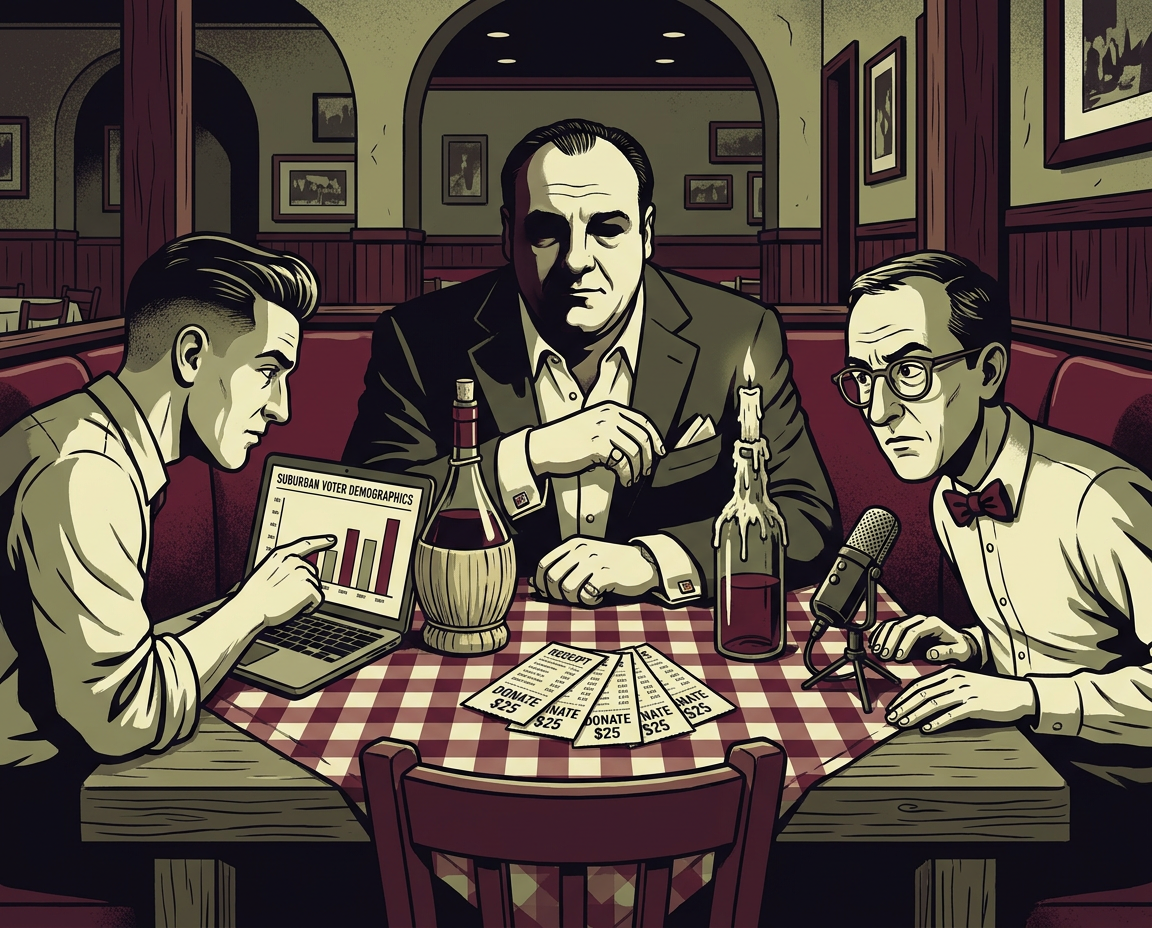
The Never Trump pundit class and the consultant apparatus both think they're running the game. They're both wrong. And the small donor who just got their third fundraising email today is paying for the confusion.
A note before we start: this piece is a companion to The Architects of the Rubble, which ran here recently and made the case that the Never Trump intellectual apparatus didn't just fail to prevent Trumpism — they built the conditions that made it inevitable. If you haven't read that one, it'll add context. If you have, this is where we go next.
 Geoff Anderson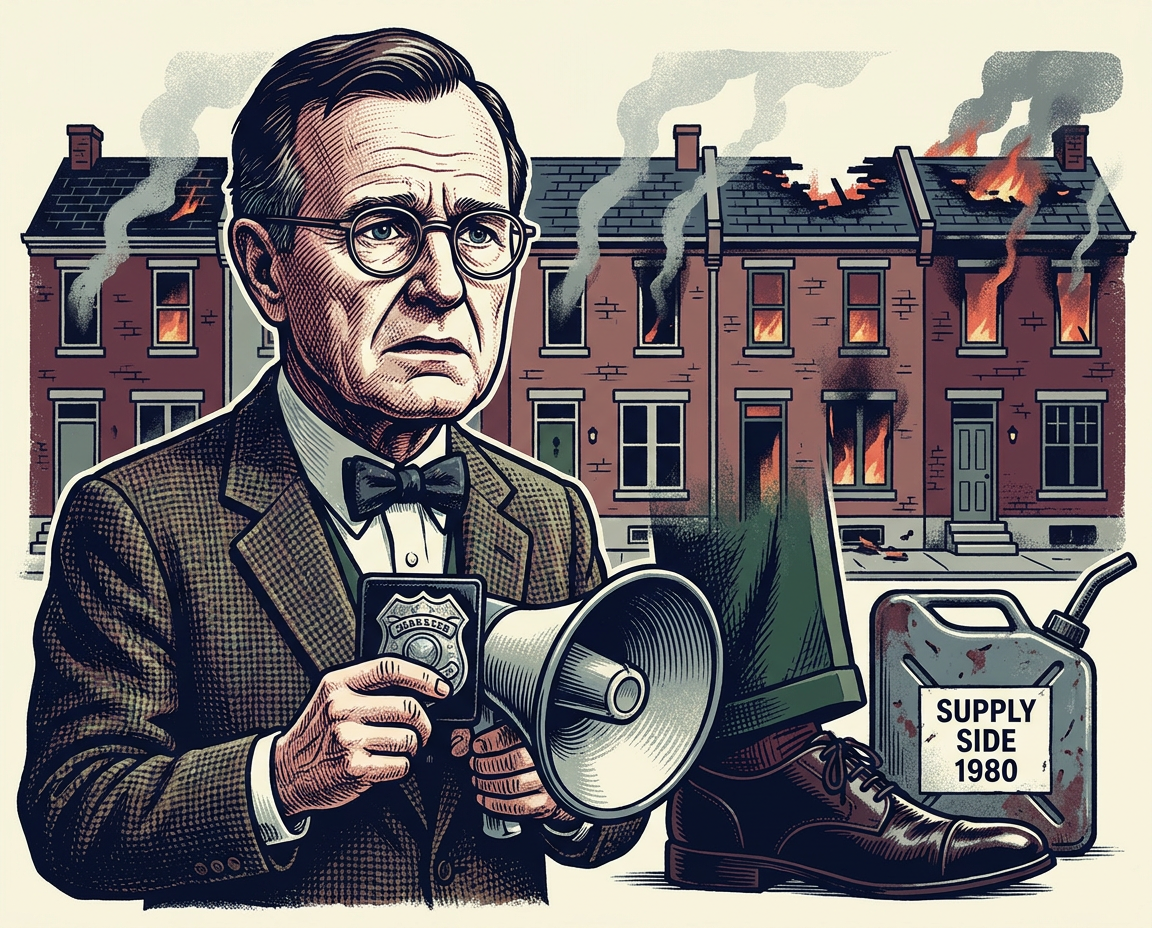
Because identifying the arsonists is only half the problem. The other half is understanding why the fire department is also part of the racket.
Also, this is a LONG post, about 3,700 words. It's what I get to when my ankle is jacked on vacation. You've been warned.
The Symbiosis Nobody Will Admit To
Two organisms that need each other to survive, both insisting they're completely independent.
Here is something that gets discussed in pieces but never quite named directly: the Never Trump pundit class and the Democratic consultant apparatus are not two parallel independent forces that happen to share some tactical preferences. They are a single system with two visible faces, serving a third party that neither of them publicly acknowledges.
Both would lose their minds reading that sentence. That's fine. Their vehemence would prove the point.
The co-dependency works like this. The consultant class — the people who run Democratic campaigns, manage the ad budgets, write the memos about which voters to target and which to write off — needs the Never Trump apparatus to justify its core strategic product. That product is the suburban persuasion strategy: the theory that the path to Democratic victory runs through flipping soft Republican voters in collar counties rather than through activating the Democratic base that didn't show up last time. It's an expensive theory. It requires large advertising budgets in premium media markets against targets who are, in measurable practice, mostly not moving. To sell that theory to donors cycle after cycle despite the evidence, you need credible Republican voices saying it's working, that these voters are reachable, that the approach is sound. The Never Trump apparatus provides those voices. Without them, the consultant's pitch falls apart.
The Never Trump apparatus, meanwhile, needs the consultant class to implement a strategy that maintains their relevance. Their entire claim to influence rests on being uniquely positioned to reach persuadable Republican voters. If Democratic campaigns stopped chasing those voters entirely, the Never Trump validator role becomes academic. Their media bookings, their endorsement currency, their Substack subscriber pitches about having special insight into the MAGA mind — all of it requires campaigns that are actually running the suburban persuasion play to remain meaningful.
Each needs the other to justify its existence. Neither will say so.
The 2024 Liz Cheney embrace is the crystallized version of how this plays out in practice. The tactical logic was completely legible: Cheney had torched her Republican career on the January 6th committee, she had credibility with exactly the soft Republican suburban women the consultant strategy was targeting, and her endorsement was supposed to provide a permission structure for crossing over. On a spreadsheet (or in targeted focus groups) it probably tested well.
What it actually communicated to anyone under 40 with a functional memory of the Bush years was considerably less useful. Cheney isn't a heroic figure who sacrificed her career for democratic principle. She is a person who championed a catastrophic war that killed hundreds of thousands of people, helped construct the surveillance state, and spent years providing intellectual cover for exactly the kind of Republican politics that created the conditions for Trump. Her January 6th positioning doesn't wash that out. It makes her useful for a specific narrow purpose in a specific media environment while signaling to the actual Democratic base exactly who the coalition is being assembled to comfort.
The Harris campaign thought they were buying a permission structure for reluctant Republicans. Instead, what they purchased was a visible demonstration that the consultant class's theory of the election centered on people who had predominately already decided, at the cost of telling everyone else to get in line and be grateful.
That's the symbiosis in action. The consultant needed the Cheney validator. The Never Trump apparatus needed the platform. The campaign needed the tactical logic to make sense to donors. And the base got to watch the party spend its visibility capital on a Bush Republican while their own priorities were described as complications.
The Bosses — Follow the Money
The consultants are the Capos. The Never Trump apparatus are the enforcers. The donor class is sitting in the back of the restaurant and nobody is supposed to mention or even see them.
Here is the part of this analysis that makes everyone uncomfortable, including people who are otherwise willing to criticize consultants and Never Trump figures at length.
Both of those institutions are serving someone. That someone is not you. It has never been you
The apex predator in this ecosystem is the professional class Democratic donor. Not all donors — the small dollar donor we'll get to in a moment is a different story. The specific figure here is the person who has made peace with the current economic arrangement, wants cultural liberalism without economic disruption, and is most comfortable writing large checks to candidates who don't threaten the conditions that made them wealthy. These donors are not villainous. They are human beings with the entirely predictable tendency to fund politics that reflects their interests. The problem is their interests are not the same as the interests of the coalition Democrats need to actually win elections.
The consultant class serves this donor. Not as a conspiracy — as a market. The donors have money. The consultants have campaigns to run. The campaigns get funded by the donors. Over time, the candidate profiles that get funded, the strategies that get implemented, the messages that get crafted, all drift toward whatever keeps the donor class writing checks. Nobody has to issue a directive. The market does the work.
The Never Trump apparatus serves this dynamic without fully realizing it. They are not consciously functioning as ideological enforcers for the donor class. They genuinely believe they are the strategic brains of the resistance, that their validator role is decisive, that their media presence translates into electoral outcomes. But their practical function — providing negative reinforcement against candidates who threaten the existing arrangement, generating the "acceptable candidate" profile that maps almost perfectly onto donor class comfort, showing up on cable news to explain why the base needs to be more patient and less demanding — aligns so precisely with what the donor class needs that the alignment doesn't require coordination to operate.
You don't need to be a conscious participant in a protection racket to serve its structural functions. You just need incentives that point the same direction.
The 2020 Super Tuesday consolidation is the mechanism exposed in a single 72-hour window. Bernie Sanders entered Super Tuesday as the frontrunner. South Carolina happened on a Saturday. By Monday, Pete Buttigieg had dropped out, Amy Klobuchar had dropped out, both had flown to Texas for a Biden rally, and the race was functionally over. The small dollar fundraising operation Bernie had built — genuinely historic in scale, a legitimate routing around the traditional bundler network — did absolutely nothing to prevent this.
Because the donor class influence at the decisive moment is not primarily financial. It's the phone calls. The access. The informal signals about viability that shape how campaigns get covered, which shapes how other candidates calculate their odds, which shapes who gets on a plane to Texas and who doesn't. You can raise $200 million from small donors. You cannot raise your way out of a coordinated establishment decision that operates through relationships rather than bank transfers.
The Capos found new instructions from the bosses. The enforcers amplified the message. The protection racket did its job. Sanders went home.
The Extraction Machine
Your twenty-five dollars is working very hard. Just not on what you think.
Let's talk about the fundraising emails.
You know the ones. The subject line is either a person's name followed by a colon, or some variant of "we're being outspent" or "this is urgent" or, if it's after 9 PM, something with multiple exclamation points that implies the fate of democracy hinges on your credit card number in the next forty-seven minutes. There's a deadline. There's always a deadline. The deadline is not real. Tomorrow there will be another deadline. It will also not be real.
ActBlue and WinRed are, structurally, the same operation wearing different jerseys. Both were built on the same foundational insight: small donor political enthusiasm is a harvestable commodity, and the harvesting infrastructure can be more profitable than the political outcomes it claims to serve. Both use the same toolkit — pre-checked recurring donation boxes that people don't notice until their bank statement shows up, manufactured urgency around arbitrary deadlines, matching gift offers that work differently than advertised, escalating ask ladders designed to extract maximum value from the genuinely motivated donor before they figure out how the machine works.
WinRed got exposed more visibly. The New York Times documented its recurring donation architecture targeting elderly donors who had no idea they'd signed up for monthly charges and couldn't figure out how to stop them. The refund rates were remarkable. It was a straightforward extraction operation that happened to have a Republican logo on it.
ActBlue's practices are less predatory in their specific targeting. They're not running the elderly donor play at the same scale. But the architecture is identical, and the specific damage ActBlue does to Democratic politics is actually worse than simple extraction.
Here's why. When a genuinely motivated progressive donor sends twenty-five dollars to ActBlue, they believe they are participating in a grassroots disruption of the donor class arrangement. They are not. They are paying a percentage to a digital infrastructure that takes its cut off the top, then routes the remainder to campaigns managed by the consultant class, which deploys it according to priorities set by the donor class the small dollar contributor thought they were circumventing.
It is controlled opposition infrastructure. The small dollar donor is funding their own neutralization, with a small processing fee attached.
The doom loop this creates is almost elegant if you can detach from the fact that it's destroying the Democratic Party's ability to build genuine grassroots power. Small dollar donors respond to existential threat content. The Never Trump apparatus produces existential threat content professionally and at scale — it's their core product, it drives subscriptions, it fills podcasts. Digital fundraising vendors package that content into emails, send them at eleven PM, and harvest the anxiety-driven donations that result. The vendor takes their percentage. The remainder goes to the consultant. The consultant runs the suburban persuasion play. The small dollar donor has funded the exact system they were trying to replace, and will receive another email about it tomorrow morning.
The Obama mythology is doing a lot of work in the small dollar theory and it needs to be corrected. The 2008 operation was genuinely revolutionary in technique and scale. It was also supplementary to, not a replacement for, traditional bundler networks and institutional donor support. Obama had both. The myth that small dollar beat the donor class in 2008 is maintained primarily because the digital fundraising apparatus that emerged from that campaign has enormous commercial interest in the story. It's a good story. It's also not what actually happened.
The 2024 Harris small dollar operation was the most recent and most relevant test. It was enormous by any historical measure. It lost. The small dollar theory has now failed its most important real-world trial, and the fundraising emails are already explaining why that means you need to donate more this cycle.
The Conditions for Breaking the Racket
The fever has to break somewhere. Here's where to look.
None of what's been described above is permanent. Protection rackets don't last forever. They last until the people being protected calculate that the protection is costing more than it's worth, or until something large enough to not need the protection shows up and makes the whole arrangement beside the point.
A few things are happening at the margins that the current system is not adequately accounting for.
The MAGA intensity transfer is not guaranteed.
The 30-35% that are ride-or-die Trump will always be there. That's not the question. The question is whether their intensity — the specific, personal, parasocial loyalty that generates the turnout and the small dollar donations and the rally attendance — transfers to whoever runs next under the MAGA banner. That loyalty is a relationship with a specific person who hosted a reality television show for fourteen years and spent decades as a tabloid figure before becoming a political one. Vance didn't do any of that. DonJr is a pale imitation without the authentic (such as it is) outsider credibility. Rubio is the guy the base already rejected once. The intensity is not an asset that gets passed down like a title. It has to be earned, and none of the designated successors have earned it with that specific cohort.
This doesn't make those voters available to Democrats. They're not. But "not available to Democrats" and "not showing up for Vance at 2024 levels" are two different things, and the difference matters when the electoral margins are what they are.
The evangelical reckoning is real, slow, and underreported.
The exvangelical movement — people raised in evangelical communities who have left, whether the faith entirely or simply the institutional church — is a documented demographic phenomenon with its own substantial and growing ecosystem. Pew has been tracking the "nones" growing specifically at the expense of white evangelical Protestantism for years. Church attendance among young evangelicals has been declining for a decade. Russell Moore resigned from the Southern Baptist Convention's Ethics and Religious Liberty Commission in 2021 specifically over the SBC's accommodation of Trump and has been writing explicitly about the church selling its witness for political power ever since.
The internal critique is being made by credible figures. It is not moving the institutional evangelical leadership because that leadership made a calculated power trade and the power is still flowing. Franklin Graham and Robert Jeffress are not confused about what they're doing. They understand the transaction.
But the people leaving are not returning. And they are spiritually homeless in a way that has real political valence if anyone addresses it directly. These are not secular voters who need to be reached with secular messaging. They are people who left evangelical institutions specifically because those institutions chose Trump over the teachings they grew up believing were non-negotiable. Go line by line through the Beatitudes against the specific policy record of the current administration. Blessed are the merciful. Blessed are the peacemakers. Blessed are those who hunger and thirst for righteousness. The USAID cuts that closed pregnancy clinics in Afghanistan and left children dying of treatable diseases in clinics with no medication — that's not a complicated theological question. It's a clear one. The institutional church answered it with silence and support.
The candidate who can speak to the formation of people who grew up in that tradition, in a language that takes their theological background seriously rather than flattening it, is addressing an activation target the consultant class's polling models don't capture because the category doesn't fit their existing voter file taxonomy.
The gender gap is the most underexplored resource in Democratic politics.
Young women have moved left at roughly the same magnitude that young men have moved right. The gender gap among voters under 30 is now larger than any demographic division in recent American electoral history. This is not a niche finding. It is a structural feature of the electorate for the foreseeable future.
The Never Trump alignment and the consultant suburban persuasion strategy specifically crowd out the messaging that reaches this population. The professional class moderation signal that reassures a 58-year-old Republican woman in the Philadelphia suburbs is not the message that activates a 26-year-old woman who came of age post-Dobbs, who has watched her bodily autonomy become a legislative question, and who is looking for a politics that reflects the actual stakes of her daily life rather than the comfort level of people who will be dead before the consequences fully arrive.
These are not the same voter. The system has been pretending they are for three cycles. The pretense has a measurable cost in turnout among the population that actually moved and needs somewhere to put it.
The Talent Requirement
Winning in 2028 is necessary. Building something that survives winning is the harder problem.
The candidate who breaks this open needs to do something that Obama didn't fully do, and it's worth being specific about what that is.
Obama was a generational political talent operating with specific historical tailwinds — Bush exhaustion, the historic nature of the candidacy, a financial crisis that landed in the final weeks and clarified the choice in ways that benefited the challenger. He won twice. He generated genuine movement energy sufficient to force the donor class to get on the plane. What he did not do was build institutional infrastructure durable enough to survive his own presidency. The 2010 wipeout, the 2014 wipeout, the hollowing of state parties while the national party atrophied — the Obama era produced a charismatic president and a gutted bench. Howard Dean's 50-state strategy, which was the closest thing to durable infrastructure the party had built, was dismantled by Obama's own apparatus because the consultant class decided they didn't need it.
The 2028 version of this candidate needs to build something the consultant class cannot dismantle. That requires grassroots loyalty deep enough that an attempt to dismantle it becomes a visible political liability rather than a quiet administrative decision. It requires an organizational model that isn't dependent on the ActBlue doom loop for its fundraising or the Never Trump apparatus for its validator role. And it requires a governing vision that is actually legible to the working class voters who drifted, the young voters who sat out, the exvangelicals who are looking for somewhere to go, and the young women who are activated and waiting for something worthy of their activation.
That is a higher bar than winning the presidency. It is also the only version of winning that interrupts the ratchet rather than just pausing it for four years.
The donor class will recalculate when they believe the alternative costs them more than the arrangement does. They always get on the plane when they think the plane is going to win. The substitution strategy doesn't require fighting the Never Trump apparatus publicly or staging a dramatic rejection of the consultant class. It requires building something large enough and coherent enough that the bosses tell the Capos to find new instructions. The Capos will comply. They always comply. Their loyalty is to the arrangement, not to any specific iteration of it.
The Mirror
Trump II without even a thin veil of competence is clarifying in ways that Trump I wasn't.
The previous Republican administration had nominally functional cabinet agencies populated by people who had at least some professional relationship to the departments they ran. That layer — wafer thin, inconsistent, frequently captured by ideology — nonetheless provided a buffer between the worst impulses and the actual outcomes. It slowed things down. It occasionally pushed back. It gave the donor class adjacent to Republican politics something to point to when the ugliness got uncomfortable.
That layer is gone. What remains are the impulses themselves, operating in the open, staffed by people whose primary qualification is demonstrated loyalty to the person who appointed them. The result is what you'd expect: chaotic, cruel, administratively incompetent governance that is producing measurable harm at a scale and speed that even a good closed-loop epistemology is going to struggle to metabolize indefinitely.
That's catastrophic as governance. It is potentially the clearest possible illustration of what forty years of this coalition's project actually produces when the restraints come off. The veil is gone. The thing underneath is visible. The question is whether the people who are genuinely persuadable — not the 35%, but the ones who drifted or sat out or sent a protest vote — can see their reflection in it clearly enough and for long enough that it changes their calculation.
The system described in this piece will try to manage that mirror. To monetize the reflection. To make sure the outrage gets channeled into a midnight fundraising email and a consultant-designed ad buy in the Philadelphia suburbs and an endorsement from a former Republican official who voted for every policy that got us here.
The only thing that overrides the system is a candidate it didn't build and a coalition it can't contain. That combination has happened before. The conditions for it are more present than they've been since 2008.
Whether the Democratic Party is capable of not screwing it up is the bleaker and more open question. Based on available evidence, I have my doubts. But I've been wrong before, and right now I am choosing to be wrong in the optimistic direction.
The alternative is considerably worse.
Like what you read? Subscribe to Sweaty's Corner — always free, direct to your inbox. If you can't do paid, buy me a coffee. It keeps the lights on and the outrage flowing.
Like what you've read, but not able to switch to paid? Why not buy me a coffee instead! All money goes to help defray the expense of running the site.