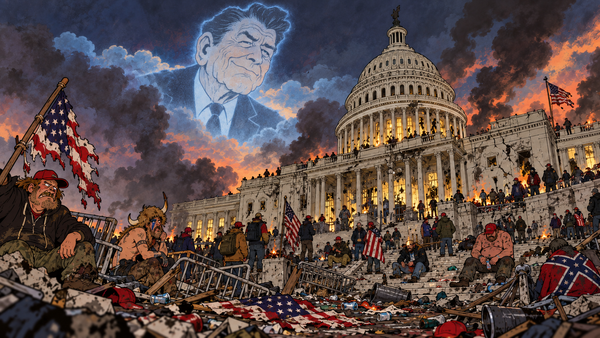
The Useful Fiction Act II: The Long Game
At the start, it wasn't a Republican or a Democrat issue, it was a plutocrat capitalist issue, and they think in multi-decade time spans. It pays to have patience

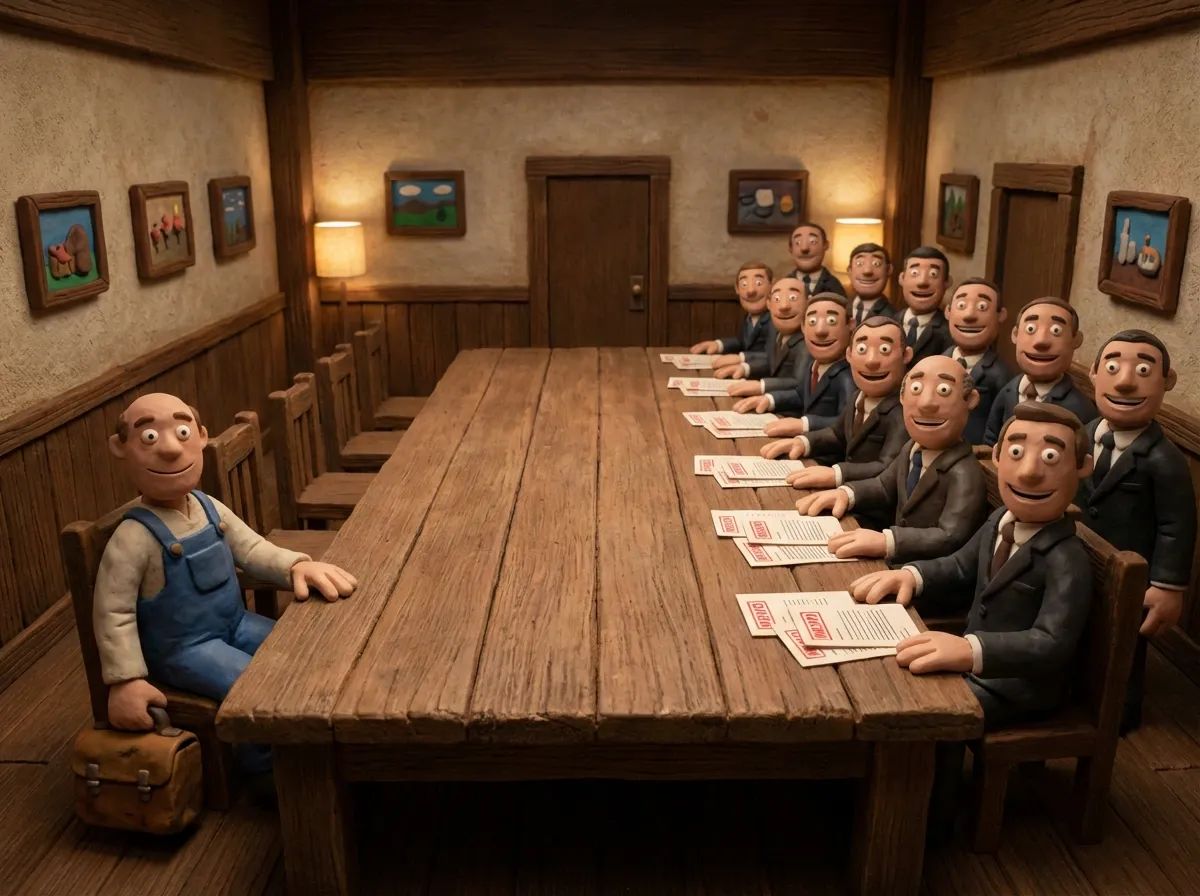
In Act I, we established the basic fact that tends to get glossed over whenever a politician talks about protecting the middle class: the whole thing was an accident. A specific convergence of wartime labor scarcity, New Deal institutional architecture, and a federal government that needed industrial production more than it needed to keep workers in their place. Capital tolerated the arrangement. Barely. And the moment the guns went quiet, it started organizing to undo it.
This is the story of what that organizing looked like. It is, I want to be clear upfront, not a conspiracy. There was no smoke-filled room where rich men twirled mustaches and decided to destroy the working class. What actually happened is simultaneously more banal and more chilling: a bunch of rational actors, each responding to their own interests, each making sensible decisions in isolation, produced a coordinated 75-year project that has worked almost perfectly.
That is how power usually works. Not with villainy. With patience.
The First Move: Taft-Hartley and the Art of the Strategic Cripple
The ink on the Japanese surrender wasn't dry before capital started pushing back. By 1946, a wave of postwar strikes involving more than five million workers had alarmed not just employers but the general public – the same public that had just spent four years being told labor was a patriotic partner in the war effort. Public opinion is a fickle instrument. Republicans exploited the backlash, won a smashing congressional majority in 1946, and got to work.
The Taft-Hartley Act of 1947 – passed over Truman's veto with bipartisan support, in what should be an early lesson for people who think one party has ever been consistently reliable on labor – was the first big structural move. It didn't destroy unions outright. That would have been too obvious, and probably not survivable politically. What it did was more elegant: it allowed states to pass right-to-work laws that let workers opt out of union membership while still benefiting from union contracts. It outlawed certain strike tactics. It required union leaders to sign anti-communist affidavits. It gave the president the ability to seek injunctions against strikes deemed harmful to national interests. Each provision, individually, sounded reasonable. Together, they were a slow leak in the tire.
This is the template for everything that follows: don't attack the thing directly. Erode the conditions that make the thing possible. Be patient. Play the long game.
The Blueprint: Powell, 1971
For two decades after Taft-Hartley, capital played a grinding but unfocused game. Lobbying here, regulatory capture there, supporting the right candidates when convenient. Useful, but not strategic. What was missing was a unified theory of the counter-offensive – something that named the enemy clearly, laid out the battlefield, and told business what to do about it.
On August 23, 1971, a corporate lawyer from Richmond named Lewis Powell sent a confidential memo to the US Chamber of Commerce, and in doing so arguably wrote the most consequential document in modern American political history that most Americans have never heard of.
The memo was titled "Attack on American Free Enterprise System," and Powell was not subtle about his intentions. He opened with the claim that the American economic system was under "broad attack" – not from the radical fringes, he was careful to note, but from "perfectly respectable elements of society: from the college campus, the pulpit, the media, the intellectual and literary journals." This was Ralph Nader's fault. And the consumer movement. And the environmental movement. And, frankly, the general direction of public opinion, which in 1971 was running fairly hard toward the idea that corporations should be accountable to something other than their shareholders.
Powell's response to this was not to argue that corporations were actually great. It was to build the infrastructure to make that argument at scale, in every arena, indefinitely. He called for businesses to fund scholars who would advocate for free enterprise. To monitor and pressure the media. To build legal organizations that could fight in the courts. To get serious about campus influence. To, in his words, use "consistency of action over an indefinite period of years."
Two months after sending the memo, Nixon appointed Powell to the Supreme Court. The Senate confirmed him without ever seeing the document.
The memo didn't stay secret for long – a columnist got hold of it in 1972 – but by then it had already done its work. Charles Koch read it and cited it directly in a 1974 speech. The Heritage Foundation, founded in 1973 by Paul Weyrich, Edwin Feulner, and beer money from Joseph Coors – "a little bit right of Attila the Hun," in his own brother's description – grew directly out of the activism the Powell Memo inspired. By 1980, the number of corporations with Washington lobbying offices had gone from 176 to 2,445. Nine thousand lobbyists. Sixty thousand trade association employees.
That wasn't happenstance. That's a build-out.
The Infrastructure: Think Tanks, Courts, and the Long Cultivation of Bad Ideas
The Heritage Foundation was just one node in a network that expanded rapidly through the 1970s. The Cato Institute launched in 1977, funded initially by Charles Koch. The American Legislative Exchange Council (ALEC), also 1973, built to produce model legislation for state houses across the country -- the idea being that you don't have to win the federal government if you can pre-wire fifty state legislatures. The Business Roundtable, reorganized in 1972, became the coordinating body for major corporate political action.
This infrastructure did something specific and underappreciated: it manufactured legitimacy. Think tanks produce white papers. White papers get cited in congressional testimony. Congressional testimony shapes legislation. Legislation changes the regulatory environment. The regulatory environment determines whether workers can organize, what companies have to pay them, what safety standards they have to meet, and whether anyone goes to jail when they don't. The whole thing is a machine for converting rich people's preferences into policy conclusions that appear to have been reached through dispassionate research.
The Heritage Foundation, to its eternal credit as an example, now produces papers arguing that the widely documented gap between worker productivity and worker wages since the 1970s is actually a measurement error. The organization that was built using fucking beer money specifically to counter the argument that workers were getting screwed has since dedicated significant resources to arguing that workers aren't getting screwed. You will be shocked to learn that this research is funded by people who benefit from workers not knowing they're getting screwed.
It is, as grifts go, impressively complete.
The Delivery Mechanism: Ronald Reagan and the Day the Signal Went Out
Time to piss off the Never Trump crowd... Let's dive into the deep end!
All of this infrastructure needed a politician willing to use it. It found one.
Ronald Reagan is remembered fondly by a significant portion of the American electorate as a sunny optimist who made them feel good about America. What he actually delivered, on behalf of the people who built the apparatus described above, was the most consequential redistribution of economic power since the New Deal – in the opposite direction.
The signal moment is August 5, 1981. Thirteen thousand members of PATCO – the Professional Air Traffic Controllers Organization, one of the very few unions that had endorsed Reagan in 1980 – went on strike demanding better pay, reduced hours, and equipment upgrades. Reagan gave them 48 hours to return to work. When 11,345 of them didn't, he fired every one of them and banned them from federal employment for life.
You want to talk about a signal? Federal Reserve Chairman Alan Greenspan, speaking at the Reagan Library in 2003, said that perhaps the most important contribution to what he called the "flexibility" of US labor markets -- "flexibility" being the word economists use when they mean "the freedom to fire" -- was the firing of the air traffic controllers in August 1981.
Private employers heard it instantly. Within a year, the Wharton School had produced a manual encouraging business leaders to learn from the PATCO strike. Corporate executives told Reagan's people directly: when your guy stood firm with those controllers, I started getting tougher with my unions too. The number of major strikes, which had run between 200 and 400 annually for decades, fell off a cliff after 1981. By 1988 there were 40. By 2017, seven.
"Suddenly," as one account put it, "people realized, hell, you can beat a union."
The rest of the Reagan program followed the same logic: tax cuts heavily weighted toward the top, deregulation of industries that had been constrained since the New Deal, a Federal Reserve under Paul Volcker that broke inflation by deliberately inducing a recession, an NLRB stacked with appointees who made no secret of their interest in limiting labor's power. None of this was hidden. Reagan campaigned on it. He won in a landslide, because the Democrats had spent the 1970s losing the plot on inflation and Iran and their own internal contradictions, and because the Powell Memo network had spent a decade making supply-side economics sound like common sense rather than a class project.
The Scoreboard, 1973 to 1989
Here's what the long game produced in concrete terms, by the time Reagan left office:
The link between productivity and wages -- which had held roughly steady through the entire Golden Bracket -- broke apart in 1973 and never came back. The American economy kept getting more productive. Workers stopped sharing in the gains. Profits went somewhere. They went to the people who owned the companies.
Union membership, which had covered a third of the non-farm workforce at its peak in the mid-1950s, was below 17 percent by the end of the 1980s. By 2022, private-sector unionization had fallen below its 1935 level -- before the National Labor Relations Act even existed. Everything the New Deal had built, in terms of organized labor's structural power, was effectively gone.
The capital class did not do this through cruelty. They did it through consistency. Thirty-five years of patient, well-funded, strategically coherent effort to change the rules of the game – in the courts, in the legislatures, in the regulatory agencies, in the think tanks and media and university economics departments – until the environment in which organized labor had flourished was simply gone. Replaced by something that looked like a level playing field and functioned like anything but.
And here is the part that should make you put your drink down: they did all of this while continuing to talk about the middle class. Every single step of the way. Taft-Hartley was sold as protecting workers from corrupt union bosses. Reagan's tax cuts were sold as relief for working families. Deregulation was sold as freedom. The think tank papers were sold as objective research. The language of the middle class was deployed, fluently and consistently, to advance policies that transferred wealth from the middle class to the people funding the operation.
That's not irony. That's the strategy. And in Act III, we'll see how the other party – the one that was supposed to be on labor's side – decided that if you can't beat the strategy, you might as well join it.
Next: Act III – "Et Tu, Donkey?" Tony Coelho, Bill Clinton, NAFTA, and the moment the Democratic Party decided the donor class was a feature, not a bug.
"The Useful Fiction" is a four-part series. Act I: The Accident
 Share on Bluesky
 Share on Threads
 Share on Facebook
 Share on Mastodon
 Share on Reddit
 Share on Email