
PART ONE: The Table Was Always Crooked
The infrastructure of distrust was assembled over decades. Some of it was earned. The rest was sold to us.

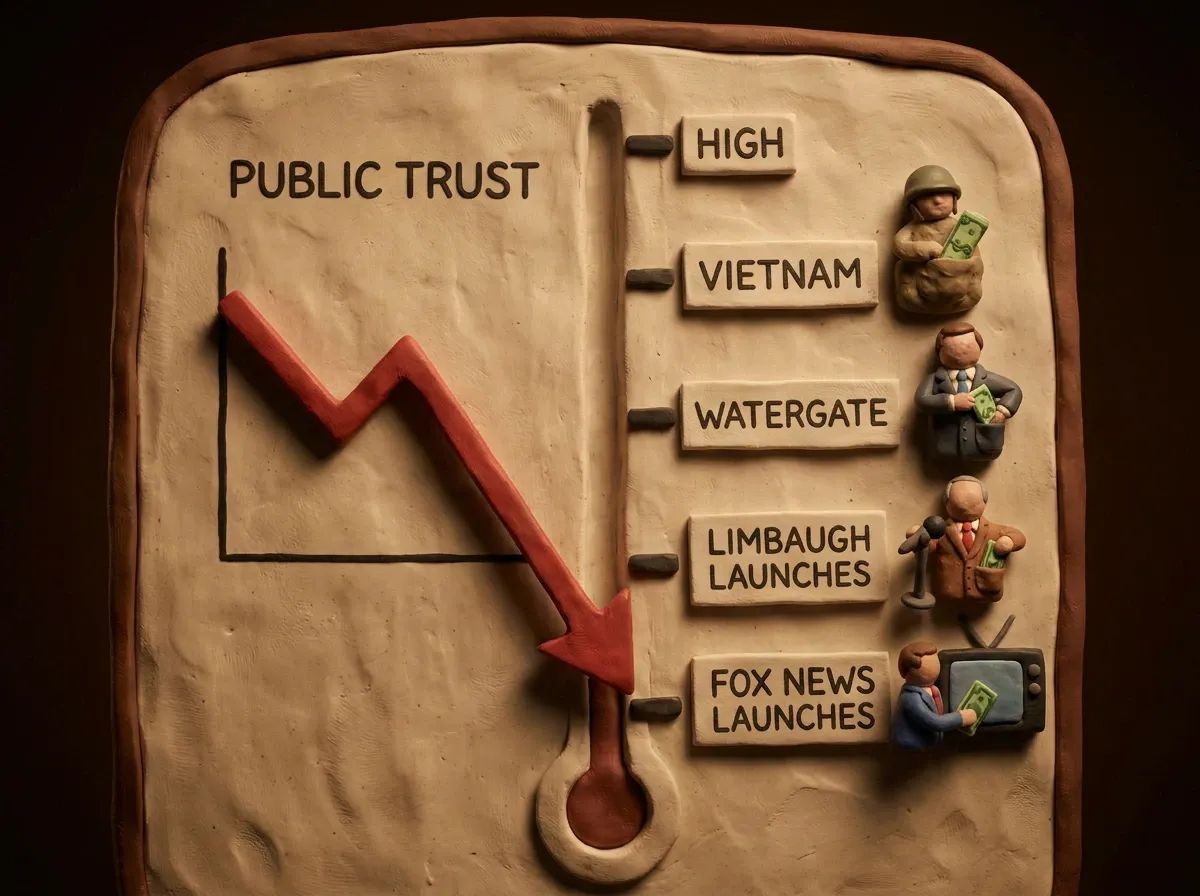
Or ... How We Built a Low-Trust Society
I heard something that stuck. Sarah Longwell, on a recent episode of The Bulwark's The Secret podcast (paywalled, and not accessible to non-subscribers — though if you're familiar with Longwell's work, you already know the general shape of her thinking, which tends toward extending the benefit of the doubt to an electorate that often does not deserve it), said something worth sitting with: we are living in a low-trust society.
That's not news exactly. But the framing opens up a more interesting question, which is how we got here and who, specifically, is responsible.
The same conversation featured David Frum working through a counterintuitive point about information and conspiracy theories. The common assumption is that conspiratorial thinking is a product of ignorance — that if people just had more facts, they'd be better calibrated. Frum's observation runs the other direction: voters aren't less informed than they used to be, they're swimming in information. The problem is what human brains do when presented with walls of data. They look for patterns. And pattern-seeking in a noisy information environment is, more or less, the cognitive substrate for conspiracy thinking. The theories aren't just ignorance. They're signal-processing gone sideways in a media environment engineered to keep it going sideways.
Both observations are correct. And together they point somewhere most people would rather not go: the problem predates the internet, predates Trump, and predates whatever your preferred villain of the moment might be.
The Nostalgia Is Lying to You
There's a comfortable story that goes: America used to trust its institutions, and then something went wrong. The story implies a restoration is possible, that the trust was real and durable, and we just need to find our way back.
That story is wrong. It is a comforting fiction that conservatives in particular like to tell themselves.
Pew Research Center data going back to 1958 shows that trust in the federal government peaked at 77% in 1964. But that number has to be understood in context. The postwar period was historically anomalous: WWII victory, sustained economic growth, a media environment where Walter Cronkite served as something close to a secular authority, and a bipartisan Cold War consensus that made public skepticism of government feel almost unpatriotic. The trust wasn't deep. It was contingent. It reflected a specific set of conditions that were already beginning to crack.
1964 was, not coincidentally, also the year LBJ signed the Civil Rights Act — which set in motion the political realignment that would rearrange everything. The solid Democratic South began its long migration right. And the federal government's new, visible role in enforcing desegregation made a significant portion of white Americans discover, quite suddenly, that they had a problem with federal authority. Trust started coming down almost immediately after that peak. Before Vietnam. Before Watergate. Before anything else.
This matters because it undermines the restoration thesis at its foundation. The golden era wasn't golden for everyone, and the trust it measured was always sitting on a fault line.
The Seventies: When Distrust Was Earned
By the time the slide really accelerated, it had cause. The credibility gap on Vietnam — where the distance between what the government said and what was actually happening in Southeast Asia was wide enough to swallow a generation — was just the first breach. Then came the Pentagon Papers in 1971, which made explicit what many suspected: that multiple administrations had systematically lied to the public and to Congress about the conduct and prospects of the war.
Then Watergate. Then the Church Committee revelations, which detailed CIA assassination plots against foreign leaders and COINTELPRO's domestic surveillance and dirty tricks campaign against civil rights leaders, Black nationalist organizations, and anti-war groups. The government wasn't just occasionally dishonest. It had been running active operations against its own citizens.
Then Iran-Contra.[1]
The conspiracy theorists of the 1970s were not, as a class, crazy. They were paying attention, and they were drawing reasonable conclusions from evidence that kept confirming the same thing: yes, the government lies, sometimes about enormous things, and the lies are systematic rather than accidental.
This is the substrate. Earned distrust, grounded in documented reality, that then became available for exploitation by people with entirely different motives.
The Colonization: Distrust as a Product
What changed in the late 1980s and 1990s wasn't the level of distrust. It was the business model.
Rush Limbaugh's national syndicated show launched in 1988. By the mid-1990s he had somewhere in the range of 20 million weekly listeners. The AM radio apparatus that followed — conservative talkers in markets across the country, filling afternoon drive time with grievance — wasn't just a media format. It was an industry, and the industry ran on outrage. Outrage requires an enemy. The enemy has to be lying to you. That's the structural requirement of the format, and it was built out systematically across the decade.
Roger Ailes launched Fox News in 1996. Ailes had spent decades in Republican politics and understood something fundamental: fear and resentment are more reliable audience-retention mechanisms than information. The Fox model wasn't just politically conservative. It was architecturally designed to manufacture and sustain distrust of competing institutions — the mainstream press, the universities, the federal bureaucracy. Every institutional failure was content. Every Democratic administration was an enemy operation.
The left never built an equivalent. This is partly ideological — there's a traditional liberal skepticism of concentrated media power that the right has never shared — and partly structural. The donor class that funds liberal institutions tends toward prestige media, toward places that care about the Pulitzer Prize rather than the guy in the truck on his lunch break. That gap mattered more than almost anything else that happened in the 1990s.
The result: by the time Barack Obama took office, the right had roughly twenty years of dedicated infrastructure specifically designed to make its audience distrust anything a Democratic administration produced. Birtherism didn't fall from the sky. It landed in a media ecosystem that had been cultivating exactly this receptivity since before most of the people spreading it had heard of Barack Obama.
Trump: The Qualitative Shift
Trump didn't create the low-trust environment. But he changed its structure in a way that previous demagogues hadn't managed.
Before Trump, even politicians who dog-whistled to conspiracy audiences maintained plausible deniability. Trump eliminated that distance. He didn't just amplify conspiracy theories — he originated them. Birtherism was his political origin story, and he rode it all the way into the Republican mainstream.
And that mainstream was primed to accept it as holy writ.
The more consequential change is epistemological. A president who endorses conspiracy theories does something specific to the information environment: it makes debunking look partisan. When the president says the election was stolen and his party's entire apparatus closes ranks behind that claim, then the fact-checkers saying otherwise become, in that framework, part of the conspiracy. The loop becomes unfalsifiable. You cannot produce evidence sufficient to break it because the capacity to evaluate evidence has itself been captured by the enemy.
That's different from Nixon lying. Nixon lied, got caught, and the system's response — the investigation, the impeachment process, the resignation — reinforced some basic confidence that accountability (and almost more importantly shame) still existed. What Trump produced was a situation where the lie and the immunity to accountability are both structural, and both function to confirm the conspiratorial worldview.
The WHCD shooting last weekend was a demonstration of exactly this. Conspiracy theories spread within minutes, well before anything was known about the shooter, across both left and right social media. The most common theory — that the whole thing was staged — had no evidence, was immediately contradicted by hundreds of journalists who were present in the room, and spread anyway.
And it spread on the left. Not just the right.
That last part is the tell. When conspiratorial epistemology has penetrated both ends of the political spectrum, you're no longer dealing with a media bubble problem. You're dealing with an environmental one.
Part Two takes up whether any offramp actually exists — and what the Biden administration's failed experiment in institutional restoration tells us about the answer.
1 - everytime someone tells you about how great Reagan was, this should be brought up.